
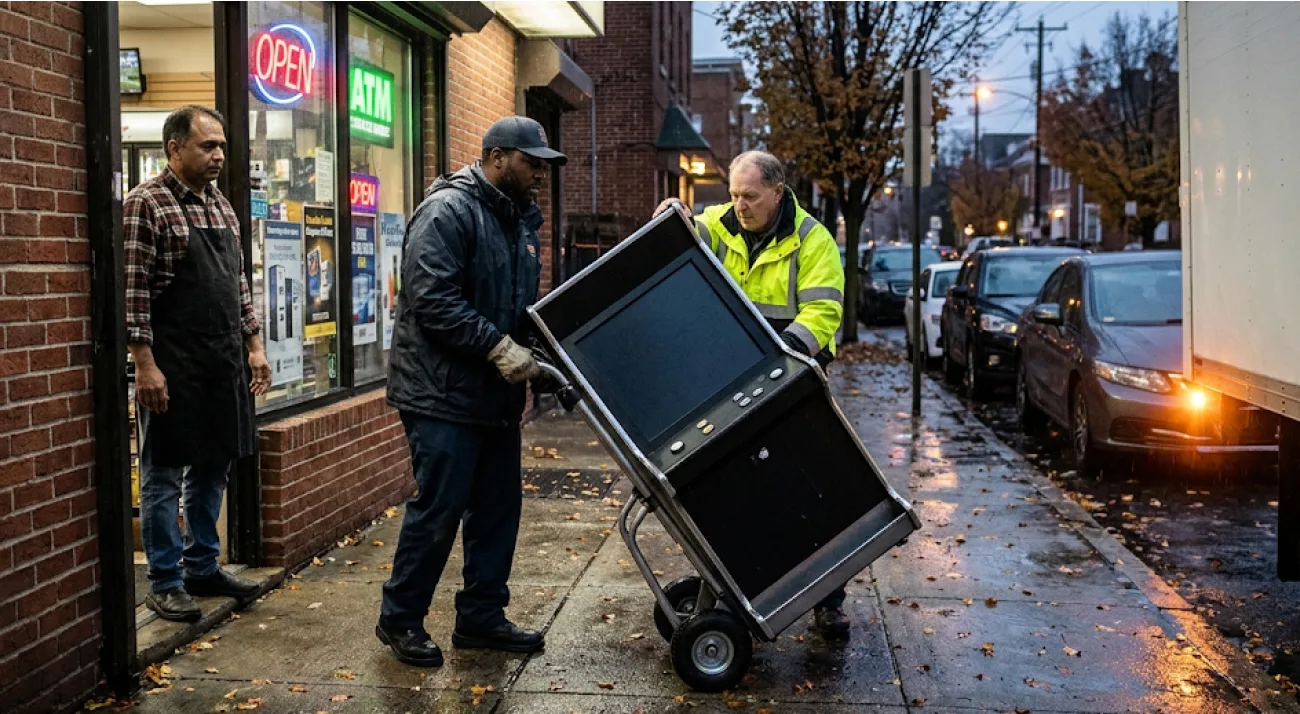
Pennsylvania’s statewide crackdown on unregulated skill-game machines has produced a surprising result: state police seized just 14 machines and $1,913 in proceeds after inspecting more than 12,000 establishments, according to an official enforcement update released on November 10, 2026.
The Pennsylvania State Police (PSP) reported a 99.4% compliance rate following the October 14 enforcement deadline, when businesses across the Commonwealth were required to remove unauthorized gambling terminals.
The crackdown followed a June 15 ruling by the Pennsylvania Supreme Court that classified the disputed skill-game devices as slot machines under state gambling law.
Before enforcement began, approximately 70,000 skill-game machines were estimated to be operating in Pennsylvania convenience stores, bars, restaurants, gas stations, and social clubs.
Yet the small number of seizures does not necessarily mean that only 14 illegal machines remained statewide. Instead, police say most of the establishments they inspected had already removed the devices, while investigations continue at other locations.
The results raise several important questions for Pennsylvania’s gambling industry: How did tens of thousands of machines disappear from storefronts so quickly? What happens to businesses that depended on skill-game revenue? And could manufacturers attempt to replace the banned terminals with sweepstakes-style gaming devices?
Pennsylvania State Police Report 99.4% Compliance After Skill Games Ban
On November 10, the Pennsylvania State Police released their first major enforcement update following the October 14 deadline.
The agency reported visiting 12,202 establishments across Pennsylvania to determine whether unauthorized skill-game devices remained on their premises.
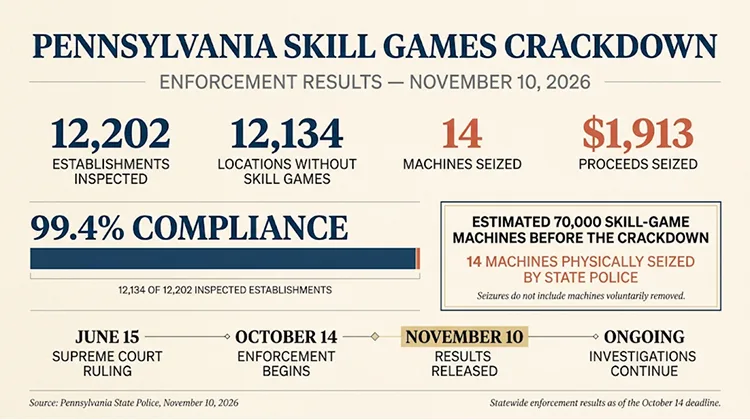
Of those locations, 12,134 no longer had skill games.
Pennsylvania skill games enforcement — November 10, 2026
Establishments inspected
12,202
Locations without skill games
12,134
Machines seized
14
Proceeds seized
$1,913
Reported compliance rate
99.4%
Compliance describes the proportion of inspected establishments where police found no skill games, not the percentage of Pennsylvania’s estimated 70,000 machines individually accounted for.
Source: Pennsylvania State Police, November 10, 2026. Commonwealth of Pennsylvania
What happened at the remaining 68 establishments?
The difference between the 12,202 inspected locations and the 12,134 establishments without skill games is 68 locations.
That does not establish that every one of those establishments was operating an illegal gambling machine or that each was subject to criminal charges.
The state police announcement did not provide a detailed breakdown of the status of all 68 locations.
Authorities confirmed that investigations are continuing and that enforcement actions may include seizures, forfeiture, and criminal charges where appropriate.
Why were only 14 machines seized?
The relatively small seizure total reflects the state’s emphasis on voluntary compliance before and after the deadline.
Pennsylvania State Police worked with distributors and businesses to arrange the removal of unauthorized devices.
By October 14, the agency had reached agreements with six operators or distributors that committed to disabling machines, removing them from businesses, and reporting their progress.
Those agreements helped create a structured removal process rather than requiring police to confiscate every machine individually.
The reported seizure total therefore measures machines physically confiscated by PSP, not the number removed voluntarily by owners or distributors. Commonwealth of Pennsylvania
Pennsylvania Supreme Court Ruling Changed the Legal Status of Skill Games
The enforcement campaign originated with a major Pennsylvania Supreme Court decision issued on June 15, 2026.
For years, skill-game manufacturers argued that their products were legally distinguishable from traditional slot machines because they included elements of player skill.
Those arguments helped the industry operate in a disputed regulatory environment while litigation continued.
The Supreme Court’s ruling changed that landscape by determining that the devices at issue qualified as slot machines under Pennsylvania’s Gaming Act.
The decision made it possible for state authorities to enforce existing gambling restrictions against unlicensed locations possessing or operating the machines.
Why does Pennsylvania consider skill games gambling devices?
Skill-game terminals often resemble casino slot machines, displaying reels, symbols, and opportunities to receive cash prizes.
Manufacturers have argued that some games differ from conventional slots because player decisions can affect the outcome.
However, Pennsylvania’s legal framework does not automatically exempt a cash-paying gambling device simply because it includes an element of skill.
Following the Supreme Court decision, state police emphasized that unauthorized devices may be unlawful whether outcomes depend on chance, skill, or a combination of both.
The key legal issue is whether the device falls within the applicable definitions of gambling equipment and whether its operation has been authorized by the state. Commonwealth of Pennsylvania+1
October 14 became the enforcement deadline
Pennsylvania authorities gave businesses time to comply before beginning statewide enforcement.
The principal dates were:
- June 15, 2026 — Supreme Court rulingPennsylvania’s highest court ruled that the disputed skill-game devices qualify as slot machines under state gambling law.
- October 9, 2026 — Additional court relief deniedThe Pennsylvania Supreme Court denied a request by state lawmakers for extraordinary relief concerning the enforcement stay.
- October 13, 2026 — Compliance deadlineBusinesses were expected to remove unauthorized machines by the end of the compliance period.
- October 14, 2026 — Enforcement beginsState police began implementing the court ruling, including voluntary-removal agreements and potential seizures.
- November 10, 2026 — Enforcement updatePSP reported 12,202 establishments inspected, 14 machines seized, and a 99.4% compliance rate.
Sources: Pennsylvania State Police and Pennsylvania Supreme Court records. Commonwealth of Pennsylvania+2
The October 9 decision was particularly important because it left the enforcement timetable in place.
It also increased pressure on lawmakers who had been debating whether to establish a separate licensing and taxation system for skill games.
What Happened to Pennsylvania’s Estimated 70,000 Skill-Game Machines?
Before the crackdown, approximately 70,000 skill-game terminals were estimated to be operating across Pennsylvania.
The machines had become common in convenience stores, gas stations, neighborhood bars, restaurants, and nonprofit social clubs.
Unlike regulated casino slot machines, these devices operated outside the Pennsylvania Gaming Control Board’s established licensing framework.
Voluntary removals explain much of the enforcement result
The Pennsylvania State Police announced on October 14 that six skill-game distributors had agreed to cooperate with the enforcement process.
Those agreements required participating businesses to render devices inoperable, provide inventories, submit weekly progress reports, and remove machines according to agreed schedules.
Police also offered conditional delays in seizure while distributors completed approved removal plans.
This approach encouraged compliance without requiring immediate confiscation of every terminal.
However, the state has not published a complete, independently verified inventory showing where all 70,000 estimated machines ultimately went. Commonwealth of Pennsylvania
Does a 99.4% compliance rate mean the crackdown succeeded?
The inspection results provide strong evidence that most visited establishments no longer displayed unauthorized skill-game terminals.
They do not establish that every device has been permanently destroyed, that all distributors have ceased operating, or that unregulated gambling has disappeared.
Three distinctions are important:
- Compliance rate: The percentage of inspected establishments where police found no skill games.
- Seizure total: The number of machines physically confiscated by PSP.
- Statewide machine inventory: The estimated number of devices previously operating, which has not been fully reconciled in the November 10 report.
The crackdown appears to have produced widespread storefront compliance, but continued inspections and distributor reporting will be necessary to assess its longer-term effectiveness.
Pennsylvania Warns That Sweepstakes Machines Could Also Be Illegal
One of the most significant developments in the November 10 announcement concerns devices marketed as sweepstakes games.
State police reported encountering machines accompanied by signs claiming that they were legal because they did not directly accept cash or functioned more like sweepstakes products than conventional slot machines.
Authorities rejected the idea that such descriptions automatically make a gambling device lawful.
Under Pennsylvania’s interpretation of its gambling laws, the payment method and marketing terminology do not necessarily determine whether a device is illegal.
Can operators avoid the ban by removing cash acceptors?
Not necessarily.
Pennsylvania State Police warned that gambling devices may still be unlawful when customers pay through alternative methods, including credit cards, debit cards, mobile payment services, or payment applications.
The agency also highlighted devices that allow players to scan QR codes or download mobile applications to participate in simulated gambling activities for cash-equivalent prizes.
A machine does not become legal simply because it uses digital payments rather than physical currency.
What about free-play sweepstakes games?
The legal analysis can become more complicated when a product offers free credits or promotional gameplay.
However, PSP specifically warned that offering free credits does not automatically legalize a device if players can subsequently use their own money to continue playing for financial rewards.
Manufacturers and distributors could face criminal charges if they continue supplying devices that violate Pennsylvania law.
The November 10 warning concerns gambling devices and related systems operating in unauthorized establishments. It should not be interpreted as a blanket legal determination about every online sweepstakes promotion in Pennsylvania. Commonwealth of Pennsylvania
How Pennsylvania’s Skill-Game Ban Affects Small Businesses
The crackdown could have substantial economic consequences for businesses that previously hosted the terminals.
Skill games were especially common in small establishments that used the machines as an additional source of income.
Depending on contractual arrangements, a business might have received a share of revenue generated by the machines.
Removing them eliminates that income stream.
Convenience stores, bars, and social clubs face lost revenue
Businesses potentially affected include neighborhood convenience stores, independent restaurants, gas stations, taverns, and fraternal organizations.
For some operators, machine revenue may have helped cover rent, payroll, utilities, or other operating expenses.
The financial impact will vary considerably.
A store with one lightly used machine will face different circumstances from a location that previously hosted several high-volume terminals.
The state has not released a verified statewide estimate of business income lost specifically because of the October 2026 enforcement campaign.
Pace-O-Matic and the skill-games industry
Georgia-based Pace-O-Matic, a prominent company associated with Pennsylvania skill-game terminals, has supported efforts to establish a legal regulatory framework for the devices.
Manufacturers and supporters have argued that taxation and licensing could preserve revenue for small businesses while generating funds for the Commonwealth.
Opponents have raised concerns about gambling expansion, consumer protections, and competition with licensed casinos.
The dispute has therefore involved more than the technical classification of gaming machines. It also concerns the economic role of gambling in Pennsylvania’s retail and hospitality sectors.
Could Pennsylvania Legalize and Tax Skill Games in 2027?
Pennsylvania lawmakers previously considered proposals to bring skill games into a regulated and taxed system.
Governor Josh Shapiro’s 2026–2027 budget proposal included a framework that would have placed skill games under the oversight of the Pennsylvania Gaming Control Board.
The proposed structure contemplated a 52% tax on gross terminal revenue and a regulated market of up to 40,000 terminals.
Those were policy proposals, not an authorization for unlicensed businesses to continue operating machines after October 14.
How much tax revenue could regulated skill games generate?
Pennsylvania’s Independent Fiscal Office analyzed the potential economic impact of regulating skill games.
Its February 2026 analysis estimated approximately $1.21 billion in annual terminal tax revenue under a modeled 52% tax framework after full implementation.
The analysis also examined how the tax burden could affect operators, businesses, and consumers.
These projections were conditional on legislation being enacted and a regulated market operating as modeled.
They are not actual tax receipts from Pennsylvania skill games in 2026. Independent Fiscal Office+1
Pennsylvania’s proposed skill-games regulatory model
Proposed tax rate
52%
On gross terminal revenue
Modeled annual tax revenue
$1.21B
Conditional estimate, not collections
Based on the Pennsylvania Independent Fiscal Office’s February 2026 analysis. The proposal was not enacted as a general authorization for skill games. Independent Fiscal Office
Why did lawmakers fail to reach an agreement?
The debate involved several unresolved questions: how many machines should be permitted, what tax rate should apply, which businesses could host them, and how proceeds should be distributed.
Some lawmakers favored legalizing and regulating the devices to protect small-business revenue.
Others argued that widespread gambling terminals could increase financial harm and undermine Pennsylvania’s existing licensed gaming system.
The General Assembly did not enact a replacement regulatory framework before the October deadline.
Lawmakers could revisit the issue in 2027, but there is no guarantee that a future proposal will pass. Spotlight PA
Are Slot Machines and Online Casinos Still Legal in Pennsylvania?
Yes. The crackdown targets unauthorized gaming devices, not every form of gambling in the state.
Pennsylvania continues to permit regulated casino gaming, online casinos, sports betting, and approved video gaming terminals under separate licensing systems.
| Gambling product | Pennsylvania legal status |
|---|---|
| Slot machines at licensed casinos | Legal and regulated |
| Approved video gaming terminals at qualifying licensed truck stops | Legal and regulated |
| Unlicensed skill-game machines in convenience stores and bars | Unauthorized |
| Licensed real-money online casino games | Legal and regulated |
| Licensed online sports betting | Legal and regulated |
| Unauthorized gambling devices marketed as sweepstakes | May violate gambling laws, depending on their operation |
The Pennsylvania Gaming Control Board oversees the state’s licensed casino and online gambling industry.
According to its October 2026 annual report announcement, Pennsylvania had 18 land-based casinos, 11 online sports wagering sites, 22 online casino gaming sites, and 72 qualifying truck-stop establishments with video gaming terminals. PGCB
Pennsylvania online casino revenue remains strong
The distinction between licensed and unlicensed gambling is especially relevant to online casino players.
Pennsylvania’s regulated iGaming industry generated approximately $2.93 billion in revenue during fiscal year 2025–2026, an increase of 18.42% over the previous fiscal year.
The state collected approximately $1.34 billion in iGaming tax revenue during that period.
Those figures demonstrate the scale of Pennsylvania’s licensed online gambling industry, but they do not establish how much activity, if any, will migrate from banned skill-game terminals to online casinos.
What Happens Next in Pennsylvania’s Gambling Crackdown?
Pennsylvania State Police say investigations remain active.
The agency continues examining locations that have not voluntarily removed unauthorized gaming devices and is scrutinizing attempts to reintroduce similar products under alternative descriptions.
Several developments will determine the longer-term outcome.
First, enforcement authorities may release additional inspection and seizure totals as investigations progress.
Second, the state could pursue criminal cases against businesses or distributors that continue operating unlawful devices.
Third, manufacturers may introduce new gaming products, creating further disputes over whether those products comply with Pennsylvania law.
Finally, lawmakers could reconsider a regulated skill-games framework during a future legislative session.
For now, the June Supreme Court decision and the October enforcement deadline remain the controlling developments for the disputed unlicensed machines.
Frequently Asked Questions About Pennsylvania’s Skill Games Ban
How many skill-game machines have Pennsylvania police seized?
As of November 10, 2026, Pennsylvania State Police reported seizing 14 machines and $1,913 in proceeds during the enforcement campaign that began October 14.
How many businesses did Pennsylvania State Police inspect?
PSP reported inspecting 12,202 establishments, with 12,134 found to have no skill-game devices. The agency described this as a 99.4% compliance rate.
Are skill games illegal in Pennsylvania?
The disputed skill-game devices covered by the Pennsylvania Supreme Court’s June 15 ruling are considered slot machines under state law. Operating or possessing unauthorized gambling devices outside licensed gaming facilities can result in enforcement action.
Why were only 14 machines seized if Pennsylvania had 70,000?
Many machines appear to have been removed through voluntary compliance and distributor agreements. The 14-machine figure counts police seizures, not every device removed from businesses.
Can Pennsylvania businesses operate sweepstakes machines instead?
A sweepstakes label does not automatically make a device lawful. Pennsylvania State Police have warned that machines offering gambling-style play for cash or cash-equivalent prizes may violate state law even when they use alternative payment systems.
Are online casinos still legal in Pennsylvania?
Yes. Pennsylvania permits licensed real-money online casino gaming under Pennsylvania Gaming Control Board oversight. The skill-games crackdown does not prohibit authorized iGaming platforms.
Could Pennsylvania legalize skill games in 2027?
Lawmakers could introduce new legislation to regulate and tax the devices. However, no general authorization has been enacted, and any future legalization remains uncertain.
Final Thoughts: Pennsylvania’s 14 Seizures Reveal the Scale of Voluntary Compliance
Pennsylvania’s November 10 enforcement report presents a striking contrast between the estimated size of its former skill-games market and the relatively small number of machines seized by police.
Authorities inspected more than 12,000 establishments and reported that 99.4% no longer had the disputed gaming devices.
The seizure of just 14 machines suggests that voluntary removals and distributor agreements have played a major role in the crackdown.
However, the state has not accounted publicly for every machine previously estimated to be operating, and investigations continue.
The emergence of devices marketed as sweepstakes products also raises new questions about how manufacturers and businesses may respond to Pennsylvania’s gambling restrictions.
For the regulated casino industry, the decision reinforces the importance of licensing and oversight.
For small businesses, it removes a source of potential revenue unless lawmakers eventually establish a legal alternative.
The central takeaway is that Pennsylvania’s crackdown has achieved widespread compliance among inspected establishments, but the broader debate over skill-game regulation, taxation, and enforcement is far from over.
Leave a Reply