

A federal judge in Manhattan has delivered a significant setback to the U.S. prediction markets industry, ruling that Novig’s sports event contracts do not qualify as financial swaps under federal commodities law and that New York can enforce its state gambling regulations against the platform.
On November 10, 2026, U.S. District Judge Colleen McMahon denied a preliminary injunction requested by Ludlow Exchange LLC, which operates the sports prediction market platform Novig.
The 35-page ruling, issued by the U.S. District Court for the Southern District of New York, rejected Novig’s argument that its federal designation by the Commodity Futures Trading Commission (CFTC) prevents New York from regulating its sports-related contracts.
The decision means that New York authorities may require Novig to obtain an appropriate state sports betting license or stop offering the disputed contracts to customers in the state.
The ruling does not automatically shut down Novig, revoke its federal exchange designation, or establish a nationwide prohibition on sports prediction markets. It addresses Novig’s request for temporary protection while the underlying legal dispute continues.
Novig has already appealed to the U.S. Court of Appeals for the Second Circuit, setting up another important legal test of whether sports prediction markets should fall under federal financial regulation, state gambling laws, or both.
New York Federal Court Rejects Novig’s Bid to Block Gambling Enforcement
Judge McMahon’s November 10 decision represents one of the clearest recent statements from a federal district court that sports-related prediction contracts can be subject to traditional gambling regulation.
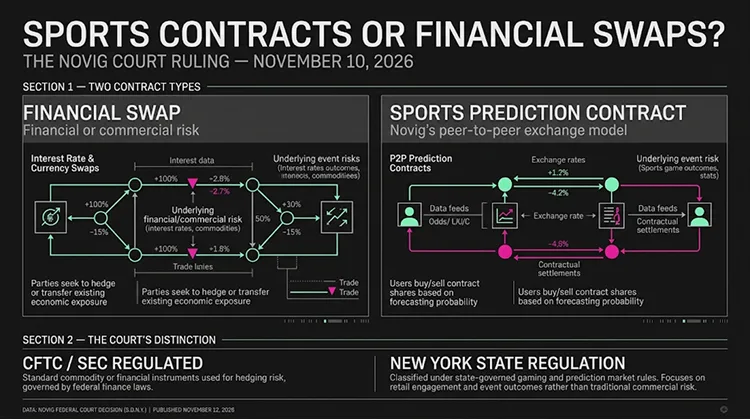
The case, Ludlow Exchange, LLC v. James, centers on whether trading contracts linked to sporting results are sufficiently different from conventional sports bets to receive protection under the federal Commodity Exchange Act.
Novig vs. New York — Key case facts
Court decision
Nov. 10, 2026
Southern District of New York
Presiding judge
Colleen McMahon
U.S. District Judge
Written ruling
35 pages
Opinion and order
Immediate outcome
Injunction denied
Appeal filed
Case No. 1:26-cv-06676 (CM), Document 73, decided November 10, 2026. Document 73 (S.D.N.Y. 2026) :: Justia
Who is involved in the Novig lawsuit?
The plaintiff is Ludlow Exchange LLC, doing business as Novig.
The defendants include New York Attorney General Letitia James and officials of the New York State Gaming Commission.
Among the named gaming regulators are Executive Director Robert Williams and Commission Chair Brian O’Dwyer.
New York maintains that companies offering mobile sports wagering to residents must comply with the state’s gambling licensing requirements.
Novig argues that its federally regulated exchange structure places the relevant contracts under the CFTC’s jurisdiction.
The dispute is therefore about more than one company’s business model. It concerns the boundary between federal derivatives regulation and the states’ longstanding authority over gambling.
What exactly did the judge decide?
McMahon concluded that Novig had not established a sufficient likelihood of success on the merits of its federal preemption claim, a necessary requirement for obtaining the preliminary injunction it requested.
As a result, the court declined to block New York authorities from applying their gambling laws.
The judge did not need to decide the remaining injunction requirements after finding that Novig failed to satisfy the likelihood-of-success standard.
This distinction matters because the decision is a preliminary ruling, not a final judgment resolving every claim in the lawsuit.
The case can continue through additional proceedings and appellate review.
Why the Judge Says Novig Sports Contracts Are Not Financial Swaps
The legal dispute turns on a specific part of the Commodity Exchange Act (CEA).
Federal law defines certain swaps as agreements whose payments depend on events or contingencies associated with potential financial, economic, or commercial consequences.
Novig argued that sporting outcomes meet this definition because customers trade contracts whose value changes depending on what happens during a game.
Judge McMahon disagreed with the company’s interpretation of the statute.
Sporting outcomes are events, but that does not automatically make them swaps
The court accepted that the result of a football game, a player’s performance, or a team’s margin of victory can qualify as an event or contingency.
However, the judge concluded that those events do not necessarily have the type of underlying financial or commercial significance contemplated by the CEA.
The ruling distinguished contracts used to manage economic risks from transactions primarily intended to give consumers an opportunity to speculate on sporting outcomes.
For example, a farmer may use commodity futures to protect against changes in crop prices.
A recreational customer buying a contract on the outcome of an NFL game generally is not managing that type of underlying commercial exposure.
Novig offered hypothetical examples of businesses hedging sports-related risks, but the court found those examples insufficient to support its broader interpretation.
The judge therefore concluded that the sports contracts at issue fell outside the relevant federal definition of a swap.
The court compared Novig’s products with traditional sportsbook bets
McMahon examined actual sports contracts listed on Novig’s platform in early November.
According to the opinion, the exchange offered products tied to NFL game winners, point spreads, total scores, player statistics, and multi-event parlays.
One example involved a four-game NFL parlay featuring the Cleveland Browns, Miami Dolphins, New York Jets, and Philadelphia Eagles.
The contract advertised a potential payout of 111.11 times the amount committed.
For a $100 position, that would correspond to a $11,111.11 payout if all required results occurred.
The judge noted that the contractual structure closely resembled wagers available through established sportsbooks, even though Novig used an exchange-based trading model.
The court’s conclusion was direct: “Novig’s sports event contracts are sports betting.” Document 73 (S.D.N.Y. 2026) :: Justia
How Novig’s Prediction Market Business Works
Novig operates an exchange where customers can take opposing positions on the outcomes of sporting events.
Unlike a traditional sportsbook, which generally sets odds and accepts bets as the counterparty, Novig matches participants who are willing to trade at an agreed price.
The platform earns fees from facilitating transactions rather than necessarily taking the opposite position on each contract.
This structural difference is central to Novig’s argument that its business should be treated as a financial exchange.
| Feature | Novig sports event contracts | Traditional online sportsbooks |
|---|---|---|
| Trading structure | Customers take opposing positions through an exchange | Customers generally place bets with an operator |
| Pricing | Contract prices emerge from exchange activity | Operator posts and adjusts betting odds |
| Sports products | Outcomes, spreads, totals, props and parlays | Outcomes, spreads, totals, props and parlays |
| Regulatory position | Claims federal derivatives oversight applies | Subject to state sports betting licensing |
| New York legal status | Disputed; state enforcement may proceed | Permitted for appropriately licensed operators |
The similarities in the underlying sports products played an important role in McMahon’s analysis.
Novig received federal exchange designation in June 2026
The CFTC designated Ludlow Exchange LLC as a designated contract market (DCM) on June 16, 2026.
A designated contract market is a federally regulated exchange permitted to operate within the applicable commodities framework.
The designation imposes requirements concerning recordkeeping, market surveillance, trading rules, compliance, and other regulatory responsibilities.
However, McMahon emphasized that obtaining DCM status does not automatically establish that every product offered on the exchange qualifies as a swap.
The distinction between the status of the exchange and the legal classification of its products is essential to understanding the ruling.
The CFTC’s own records continue to identify Ludlow Exchange LLC as a designated market.
Novig previously held a Colorado sports betting license
The court also examined Novig’s earlier business model.
According to the opinion, Novig’s parent company pursued conventional sports wagering licensing before transitioning to its federal exchange strategy.
The company obtained an Internet Sports Betting Operator license in Colorado in 2023 but subsequently returned it.
Its later strategy centered on offering sports-related event contracts through a federally designated exchange.
McMahon cited this history when discussing whether the company could comply with state gambling rules while maintaining its broader business.
The court’s analysis suggested that state licensing and geographic restrictions could provide alternatives to operating without state authorization. Document 73 (S.D.N.Y. 2026) :: Justia
CFTC and New York Disagree Over Who Regulates Sports Prediction Markets
The Novig decision exposes an increasingly significant conflict between federal and state regulators.
The CFTC maintains that qualifying event contracts can fall within its authority under the Commodity Exchange Act.
New York regulators argue that products functioning as sports bets must comply with state gambling laws, regardless of the terminology or exchange structure used.
Both positions have potentially significant consequences for the growing prediction markets industry.
CFTC Chairman Michael Selig supports federal oversight of event contracts
On October 9, 2026, the CFTC announced a proposed rule intended to clarify that certain event contracts, including contracts linked to sports, politics, culture, and weather, fall within the federal definition of swaps.

CFTC Chairman Michael S. Selig described those contracts as financial derivatives within the agency’s jurisdiction.
The proposal reflected the federal regulator’s position that event-contract markets deserve a coherent national framework.
However, a proposed rule is not the same as a finalized, legally binding regulation. CFTC
Judge McMahon criticized the CFTC’s October regulations
On the same day, the CFTC also announced an interim final rule excluding certain casino-style gambling products, including traditional sportsbook wagers, from the definition of a swap.
McMahon questioned how the agency could simultaneously distinguish conventional sports betting from sports event contracts when both products depend on sporting outcomes.
The judge described the CFTC’s positions as contradictory and declined to defer to the agency’s preferred interpretation.
The ruling also criticized the federal regulator’s involvement in related litigation over state enforcement.
These criticisms are the district judge’s legal assessment, not a final determination that the CFTC acted unlawfully.
The underlying question of federal regulatory authority remains the subject of continuing litigation and appeals. CFTC+1
Even If Novig’s Contracts Were Swaps, New York Could Still Regulate Gambling
One of the most consequential parts of McMahon’s opinion is its alternative legal reasoning.
The court concluded that even if Novig’s sports contracts qualified as swaps, federal commodities law would not necessarily prevent New York from applying its gambling laws.
This is a separate argument from the decision about whether the contracts meet the statutory definition of a swap.
What is federal preemption?
Federal preemption occurs when valid federal law displaces state law because Congress has exercised its authority over a particular subject.
Novig relied on three related arguments:
- Express preemption: The CEA explicitly grants the CFTC exclusive jurisdiction over relevant transactions.
- Field preemption: Federal derivatives regulation is sufficiently comprehensive to exclude state regulation in the same field.
- Conflict preemption: Complying with both federal and state requirements would be impossible, or state law would obstruct federal objectives.
McMahon rejected Novig’s arguments at the preliminary-injunction stage.
She reasoned that federal authority over the licensing and operation of derivatives exchanges does not necessarily eliminate separate state authority over gambling activity.
The opinion also explained that a company could potentially comply with both systems by obtaining appropriate state authorization or limiting access in jurisdictions where the relevant sports contracts are not permitted.
The court did not hold that state gambling regulators can regulate every aspect of a federally designated exchange. Instead, it distinguished gambling restrictions from regulation of the exchange’s federal market functions.
Timeline: How Novig’s New York Lawsuit Reached the November 10 Ruling
The case developed rapidly after Novig entered New York’s sports event-contract market.
- June 16, 2026 — Federal designationThe CFTC designated Ludlow Exchange LLC as a contract market.
- August 4, 2026 — New York expansion announcedNovig announced that sports event contracts would become available to customers in New York.
- August 5–6, 2026 — Legal challengeNovig pursued federal litigation against New York officials and moved for a preliminary injunction.
- August 11, 2026 — Temporary restraining order deniedThe district court rejected Novig’s initial request for emergency protection.
- September 17, 2026 — Tribal organizations participateThe court accepted an amicus brief from 24 federally recognized tribal governments and tribal organizations supporting New York’s opposition.
- October 9, 2026 — CFTC announces new rulesThe federal regulator announced its interim final rule and proposed event-contract clarification.
- November 10, 2026 — Injunction deniedMcMahon issued her 35-page decision. Novig filed a notice of appeal to the Second Circuit.
What the Novig Ruling Means for Kalshi, Polymarket, and DraftKings Predictions
The decision comes as several prediction market companies face litigation over sports-related event contracts.
Although McMahon’s order directly concerns Novig, the reasoning could influence how other federal courts evaluate similar products.
Kalshi faces separate litigation in New York
New York Attorney General Letitia James and Governor Kathy Hochul announced a lawsuit against Kalshi on July 31, 2026.
State officials alleged that Kalshi was offering unlicensed gambling through sports-related event contracts.
Kalshi has maintained that its contracts are federally regulated financial products rather than conventional state-regulated gambling.
The state disputes that characterization.
New York previously obtained a favorable district court ruling against Kalshi in July, and related appellate proceedings continue.
The Novig ruling adds support to New York’s legal position, but it does not automatically determine the outcome of Kalshi’s separate cases. New York State Attorney General+2
Polymarket is also facing New York enforcement
On September 24, New York announced a separate lawsuit against Polymarket.
State officials alleged that the company’s sports-related prediction markets violated gambling requirements and requested relief against the alleged unlicensed activity.
The lawsuit is another example of New York’s effort to apply traditional gambling protections to event-contract products.
The allegations are contested legal claims and should not be treated as final findings of liability. New York State Attorney General
Could the decision affect DraftKings Predictions?
DraftKings is investing heavily in the prediction markets industry, and the Novig case highlights a legal risk that could affect the broader sector.
If courts ultimately determine that sports event contracts remain subject to state gambling laws, companies may need to reconsider where they offer those products and how they structure compliance.
Potential consequences include additional licensing obligations, geographic access restrictions, increased compliance costs, and changes to available sports contracts.
However, the Novig opinion does not directly rule on DraftKings Predictions or invalidate the products of other operators.
Its broader influence will depend on subsequent court decisions, especially appellate rulings addressing federal preemption.
Why Tribal Gaming Organizations Are Watching the Case
The dispute also raises concerns about tribal sovereignty and the federal framework governing gambling on tribal lands.
In September, the district court accepted a brief from 24 federally recognized tribal governments and tribal organizations supporting New York’s opposition to Novig’s requested injunction.
These parties argued that an overly broad interpretation of the CFTC’s exclusive jurisdiction could undermine the established division of authority under the Indian Gaming Regulatory Act.
McMahon considered those concerns when explaining why Congress was unlikely to have intended the Commodity Exchange Act to displace longstanding gambling regulations without making that intention clear.
The issue extends beyond New York because federal prediction markets can potentially reach customers across multiple states and tribal jurisdictions.
An eventual appellate resolution could therefore influence regulatory relationships well beyond conventional online sports betting. Document 73 (S.D.N.Y. 2026) :: Justia+1
What Does the Ruling Mean for New York Sports Bettors?
For New York consumers, the immediate significance is the distinction between licensed sportsbooks and sports event contracts offered through disputed regulatory arrangements.
New York already permits licensed mobile sports wagering.
Operators must comply with requirements covering eligibility, identity verification, player protections, geographic location, and authorized wagering activity.
New York requires sports bettors to be at least 21
New York’s legal minimum age for mobile sports wagering is 21.
In its earlier enforcement action against Kalshi, the state specifically raised concerns about prediction market access for customers ages 18–20.
The Novig court opinion, however, states that Novig permits only customers aged 21 or older to trade on its exchange.
Therefore, the broader age-related concerns raised in other prediction market cases should not be misrepresented as evidence that Novig was allowing underage customers to trade. New York State Attorney General+1
Can New York residents still use Novig?
The November 10 order does not, by itself, terminate Novig’s operations or suspend the company’s federal designation.
It denies the company’s request to prevent New York from enforcing its gambling laws while the litigation continues.
Any future restrictions on New York customers will depend on enforcement activity, subsequent court orders, and Novig’s operational decisions.
Customers should verify the platform’s current terms, geographic eligibility, and official regulatory notices before using sports-related trading products.
Does this affect licensed online casinos?
The case does not directly concern regulated online casino games.
New York’s current gaming framework permits licensed mobile sports betting, but it has not established a general statewide licensing system for real-money online casino gaming.
Sports prediction markets, conventional sports betting, and online casino products are distinct regulatory categories.
The Novig ruling addresses the classification and regulation of sports-related event contracts rather than creating new rules for online slots, blackjack, or other casino games.
Novig Appeals: What Happens Next in the Second Circuit?
Novig filed a notice of appeal following the district court’s November 10 decision.
The appeal places the dispute before the U.S. Court of Appeals for the Second Circuit.
The central questions are likely to include whether sports event contracts qualify as swaps under federal law and whether the CEA prevents states from applying their gambling laws to those products.
The appeals court could agree with McMahon, reject some or all of the legal analysis, or issue a narrower ruling.
Why the appeal matters beyond New York
Federal courts across the country have considered similar challenges involving prediction market operators and state gambling authorities.
The resulting decisions have not been completely uniform, particularly regarding how federal commodities law interacts with state gambling restrictions.
An appellate ruling from the Second Circuit could provide important guidance for courts in New York, Connecticut, and Vermont.
However, it would not automatically settle every related case nationwide.
A definitive national resolution might require further appellate review, a Supreme Court decision, new federal legislation, or regulatory changes consistent with applicable law.
What developments should the industry monitor?
The most important developments are further Second Circuit proceedings, any New York enforcement action specifically affecting Novig, final CFTC decisions concerning event contracts, and related cases involving Kalshi and other operators.
Companies will also need to assess whether the economics of expanding sports prediction markets remain attractive if state-level licensing and access restrictions become more significant.
For now, there is no confirmed date for a final appellate resolution.
Frequently Asked Questions About the Novig New York Court Ruling
Did a New York judge rule that Novig prediction markets are gambling?
Yes. On November 10, 2026, Judge Colleen McMahon concluded at the preliminary-injunction stage that Novig’s disputed sports event contracts are sports betting rather than swaps protected by the federal commodities framework.
Who is Judge Colleen McMahon?
Colleen McMahon is a U.S. District Judge for the Southern District of New York. She issued the opinion denying Novig’s request to block New York gambling enforcement.
Are Novig sports prediction contracts illegal nationwide?
No. The ruling concerns the application of New York law and the company’s request for preliminary injunctive relief. It does not establish a nationwide prohibition.
Did Novig lose its CFTC license?
No. The court did not revoke Novig’s designated contract market status. Its decision addresses the legal classification of specific sports contracts and whether New York may enforce gambling requirements.
What is the difference between a prediction market and a sportsbook?
A prediction market generally enables participants to trade contracts tied to event outcomes. A conventional sportsbook usually accepts bets as the counterparty. The products can nevertheless create similar economic exposure when both depend on sporting results.
Did Novig appeal the decision?
Yes. Novig filed a notice of appeal to the U.S. Court of Appeals for the Second Circuit on November 10, 2026.
Does the ruling affect Kalshi and Polymarket?
The decision may influence similar legal disputes, but it does not directly decide the separate cases involving Kalshi or Polymarket.
Can New York require prediction market operators to obtain gambling licenses?
The district court concluded that New York may apply its sports wagering laws to Novig’s disputed products. The broader legal issue remains subject to further proceedings and potential appellate review.
Final Thoughts: New York’s Novig Ruling Could Reshape Sports Prediction Markets
The November 10 decision against Novig marks another important development in the struggle to determine how sports prediction markets should be regulated in the United States.
Judge Colleen McMahon concluded that Novig’s sports event contracts do not qualify as swaps under the Commodity Exchange Act and rejected the company’s attempt to block New York gambling enforcement.
The opinion went further by reasoning that even qualifying swaps would not necessarily be exempt from state gambling laws.
For New York regulators, the decision reinforces their authority to challenge sports wagering products operating without state authorization.
For Novig, it creates an immediate legal obstacle while the company pursues an appeal.
For Kalshi, Polymarket, DraftKings Predictions, and other platforms, it highlights the regulatory uncertainty surrounding sports event contracts.
The central takeaway is that federal exchange designation does not automatically protect a prediction market’s sports contracts from state gambling laws.
The outcome of the Second Circuit appeal could become one of the most consequential legal developments for the American prediction markets industry as it approaches 2027.
Leave a Reply