

New York-based prediction market operator Polymarket has confirmed employee layoffs and the termination of contractor agreements as competition intensifies with rival Kalshi.
The restructuring became public after an internal termination email, effective November 4, 2026, circulated on social media. On November 11, Polymarket confirmed the email was authentic but declined to disclose how many employees and contractors were affected.
According to Reuters, more than half of the affected workers were contractors, citing a person familiar with the matter. Separate reporting indicated that the reductions included positions in marketing, creative production, customer experience, and engineering.
The company disputed online claims that it had eliminated 30% of its workforce. No verified total number of affected workers has been publicly released.
The layoffs come at a critical moment for the prediction markets industry. Kalshi has overtaken Polymarket in monthly trading volume while expanding distribution partnerships and securing major investments.
On October 29, 2026, Kalshi announced a $1 billion funding round at a $40 billion valuation, highlighting the enormous financial expectations surrounding event-contract trading.
For Polymarket founder and CEO Shayne Coplan, the challenge is now to transform rapid industry growth into a more disciplined, scalable business while competing with a rival that has established a significant lead in reported trading activity.
Polymarket Confirms November 2026 Layoffs and Contractor Cuts
Polymarket’s restructuring began attracting attention during the first week of November when screenshots of an internal contractor termination email appeared on X.
The message informed certain contractors that their engagements would end effective November 4 as part of a company-wide workforce reduction.
Polymarket confirmed the authenticity of that message on November 11.

The company explained that its organizational changes were associated with growth, new leadership appointments, and preparations for its next phase of development.
The statement acknowledged that some personnel were leaving while other positions were being filled.
Polymarket layoffs — Verified facts
Contract termination date
Nov. 4, 2026
Company confirmation
Nov. 11, 2026
Share of cuts involving contractors
Over 50%
Source familiar with the matter
Total workforce reduction
Undisclosed
30% claim disputed
Sources: Reuters and Front Office Sports, November 11, 2026. Investing.com+1
Which Polymarket teams were affected?
Reporting from Front Office Sports and FOX Business indicated that the restructuring primarily affected contractors and employees associated with marketing, creative production, growth, customer experience, and engineering.
Marketing appears to have undergone particularly extensive changes, alongside the appointment of new senior executives.
The restructuring was not limited exclusively to contractors. Some full-time employees also lost their positions.
However, Polymarket did not publish a department-by-department breakdown, leaving the exact scope of the cuts unclear.
Did Polymarket really lay off 30% of its workforce?
There is no verified evidence supporting that figure.
Social media posts claimed that approximately 30% of Polymarket’s workforce had been dismissed after the November 3 U.S. elections.
Sources familiar with the restructuring told reporters that the figure was inaccurate.
Polymarket separately declined to disclose its total headcount or the percentage affected.
The confirmed story is that Polymarket eliminated positions and contractor agreements; the precise number of job losses remains unknown.
It would also be misleading to claim that the cuts were caused by a particular election outcome. The available reporting links them to broader organizational changes, leadership appointments, and increasing competitive pressure.
Kalshi Overtakes Polymarket in Prediction Market Trading Volume
Polymarket’s internal restructuring comes as Kalshi strengthens its position in the fast-growing U.S. event-contract industry.
The two platforms compete for customers interested in trading contracts tied to sports, elections, economic indicators, financial developments, and other real-world outcomes.
Although Polymarket was previously a leading name in prediction markets, Kalshi now processes substantially more monthly trading volume, according to industry analytics reviewed in November 2026.
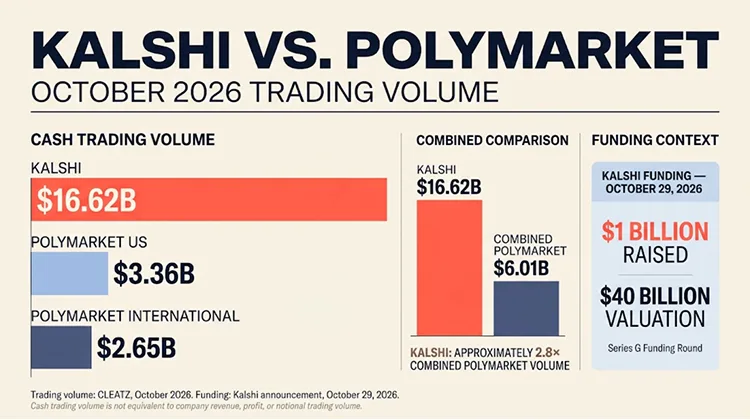
Kalshi generated $16.62 billion in October cash trading volume
Data published by CLEATZ shows the following October 2026 trading activity:
| Prediction market platform | October 2026 cash trading volume |
|---|---|
| Kalshi | $16.62 billion |
| Polymarket US | $3.36 billion |
| Polymarket International | $2.65 billion |
| Combined Polymarket platforms | $6.01 billion |
October 2026 Cash Trading Volume
Cash trading volume in billions of U.S. dollars, using a consistent methodology across platforms.
$0$5B$10B$15B$20BKalshiPolymarket USPolymarket InternationalSource: CLEATZ prediction market volume dashboard, October 2026. Figures are rounded. These are cash trading volume estimates, not company revenue or profit. CLEATZ
Under this measurement, Kalshi handled approximately 2.8 times the combined trading volume of Polymarket’s U.S. and international platforms during October.
This represents a substantial competitive advantage in market activity, although both companies continued growing.
Why do some reports show much larger trading-volume figures?
Prediction market data providers use different methodologies.
Some measure the actual dollars exchanged when contracts are traded. Others measure notional value, which can represent contracts at their full potential payout.
These methods can generate dramatically different totals.
For example, another industry dataset estimated Kalshi’s October notional volume at approximately $98.15 billion and Polymarket’s combined volume at approximately $20.32 billion.
Those figures should not be directly compared with cash trading volume because the measurement bases differ.
In either case, the consistent conclusion is that Kalshi maintained a significant lead in October.
Does Kalshi’s lead mean Polymarket is shrinking?
Not necessarily.
Polymarket’s U.S. operation has also experienced substantial growth.
According to TickerTracker data reported in November, Polymarket US increased its monthly notional volume from approximately $4.04 billion in June to $14.77 billion in October 2026.
That represents an increase of approximately 266%.
These figures suggest that the two companies are competing in an expanding market rather than one platform simply losing all its customers to the other.
Kalshi’s trading-volume lead does not, by itself, establish that it has higher net profit, better customer retention, or a larger active user base under every measurement.
Why Kalshi Is Gaining Ground Against Polymarket
Kalshi’s expansion has been supported by investment, product distribution, marketing partnerships, and growing interest in sports event contracts.
The company’s position in sports-related prediction markets has become especially important as major sporting events attract customers who may already be familiar with traditional sportsbooks.
Kalshi’s sports partnerships increased its visibility
During the 2026 FIFA World Cup, Kalshi pursued partnerships designed to make its prediction markets more visible to sports audiences.
On June 10, 2026, the company announced an official partnership with the Argentine Football Association (AFA) for the tournament.
The arrangement connected Kalshi with Argentina’s national football organization during one of the year’s largest sporting events.
Reuters has also identified Kalshi’s expanded distribution and sports partnerships as factors contributing to its competitive position.
These relationships may help attract customers and increase trading activity, although individual partnership announcements do not establish the precise number of users acquired or revenue generated.
The NFL season has become another growth driver
The start of the NFL season in September created additional opportunities for sports event-contract trading.
Prediction markets may offer contracts tied to game outcomes, point spreads, player performances, and combinations of sporting events, subject to platform rules and applicable legal restrictions.
Sports-focused products can attract large trading volumes because customers understand the underlying events.
However, the overlap between event contracts and conventional sports wagers has also intensified regulatory disputes.
This creates an unusual competitive environment: platforms may gain customers by expanding sports markets while simultaneously increasing their exposure to legal challenges.
Kalshi Raises $1 Billion at a $40 Billion Valuation
Kalshi’s financial momentum became particularly evident on October 29, 2026, when it announced a $1 billion funding round.
The transaction valued the company at $40 billion.
The investment round was co-led by Sequoia Capital and Wellington Management.
According to Reuters, Tiger Global Management and Dragoneer Investment Group also participated.
Kalshi’s October 2026 funding announcement
Capital raised
$1B
Company valuation
$40B
Announced October 29, 2026. The $40 billion figure is a private financing valuation, not annual revenue or market capitalization from publicly traded shares. Investing.com
Kalshi wants to expand beyond prediction markets
Kalshi’s fundraising announcement also outlined ambitions beyond event contracts.
The company is exploring opportunities to compete more directly with traditional financial exchanges and offer additional trading products.
That strategy could eventually place Kalshi in competition with established financial market infrastructure businesses.
However, entering additional asset classes would involve new operational, financial, and regulatory challenges.
The $40 billion valuation reflects investor expectations about future growth, not proof that those expansion plans will succeed.
What does Kalshi’s funding mean for Polymarket?
Access to capital is important because prediction market platforms face substantial spending requirements.
These include software development, regulatory compliance, security, customer acquisition, data infrastructure, marketing, and partnerships.
A well-funded competitor may be able to invest aggressively in those areas.
Polymarket’s restructuring suggests that management is assessing how its own organization can support continued expansion.
Nevertheless, the timing of layoffs alongside Kalshi’s financing announcement does not establish that Kalshi directly caused the workforce reductions.
The available reporting identifies broader organizational changes and competitive pressures, not a single confirmed cause.
Shayne Coplan Restructures Polymarket’s Leadership Team
Polymarket founder and CEO Shayne Coplan has been reshaping the company’s senior leadership as it expands its U.S. operations.
Bloomberg reported that investors had pressed Coplan to introduce greater organizational discipline.
The hiring of experienced executives suggests an effort to establish stronger financial oversight and operational management.
Warren Jenson becomes Polymarket’s first chief financial officer
In September 2026, Polymarket appointed Warren Jenson as its first chief financial officer.
Jenson previously held senior financial leadership positions at major companies, including Amazon, Electronic Arts, and Delta Air Lines.
His appointment gives Polymarket an executive with experience managing financial operations at large organizations.
For a growing technology company, a dedicated chief financial officer can oversee financial reporting, budgeting, capital allocation, and investor relationships.
The appointment is particularly relevant while Polymarket explores additional financing.
Travis VanderZanden takes over growth leadership
Polymarket also appointed former Uber executive Travis VanderZanden as chief growth officer.
His arrival followed changes in the marketing department, including the October departure of former chief marketing officer Matthew Modabber.
Reporting from Front Office Sports linked the restructuring to efforts to reorganize marketing and introduce more experienced leadership.
Additional appointments have included Malea Otranto, who joined as global head of trust and safety, and Lisa Mantil, who became head of institutional growth.
These hires suggest that Polymarket is placing greater emphasis on governance, compliance, institutional relationships, and customer acquisition.
However, the company has not released a comprehensive public explanation detailing how every new appointment relates to specific layoffs. Front Office Sports+1
Polymarket Reports More Than $1.8 Billion in Annualized Revenue
The layoffs come despite Polymarket reporting rapid revenue growth.
On November 10, 2026, the company told CNBC that its annualized revenue had exceeded $1.8 billion.
That was up from an annual revenue run rate above $1 billion reported in June.
The increase has been associated with expansion of the company’s U.S. exchange, which has attracted greater trading activity since opening more broadly to customers in 2026. Quartz+1
Annualized revenue is not the same as full-year revenue
The $1.8 billion figure requires an important qualification.
An annualized revenue run rate extrapolates a recent level of business activity across an entire year.
It does not mean Polymarket has already recorded $1.8 billion in revenue during 2026.
Nor does it establish that the company is profitable.
Polymarket is privately held and has not published comprehensive audited financial results confirming its net income, operating expenses, or free cash flow.
Management’s annualized revenue claim therefore provides an indicator of business momentum, but not a complete picture of financial performance.
Why would a growing company lay off workers?
Companies sometimes reduce staffing in certain departments while adding personnel in others.
This can happen when a business changes its strategy, adopts new management structures, reorganizes product teams, or adjusts its approach to marketing.
Polymarket’s own statement acknowledged that the reorganization included new hiring alongside personnel reductions.
According to Front Office Sports, sources described the changes as part of an effort to professionalize the organization.
The available evidence does not establish that Polymarket is facing a cash shortage or that its layoffs resulted from declining revenue.
The distinction is important because rising business volume and workforce restructuring can occur simultaneously.
Polymarket’s U.S. Expansion Faces Federal and State Regulatory Scrutiny
Beyond competition with Kalshi, Polymarket faces a complicated regulatory environment.
The company operates a U.S.-regulated exchange under a separate structure from its international prediction market platform.
Its American exchange operates through QCX LLC, doing business as Polymarket US.
The Commodity Futures Trading Commission lists QCX as a designated contract market, with an original designation date of July 9, 2025. CFTC
The CFTC is investigating Polymarket’s previous restrictions on U.S. users
On October 27, Reuters reported that the CFTC was examining whether Polymarket had complied with a previous enforcement settlement.
The investigation concerns whether the company implemented adequate restrictions preventing U.S. residents from accessing its international platform.
The agency was also examining certain advertising practices, according to people familiar with the matter.
Those inquiries do not establish that Polymarket violated the law.
As of November 12, no final finding from that investigation has been cited in the reporting reviewed for this article. Investing.com
Polymarket previously paid a $1.4 million CFTC penalty
The current scrutiny follows an earlier enforcement action.
On January 3, 2022, the CFTC announced a settlement with Blockratize Inc., doing business as Polymarket.
The regulator alleged that Polymarket had offered off-exchange event-based binary options without the required federal registration or designation.
The settlement required the company to pay a $1.4 million civil monetary penalty, resolve noncompliant markets, and cease the conduct identified in the order.
Polymarket’s subsequent development of a designated U.S. exchange represents a significant change from the earlier arrangement.
However, the existence of a regulated U.S. operation does not automatically resolve questions concerning past compliance by its separate international platform. CFTC
New York is also challenging Polymarket’s sports contracts
On September 24, 2026, New York Attorney General Letitia James and Governor Kathy Hochul announced a lawsuit against Polymarket US.
The state alleged that certain sports-related event contracts constituted unlicensed gambling.
New York authorities sought to prevent the company from offering the disputed activity without appropriate authorization and requested additional legal remedies.
Polymarket’s position is that its event contracts operate within the federal commodities regulatory framework.
The disagreement reflects the broader conflict between federal derivatives oversight and state sports betting laws.
Importantly, the lawsuit contains allegations that remain subject to judicial proceedings. It is not equivalent to a final determination of liability. New York State Attorney General
What Polymarket’s Layoffs Mean for the U.S. Online Gambling Industry
The restructuring is another indication that prediction markets are becoming an increasingly significant part of the American gambling and financial technology landscape.
Platforms offering sports event contracts compete for some of the same customer attention as licensed online sportsbooks.
They may also compete for advertising partnerships, market data, software talent, and investment capital.
However, prediction markets and state-licensed online casinos are not legally interchangeable products.
Traditional real-money online casino platforms offer regulated gambling products such as slots, blackjack, roulette, and live dealer games in states where those activities are authorized.
Prediction market exchanges facilitate trading in event contracts, with legal treatment depending on the contracts offered and the applicable regulatory framework.
Could traditional sportsbooks face stronger competition?
Companies such as DraftKings and FanDuel already operate established online sports betting platforms across multiple U.S. states.
The expansion of Kalshi and Polymarket increases competition for customers interested in sports outcomes.
If event contracts continue attracting substantial trading activity, conventional sportsbooks may need to reconsider how they acquire and retain customers.
However, the precise impact on sportsbook revenue is difficult to measure.
Trading volume in prediction markets cannot be compared directly with sportsbook revenue because the business models and accounting methods differ.
What about responsible gambling protections?
The rapid growth of sports event contracts also raises questions about consumer protection.
Potential issues include customer identification, marketing practices, age verification, geographic restrictions, problematic trading behavior, and access to customer support.
Regulators have expressed concern that platforms offering products economically similar to sports bets should not avoid applicable safeguards merely by using different terminology.
Prediction market companies maintain that their federally regulated exchange structures impose compliance obligations of their own.
The eventual balance between federal and state oversight remains unresolved.
Could Polymarket Prepare for a 2027 IPO?
Polymarket’s leadership changes have generated speculation that the company may eventually pursue an initial public offering.
Front Office Sports reported that sources familiar with the business discussed the possibility of a public-market transaction as early as 2027.
However, Polymarket has not announced a confirmed IPO date or publicly committed to going public in 2027.
There is no basis to treat a potential listing as an established corporate plan.
The company has also reportedly been pursuing a new financing round of approximately $1 billion at a valuation around $21 billion.
That reported valuation is separate from Kalshi’s confirmed $40 billion financing valuation and should not be treated as the value of a completed, publicly traded transaction.
For investors, future developments worth monitoring include Polymarket’s funding, financial disclosures, corporate governance, and regulatory proceedings. Front Office Sports+1
What Happens Next in the Polymarket vs. Kalshi Competition?
The next phase of competition will likely involve efforts to expand customer access, improve trading products, strengthen regulatory compliance, and establish sustainable revenue models.
Kalshi has a significant lead in reported monthly trading volume and has secured substantial investment capital.
Polymarket continues expanding its U.S. business while introducing experienced executives and reorganizing internal operations.
Both face regulatory uncertainty over certain sports-related contracts.
Several factors will determine which company strengthens its position during 2027.
Customer acquisition and retention
Attracting new users is important, but retaining active customers is critical for long-term growth.
High-profile sports and political events can produce temporary increases in trading activity.
Platforms must demonstrate that customers continue participating during periods without major headline events.
Trading liquidity and platform performance
Prediction markets require sufficient liquidity for participants to buy and sell contracts efficiently.
A platform with more active traders may offer better execution in certain markets, but activity can vary significantly by event type.
Maintaining reliable trading infrastructure will become increasingly important as transaction volumes grow.
Regulatory decisions
Federal court rulings, CFTC policy decisions, and state enforcement actions could affect which contracts platforms may offer and where customers can access them.
Changes to the regulatory framework could also influence compliance costs and future investment decisions.
Financial efficiency
Both companies must ultimately demonstrate that their growth strategies support sustainable financial performance.
High trading volume, large funding rounds, and substantial annualized revenue estimates are important indicators, but none guarantees profitability.
Polymarket’s November restructuring suggests that organizational efficiency has become an important part of its competitive strategy.
Frequently Asked Questions About Polymarket Layoffs
Did Polymarket confirm layoffs in November 2026?
Yes. On November 11, Polymarket confirmed that it had laid off employees and ended certain contractor agreements as part of an organizational restructuring.
How many Polymarket employees were laid off?
The company has not disclosed the total number. Reuters reported that more than half of the affected workers were contractors, while claims of a 30% workforce reduction have been disputed.
Why is Polymarket cutting jobs?
Polymarket attributed the changes to organizational growth, new leadership, and restructuring. Industry reporting also identified investor pressure and increased competition with Kalshi. The company has not identified a single definitive cause.
Is Kalshi bigger than Polymarket?
Kalshi currently leads in reported monthly prediction market trading volume. October 2026 cash-volume estimates indicate approximately $16.62 billion for Kalshi, compared with a combined $6.01 billion for Polymarket’s U.S. and international operations.
How much is Kalshi worth in 2026?
Kalshi announced a $1 billion funding round on October 29, 2026, at a private company valuation of $40 billion.
Is Polymarket losing money?
Polymarket has not publicly released enough comprehensive audited financial information to establish its current net profitability. Its reported $1.8 billion annualized revenue run rate does not establish net income.
Who is the CEO of Polymarket?
Polymarket was founded by Shayne Coplan, who continues to serve as its chief executive officer.
Is Polymarket legal in the United States?
Polymarket US operates through a CFTC-designated contract market. However, the legality of certain sports-related event contracts remains contested in state and federal proceedings. Authorization of an exchange does not necessarily settle the legal status of every contract or its availability in every state.
Will Polymarket go public in 2027?
A possible 2027 IPO has been discussed in industry reporting, but the company has not confirmed an official listing date.
Final Thoughts: Polymarket Faces a New Competitive Reality
Polymarket’s confirmed November 2026 layoffs illustrate a major transition in the prediction markets industry.
The New York-based company is reorganizing its workforce, reducing contractor relationships, and introducing experienced executives while continuing to expand its U.S. operations.
The changes are happening as Kalshi establishes a significant advantage in trading volume and attracts billions of dollars in investor capital.
Kalshi’s October 29 financing round, which valued the company at $40 billion, illustrates the extraordinary growth expectations surrounding prediction markets.
Yet Polymarket’s own reported trading activity and annualized revenue suggest that its business continues expanding.
The layoffs are therefore better understood as part of a broader restructuring rather than proof of financial collapse.
At the same time, federal investigations and state gambling lawsuits present additional challenges for prediction market operators.
The central takeaway is that Polymarket is reorganizing to compete more effectively with Kalshi, but the industry’s long-term winners will be determined by profitability, customer retention, liquidity, and regulatory outcomes—not trading volume alone.
As the industry approaches 2027, the competition between Polymarket and Kalshi is likely to remain one of the most important developments at the intersection of American sports betting, financial technology, and gambling regulation.
Leave a Reply