
Washington, D.C., is moving closer to a decision on whether to legalize real-money online casinos, with a key committee vote scheduled for Wednesday, November 18, 2026.
The Council of the District of Columbia’s Committee on Human Services will consider Bill B26-0656, the Internet Gaming and Consumer Protection Act of 2026, a proposal that would establish a regulated online casino market while prohibiting unlicensed sweepstakes-style gambling platforms.
The legislation was introduced on April 9, 2026, by Ward 7 Councilmember Wendell Felder. It would permit licensed operators to offer online slots, blackjack, roulette, poker, and other approved casino games to adults aged 21 and older.
Under the introduced version, online casino operators would pay a 25% tax on adjusted gross internet gaming revenue and a $2 million nonrefundable license application fee.
The bill also proposes enforcement measures against unauthorized dual-currency sweepstakes casinos, including cease-and-desist orders, financial penalties, and civil legal action.
The November 18 committee markup is scheduled for 3 p.m. Eastern Time, chaired by Councilmember Matthew Frumin, at the John A. Wilson Building in Washington, D.C., with remote participation available.
Online casino gambling has not yet been legalized in Washington, D.C. The November 18 vote is a committee-stage decision, not a final vote approving the launch of real-money iGaming.
The outcome could determine whether the proposal advances before the Council’s remaining legislative meetings in December.
Washington, D.C. Online Casino Bill B26-0656: Key Provisions
The Internet Gaming and Consumer Protection Act of 2026 would establish a comprehensive licensing system administered by the District’s Office of Lottery and Gaming (OLG).
It would create a legal framework for internet casino games that currently lack general authorization under D.C.’s gambling laws.
The April 9 proposal also introduces taxes, regulatory assessments, local business participation requirements, responsible gambling safeguards, and enforcement powers against unlicensed operators.
Washington, D.C. proposed online casino market — Key figures
Proposed iGaming tax
25%
Adjusted gross gaming revenue
Operator application fee
$2M
Nonrefundable
License duration
5 years
Minimum player age
21
Operator license renewal
$500,000
Additional assessments
2% + 2%
Regulation and community impact
Figures reflect Bill B26-0656 as introduced on April 9, 2026. They may change during the November 18 committee markup. lims.dccouncil.gov+1
Which online casino games would be permitted?
The introduced legislation covers internet casino gaming conducted through approved platforms.
Eligible products could include online slots, blackjack, roulette, poker, live-dealer games, and other casino-style games approved under OLG regulations.
The bill expressly distinguishes internet gaming from traditional lottery products, sports wagering, and separately regulated skill-game machines.
Operators could offer approved internet gaming only after receiving the required licenses and satisfying the District’s technical requirements.
The legislation also contemplates reciprocal agreements with other jurisdictions, including potential shared liquidity arrangements for online poker.
Such agreements would need to comply with federal law and receive the necessary approvals. lims.dccouncil.gov
Would the District limit the number of online casino operators?
The introduced bill does not establish a numerical cap on operator licenses.
Instead, the OLG would evaluate applicants based on their qualifications and compliance with the licensing framework.
An operator would generally be authorized to operate up to two approved internet gaming brands or platforms.
The regulator could approve additional brands when justified by market conditions, compliance capacity, and the public interest.
This structure could allow several companies to compete in the District, although approval would not be automatic.
Washington, D.C. Proposes a 25% Online Casino Tax Plus Additional Assessments
One of the most significant financial aspects of B26-0656 is the proposed tax structure.
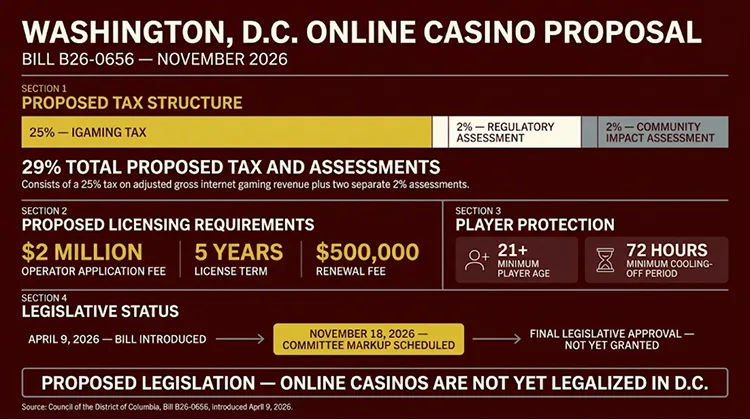
The introduced bill would require licensed operators to pay 25% of adjusted gross internet gaming revenue.
That revenue measure generally reflects wagering revenue after accounting for player winnings and certain canceled, voided, or refunded wagers.
It should not be confused with the total amount wagered by customers.
An additional 4% would fund regulation and community programs
Beyond the 25% tax, the proposal establishes two separate assessments:
- A 2% regulatory assessment to finance administration and enforcement by the Office of Lottery and Gaming.
- A 2% community impact assessment to support programs addressing the social and economic consequences of internet gaming.
Together, the tax and assessments would represent 29% of the specified revenue base.
However, only the 25% component is characterized as a tax under the introduced legislation.
How the proposed 29% combined obligation is structured
Proposed tax and assessments on adjusted gross internet gaming revenue
Community impact assessment
Regulatory assessment
iGaming tax
The chart shows the relative sizes of the proposed 25%, 2%, and 2% obligations. It does not depict shares of total wagers or casino profits. lims.dccouncil.gov
For illustration, an operator generating $10 million in adjusted gross internet gaming revenue would owe approximately $2.5 million in the proposed tax and $400,000 in the two assessments, before considering license fees and other expenses.
That example is hypothetical, not a forecast of any particular casino operator’s performance.
How much revenue could Washington, D.C. collect?
Councilmember Felder’s April 9 introductory letter estimated that District residents wagered approximately $700 million through unlicensed online platforms in 2024.
He argued that regulating the activity could capture revenue that currently falls outside the District’s oversight.
The same letter suggested that annual tax receipts could eventually reach tens of millions of dollars.
Those figures are estimates presented in support of the legislation. They are not verified collections from a regulated D.C. online casino market, which has not launched.
The actual fiscal impact would depend on customer demand, licensed operator participation, promotional spending, effective tax collections, and possible migration from existing lottery or sports wagering products. lims.dccouncil.gov
Proposed Sweepstakes Casino Ban Targets Dual-Currency Gaming Platforms
The second major feature of B26-0656 is its proposed prohibition on unauthorized sweepstakes-style gambling.
The measure specifically addresses dual-currency gaming products, which are commonly associated with certain online sweepstakes casinos.
These platforms may use two types of virtual credits, often including a recreational currency and another currency that can be redeemed for cash or prizes.
Under the legislation, operators could not avoid gambling restrictions solely by describing their products as promotional sweepstakes.
How would the proposed sweepstakes ban work?
Section 520 of the introduced legislation would prohibit unlicensed persons or businesses from offering, promoting, or conducting certain casino-like, sports wagering-like, or lottery-like activities in exchange for money or another form of consideration.
The provision expressly includes dual-currency gaming products.
It also describes consideration broadly enough to encompass purchases of credits, tokens, subscriptions, entries, or access used to participate or continue playing.
This language is intended to address models in which customers purchase one type of virtual currency and receive another type connected to opportunities to win prizes.
The bill does not establish that every legitimate promotional sweepstakes contest is illegal. Its application would depend on the statutory definitions, the activity involved, and the final legislation.
What penalties could sweepstakes casino operators face?
The introduced legislation provides several potential enforcement mechanisms.
| Enforcement measure | Proposed authority |
|---|---|
| Cease-and-desist orders | OLG could direct unauthorized activity to stop |
| Civil fines | Up to $100,000 for an individual violation |
| Aggregated violations | Up to $500,000 for certain related violations |
| Injunctive relief | Courts could be asked to prohibit unlawful activity |
| Restitution and disgorgement | Attorney General could seek appropriate financial remedies |
| Repeated violations | Each day of prohibited sweepstakes activity could constitute a separate violation |
These penalties are proposed statutory remedies. They have not been imposed on a particular company under B26-0656, because the legislation has not passed.
The prohibition is directed primarily at those offering, promoting, or conducting unauthorized gaming products rather than establishing a new penalty specifically for individual players.
Are sweepstakes casinos already banned in Washington, D.C.?
The new sweepstakes prohibition in B26-0656 has not taken effect.
The District’s existing laws may still apply to particular gambling products, depending on how they operate.
Therefore, the absence of an enacted B26-0656 prohibition should not be interpreted as a guarantee that every sweepstakes casino is currently lawful in Washington, D.C.
Players should distinguish proposed legislation from existing legal requirements and verify an operator’s terms and applicable restrictions.
DraftKings, BetMGM and Caesars Support D.C. Online Casino Expansion
The potential legalization of online casinos could create a new commercial opportunity for companies already operating regulated sportsbooks in Washington, D.C.
Following regulatory changes in 2024, the District opened its mobile sports betting market to additional operators.
Established brands now serving the local sports wagering market include DraftKings, BetMGM, Caesars Sportsbook, FanDuel and Fanatics Sportsbook.
During the May 4 legislative hearing, representatives associated with Caesars, DraftKings, and BetMGM supported the proposal.
Their participation illustrates interest among established gaming businesses, but none has received a D.C. online casino license under B26-0656.

Existing sportsbook licenses could accelerate iGaming applications
The introduced bill allows companies already holding a District sports wagering license or another gaming license to receive expedited consideration for an internet gaming license.
The OLG could rely on previous background investigations and licensing history to streamline its review.
However, the companies would still need to satisfy the new online casino requirements and obtain approval.
This provision may favor operators with existing regulatory infrastructure, compliance teams, and customer verification systems.
Why are online casinos attractive to sportsbook operators?
Online casinos can generate customer activity throughout the year, rather than depending primarily on the schedules of professional and college sporting events.
Products such as digital slots and table games also create opportunities for additional engagement among eligible adult customers.
Operators that already maintain sportsbook platforms may be able to reuse some infrastructure, subject to regulatory approval.
Nevertheless, the potential benefits would depend on licensing costs, taxes, customer acquisition expenses, and the actual size of the District’s regulated market.
A successful sports betting operation does not guarantee a profitable online casino business.
Thomas Burnside Says iGaming Could Offset Lottery Revenue Losses
The May 4 public hearing provided an opportunity for policymakers, regulators, and industry representatives to evaluate the proposal.
Among the most important participants was Thomas R. Burnside, Executive Director of the D.C. Office of Lottery and Gaming.
Burnside acknowledged that the introduction of regulated online casinos could reduce demand for some existing D.C. Lottery products.
However, he expressed confidence that additional iGaming revenue could outweigh the lost lottery revenue.
His testimony supported consumer protections such as identity verification, geolocation technology, anti-money-laundering measures, and responsible gambling requirements.
Burnside also submitted proposed amendments to the legislation.
These recommendations could influence the committee version considered on November 18, although there is no guarantee that every proposed change will be adopted.
Critics question whether online casinos would increase gambling harm
Not every participant supported the bill.
Representatives of gambling reform organizations raised concerns about the potential expansion of gambling addiction, financial harm, and the effects of casino-style gaming being available continuously through smartphones.
Les Bernal, representing Stop Predatory Gambling, argued that legalization could impose substantial costs on District residents.
The National Association Against iGaming raised questions about the federal legal framework, including the Johnson Act.
Councilmember Christina Henderson also expressed reservations during the legislative discussion, reflecting the fact that support for the bill was not unanimous.
These objections highlight an important policy disagreement.
Supporters believe licensing could move existing unregulated activity into a safer, taxable system.
Opponents question whether legalization would instead increase total gambling participation and expose more households to financial harm.
Both the likely fiscal benefits and the potential social costs require consideration.
Responsible Gambling Protections Would Be Mandatory Under the Bill
B26-0656 includes a detailed framework for consumer protection.
Licensed operators would need to verify player identities, confirm that customers meet the minimum age requirement, and establish that wagers originate from legally permitted locations.
The introduced legislation would also require operators to maintain player funds separately from operational funds or use another approved method providing equivalent protection.
What responsible gambling tools would online casinos need?
The proposal includes several safeguards:
- Daily, weekly, and monthly deposit and loss limits.
- Session time limits and reminders about gambling activity.
- Cooling-off periods of at least 72 hours.
- Self-exclusion and account closure options.
- Access to account histories showing deposits, withdrawals, winnings, losses, and time spent gambling.
- Controls against account fraud, unauthorized payments, and proxy wagering.
The OLG would also establish or extend a voluntary self-exclusion program.
Licensed operators would be expected to train relevant employees and submit annual responsible gambling reports.
These provisions would establish baseline protections, although their effectiveness would depend on implementation, enforcement, and the specific regulations eventually adopted.
D.C. Online Casino Revenue Would Support Local Community Programs
The legislation also includes a requirement intended to direct some economic benefits toward District businesses.
Applicants would need to submit Certified Business Enterprise participation plans demonstrating that at least 35% of their District-related internet gaming operating budgets would be contracted with eligible local businesses.
This requirement could create opportunities for companies providing technology, customer support, administrative services, marketing, and other qualified commercial functions.
The proposal also allows for approved joint ventures and certain waivers.
How would community reinvestment funding be distributed?
The introduced bill proposes allocating revenue from the 2% community impact assessment across four program areas.
| Proposed allocation | Recipient | Intended purpose |
|---|---|---|
| 30% | Department of Insurance, Securities, and Banking | Financial counseling, debt management and consumer protection |
| 30% | Office of Victim Services and Justice Grants | Domestic violence and family stability services |
| 10% | Department of Health | Research on gambling behavior and gambling harm |
| 30% | Department of Employment Services | Youth development and technology workforce training |
The introduced text also directs the first $500,000 of iGaming tax revenue toward behavioral health services.
There is an additional legislative detail: the District’s FY2027 budget legislation contains a related internet gaming revenue-fund provision referring to $750,000 for behavioral health.
The committee may need to reconcile the introduced bill’s allocation with the budget framework. Neither figure should be presented as online casino tax revenue already collected.
November 18 Committee Vote: What Happens Next?
The scheduled November 18 markup represents the proposal’s first significant committee action since its May 4 public hearing.
Members of the Committee on Human Services can review the introduced legislation, consider amendments, and decide whether to advance it.
The outcome could be especially important because the Council has limited time remaining in its current legislative period.
Washington, D.C. online casino legislation timeline
- April 9, 2026 — Bill introducedCouncilmember Wendell Felder introduces the Internet Gaming and Consumer Protection Act of 2026.
- May 4, 2026 — Public hearingIndustry representatives, regulators, lawmakers, and gambling reform advocates present their views.
- November 18, 2026 — Committee markup scheduledThe Committee on Human Services is expected to consider amendments and vote on whether to advance the proposal.
- December 1, 2026 — Full Council legislative meetingA possible opportunity for further consideration if the bill advances in time. No final vote is guaranteed.
- December 15, 2026 — Final scheduled legislative meeting of the yearThe remaining window for Council action becomes particularly tight.
- January 2, 2027 — Council period endsLegislation that has not completed the necessary process may need to be reintroduced in the next Council period.
Dates reflect the published Council calendar and legislative reporting available November 16, 2026. Future consideration of B26-0656 remains conditional.
Would committee approval legalize online casinos immediately?
No.
Even if the Human Services Committee approves B26-0656, the legislation must still complete the District’s legislative process.
That generally involves Committee of the Whole consideration, two readings before the full Council, mayoral action, and the applicable congressional review period.
The introduced bill also links its application to inclusion of its fiscal effect in an approved budget and financial plan.
Only after the legal and budgetary requirements are satisfied could regulators proceed toward implementation.
When could online casinos launch in Washington, D.C.?
There is no confirmed launch date.
Under the introduced bill, the Chief Financial Officer would establish an application process within 30 days of the act’s effective date and issue implementing rules within 90 days.
The bill anticipates authorization of a launch within 180 days of effectiveness unless additional time is required for regulatory readiness or public protection.
Crucially, internet gaming could not begin until the CFO certifies that the required regulatory framework, technical standards, and integrity controls are in place.
These are proposed implementation deadlines, not a guaranteed 2027 launch schedule. lims.dccouncil.gov
Could Washington, D.C. Become the Next U.S. Online Casino Market?
The District would enter a relatively small group of U.S. jurisdictions permitting regulated real-money online casino games.
States such as New Jersey, Pennsylvania, Michigan, Connecticut, Delaware, West Virginia, and Rhode Island have established regulated iGaming markets.
Supporters believe Washington, D.C., could use those markets as models for licensing, consumer protection, revenue reporting, and responsible gambling programs.
However, the District’s population and market structure differ substantially from those of larger states.
The local market would also be influenced by its existing sports wagering system, lottery operations, and proximity to Maryland and Virginia.
Could legalization influence neighboring states?
A successful D.C. online casino market could add pressure to future legalization discussions in Maryland and Virginia.
Both states already have established sports betting markets, but statewide real-money online casino legalization remains a separate legislative question.
The impact would not be automatic.
Maryland and Virginia would need to enact their own laws, and neighboring states would retain authority over gambling within their borders.
Washington, D.C.’s eventual experience could nevertheless provide policymakers with additional evidence about consumer demand, tax collections, and the effects of regulated iGaming.
Frequently Asked Questions About Washington, D.C. Online Casino Legalization
Is online casino gambling legal in Washington, D.C. in November 2026?
No. As of November 16, 2026, the District has not enacted a general framework authorizing licensed real-money online casino gaming. B26-0656 is still pending.
When is the Washington, D.C. online casino vote?
The Committee on Human Services has scheduled a markup and vote for November 18, 2026, at 3 p.m. ET.
Who introduced the D.C. online casino bill?
Ward 7 Councilmember Wendell Felder introduced B26-0656 on April 9, 2026.
What tax rate would online casino operators pay?
The introduced legislation proposes a 25% tax on adjusted gross internet gaming revenue, plus separate 2% regulatory and 2% community impact assessments.
How much would an online casino license cost?
The proposed application fee is $2 million, with a five-year license term and a $500,000 renewal fee.
Would the bill ban sweepstakes casinos?
It would prohibit specified unauthorized sweepstakes-style and dual-currency gaming products. The scope of the prohibition will depend on the final statutory language if the legislation is enacted.
Could DraftKings, BetMGM and Caesars launch online casinos in D.C.?
Potentially. Existing sportsbook operators could apply for iGaming authorization and may qualify for expedited review. However, none would be automatically licensed.
Would players need to be physically located in Washington, D.C.?
The introduced bill requires eligible players to be physically located in the District or another permissible jurisdiction covered by an authorized arrangement, with appropriate location verification.
What happens if the November 18 committee approves the bill?
The legislation could advance toward further Council consideration. It would still need to complete additional legislative, executive, congressional review, budgetary, and regulatory steps before any online casino launch.
Will Washington, D.C. legalize online casinos before 2027?
It is possible that lawmakers could advance the legislation before the current Council period ends, but passage is not guaranteed. Even approval in 2026 would not necessarily mean online casinos could begin operating before 2027.
Final Thoughts: November 18 Could Shape Washington, D.C.’s Online Casino Future
Washington, D.C.’s scheduled November 18 committee vote is a significant development for the U.S. online casino industry.
The Internet Gaming and Consumer Protection Act of 2026 would introduce a regulated real-money iGaming market, establish licensing requirements, and impose a 25% tax on adjusted gross internet gaming revenue.
It would also prohibit certain unlicensed dual-currency sweepstakes products and introduce new enforcement tools.
Supporters, including major gambling operators, argue that regulation could improve consumer protection and generate additional tax revenue.
Critics remain concerned about gambling-related financial harm, increased availability of casino games, and the effects on existing regulated gaming products.
The legislation’s future will depend on the committee’s decisions, the limited remaining Council calendar, and the ability of lawmakers to resolve outstanding policy questions.
The key takeaway is that Washington, D.C., has scheduled an important vote on online casino legalization and a sweepstakes ban, but neither change has become law.
November 18 could determine whether the District moves toward a new regulated iGaming market before the end of 2026 or returns to the issue during the next legislative period.
Leave a Reply