

Today’s U.S. online casino maps make one point clear for iPhone players: a national casino brand does not mean national casino access. A user may recognize BetMGM, DraftKings, FanDuel, Caesars, BetRivers, Fanatics, Golden Nugget, bet365, Hard Rock Bet, or another major gambling brand, but real-money online casino apps still depend on where the player is physically located, which state has authorized iGaming, and whether that market has actually launched.
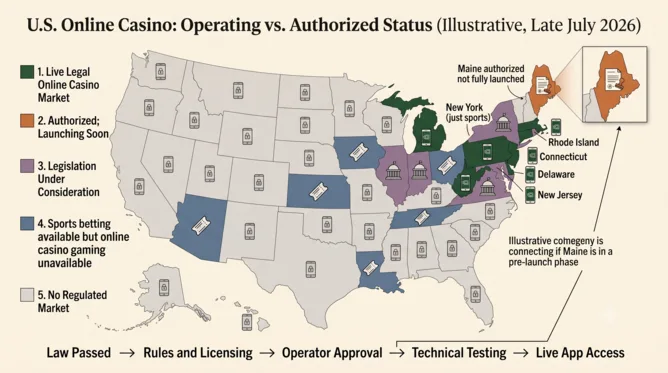
CBS Sports’ July 30, 2026 state-by-state online casino guide said only eight states had legalized real-money online casinos as of July 2026: Connecticut, Delaware, Michigan, New Jersey, Pennsylvania, Rhode Island, Maine, and West Virginia. That list is useful, but players still need to read it carefully. A legal authorization map is not always the same as a live app map, and Maine’s 2026 status shows why that distinction matters for users trying to play on an iPhone today. U.S. online casino map
For slotonlinecasinosios.com readers, the takeaway is practical. The first question should not be which national brand has the best-looking app. The first question should be whether licensed real-money casino apps are legal and live in the user’s state. After that, players can compare app speed, payout clarity, slot libraries, responsible gambling tools, payment methods, and customer support.
Why Online Casino Maps Matter More Than Brand Recognition
National casino brands create the impression of broad access. They advertise across sports broadcasts, app stores, search results, social media, and affiliate comparison pages. A player in Florida, Texas, California, or Georgia may see familiar names and assume that a real-money casino app is available in the same way mobile sports betting or social casino products appear.
That assumption is risky. Real-money online casino gaming has grown more slowly than online sports betting. Sportsbook apps are available in many more states, but online casino apps remain concentrated in a smaller group of markets. A sportsbook app that works in one state does not automatically unlock slots, blackjack, roulette, live dealer games, or video poker in that same state.
Casino.org’s July 31, 2026 legal guide makes the live-market distinction clear: real-money online casino games are legal in seven live states today — New Jersey, Pennsylvania, Michigan, West Virginia, Connecticut, Delaware, and Rhode Island — with Maine legalized and launching next. U.S. online gambling laws
That is the difference iPhone players need to understand. A map that says “legalized” can include states that passed a law but still need rules, licensing, technical approvals, operator launches, or tribal-market implementation. A map that says “live” tells players where real-money casino apps are actually operating today.
The stronger casino app review starts with that distinction. Brand recognition can help users identify operators, but state access decides whether the app can legally offer real-money casino games at all.
How Live States Shape The iPhone Casino Experience
Legal online casino states do not all work the same way. New Jersey and Delaware launched early in 2013. Pennsylvania followed in 2019. West Virginia launched in 2020. Michigan and Connecticut launched in 2021, and Rhode Island added online casino gaming in 2024. Each market has its own regulator, approved operators, tax structure, platform rules, and responsible gambling requirements.
That means an iPhone casino app may feel different from state to state, even under the same national brand. A player may see different games, different payment methods, different withdrawal options, different bonus terms, and different account-control tools depending on location. App-store branding can look national, but the product behind the login is local.
The American Gaming Association’s State of the States 2026 report shows why those local markets matter. Internet gaming revenue across the seven states with lawful online casinos exceeded $10 billion in 2025, reaching a record $10.73 billion after 27.6% year-over-year growth. Michigan, New Jersey, and Pennsylvania accounted for nearly 90% of the nationwide iGaming total. State of the States 2026
That concentration explains why online casino maps are more useful than national brand lists. The strongest iGaming markets are not spread evenly across the country. They are clustered in a few states with mature regulatory systems and active operator competition.
For iPhone users, that affects every part of the app experience. Geolocation must confirm the player is inside a legal state. Account verification must satisfy local rules. Payment methods must match state and operator policies. Responsible gambling tools must follow state requirements. A large national brand cannot override those local conditions.
Why Maine Shows The Problem With Simple Legal-State Lists

Maine is the clearest reason online casino maps need careful wording in July 2026. Some guides list Maine among states that have legalized online casino gaming. Other guides separate Maine from the seven live markets and describe it as authorized but not yet fully launched.
That matters because an iPhone player does not need an abstract policy label. They need to know whether a real-money casino app can be used today. If a state is legalized but not live, users should not expect the same app access they would see in New Jersey, Michigan, Pennsylvania, Connecticut, West Virginia, Delaware, or Rhode Island.
Action Network’s July 31, 2026 legal online casino tracker listed Connecticut, Delaware, Maine, Michigan, New Jersey, Pennsylvania, Rhode Island, and West Virginia as legal U.S. online casino states, and identified Illinois, Indiana, Massachusetts, Maryland, New York, and Virginia as states with legislation under consideration. legal online casino states
That kind of map is useful for tracking policy momentum, but casino app readers need an extra layer. They need to know whether a state is live, pre-launch, under consideration, or fully prohibited. Without that context, a national brand can look more accessible than it really is.
| State Status | What It Means For iPhone Casino Players | What To Check Before Downloading |
|---|---|---|
| Live Legal Market | Real-money casino apps are operating under state rules | Licensed operators, payment methods, app ratings, and withdrawal rules |
| Authorized But Pre-Launch | Law exists, but apps may not be live yet | Launch timeline, regulator rules, and approved operators |
| Legislation Under Consideration | Lawmakers are debating possible iGaming rules | Bill status, committee movement, and regulator statements |
| Sportsbook-Only Market | Sports betting may be legal, but casino games may not be | Product type inside the app |
| No Legal iCasino Market | Real-money casino apps are not authorized | Avoid claims of broad access or app-store confusion |
That table is more useful than a brand-only ranking. A major operator may appear in several categories, but the state status determines what the user can actually do.
Why State Access Comes Before Casino App Rankings
Casino app rankings are still valuable. They help users compare app stability, slot libraries, withdrawal speed, banking options, geolocation performance, and customer support. The problem starts when rankings ignore location or suggest that a single national list applies the same way everywhere.
A July 2026 app ranking might name well-known casino brands, but those brands can only offer real-money casino games where authorized. A player in New Jersey may compare several legal apps. A player in Michigan may see a different mix. A player in Pennsylvania may have a broader operator menu but different rules. A player in California or Texas may see casino-style products, social casino apps, or sweepstakes-style platforms without the same regulated real-money iCasino structure.
That is why the recent slotonlinecasinosios.com discussion of iPhone casino payouts fits this topic. Payout speed is an important ranking factor, but it only matters after state access is confirmed. A fast-withdrawal casino app is useful only in a state where the operator can legally offer real-money casino play.
Players should read rankings in this order: state access first, licensed operator second, app performance third, payout rules fourth, game library fifth, bonuses last. That order protects users from choosing an app based on brand familiarity or bonus language before confirming whether the product is legal and available in their location.
Why Sports Betting Expansion Can Confuse Casino Players
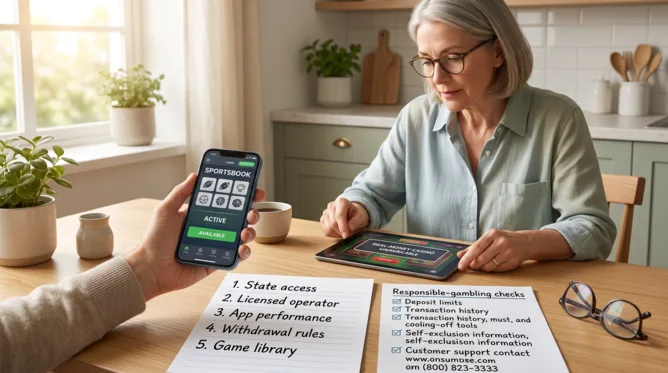
Sports betting expansion has made online gambling feel more national than online casinos really are. Many users now recognize sportsbook brands from professional sports coverage, World Cup advertising, NFL broadcasts, NBA integrations, and app-store charts. That familiarity can blur the line between sportsbook access and online casino access.
The two markets are different. Online sports betting is live in far more states than real-money online casino gaming. A brand may legally offer sports betting in one state and casino games in another. A user may have a sportsbook account and still lack legal access to slots or live dealer blackjack in the same location.
That difference is especially important on mobile. Apps may use one brand umbrella, one login system, or similar marketing language. A user might see a casino tab, casino-style content, or promotional copy in search results, but state rules determine whether real-money casino games are available.
A clear online casino map protects users from that confusion. It separates legal online casino states from sportsbook-only states. It distinguishes live casino apps from pre-launch legislation. It helps players understand why the same national brand can offer different products in different places.
For iPhone casino content, that distinction should appear early. A guide that starts with brand ranking but delays the legal-state explanation may leave users with the wrong impression.
Why Responsible Gambling Tools Depend On State Rules
State access does not only decide whether a casino app can launch. It can shape responsible gambling protections, self-exclusion systems, deposit limits, advertising rules, and helpline visibility. That means state maps are also player-protection maps.
The National Council on Problem Gambling announced in January 2026 that 1-800-MY-RESET is the National Problem Gambling Helpline number, with existing access points such as 1-800-522-4700 remaining active. NCPG says broader adoption and promotion of 1-800-MY-RESET will vary by jurisdiction because of state-level regulatory requirements and policies. National Problem Gambling Helpline
That state-level variation matters inside casino apps. A responsible gambling page may look different depending on the state. A self-exclusion tool may connect to a specific regulator. A deposit-limit rule may have different timing or cooling-off requirements. A helpline label may vary by jurisdiction.
For iPhone users, responsible gambling tools should be part of the app comparison after access is confirmed. A legal casino app should make limits, time reminders, cooling-off tools, self-exclusion information, transaction history, and support resources easy to find. A national brand does not excuse weak placement of safety tools.
State-based regulation also explains why app reviews should avoid blanket claims. The same operator may support different account tools or terms across markets. A good review should say where the app is available and what users should confirm in their own state.
Why Broader Online Gambling Sites Need Cleaner Labels
Online casino maps also help users separate licensed casino apps from broader gambling sites. Search results can mix regulated casino apps, sportsbooks, poker sites, social casinos, sweepstakes casinos, prediction markets, fantasy sports platforms, and offshore gambling pages. Those categories do not operate under the same rules.
A licensed real-money casino app in New Jersey or Michigan is not the same product as a social casino available nationwide. A sweepstakes-style casino is not the same as a state-regulated iGaming app. A prediction market is not a mobile slot app. A sportsbook app is not automatically a casino app.
This is where state maps and product labels work together. The map tells users where legal online casino access exists. The product label tells users what kind of app they are opening. Both steps are necessary before comparing national brands.
For slotonlinecasinosios.com, that should remain a core editorial standard. Articles about casino app rankings, mobile slots, payouts, bonus terms, and responsible play should make clear whether the subject is a licensed real-money casino app, a broader online gambling site, or another digital gaming format.
What iPhone Players Should Do Before Comparing Brands
A safe iPhone casino comparison starts with state access. Players should confirm whether real-money online casino gaming is live in their state, then check the regulator or trusted legal tracker for approved operators. After that, they can compare app quality.
The next step is to review the app’s account system. Does it clearly explain deposits and withdrawals? Does it show transaction history? Does it separate cash and bonus balances? Does it provide support access? Does geolocation work reliably? Are responsible gambling tools visible from the cashier and account areas?
Game libraries still matter, but they should come after these checks. A large slot library is useful only when the app is legal, licensed, stable, clear about payments, and serious about account controls. A famous brand is useful only when that brand is authorized to operate in the user’s state.
That is why today’s U.S. online casino maps still matter. They turn a broad national market into a state-by-state reality. For iPhone players, that map is the first filter. Brand comparison comes later.
Why State Access Still Defines U.S. Casino Apps
The U.S. online casino market in July 2026 is growing, but it is not national. Legal access remains state-based, live app availability remains limited, and player protections vary by jurisdiction. National brands may make the market look uniform, but the app experience still depends on local law.
Online casino maps help iPhone players avoid the biggest mistake in app comparison: assuming a familiar brand equals legal casino access everywhere. It does not. The better approach is to check the state, confirm the operator, review the app’s banking and account controls, and then compare games or bonuses.
For U.S. iPhone casino users, state access still matters more than national casino branding. The map decides where the real comparison begins.
Leave a Reply