

Michigan, New Jersey, and Pennsylvania still define the U.S. mobile casino app market because they are not just three large iGaming states. They are the places where legal online casino apps are being tested at the highest scale, with real players comparing slot libraries, live dealer tabs, payout timing, cashier design, account limits, geolocation, and responsible gambling tools on iPhone screens every day.
The numbers explain why these states matter. The American Gaming Association’s State of the States 2026 report said internet gaming revenue across the seven lawful online casino states exceeded $10 billion in 2025, reaching a record $10.73 billion after 27.6% year-over-year growth. The same report said Michigan, New Jersey, and Pennsylvania continued to account for nearly 90% of nationwide iGaming revenue. State of the States 2026
For slotonlinecasinosios.com readers, that concentration is a product signal. When three states carry most of the legal iGaming market, their app standards become national reference points. The best iPhone casino apps are no longer judged only by how many games they list. They are judged by how well they manage access, payments, identity checks, responsible gambling controls, and user trust.
Why The Big Three Still Shape Legal iGaming
Michigan, New Jersey, and Pennsylvania are different markets, but together they show what mature mobile casino competition looks like. New Jersey has the oldest large-scale online casino market among the three. Pennsylvania has become one of the highest-revenue states. Michigan has grown into a major app-driven iGaming market with commercial and tribal operators.
June 2026 showed the scale clearly. Michigan reported $301.2 million in iGaming gross receipts, according to the Michigan Gaming Control Board’s July 21 release. Michigan June iGaming revenue New Jersey’s Division of Gaming Enforcement reported $271.0 million in Internet Gaming Win for casinos and their partners in June 2026, up 17.5% from June 2025. New Jersey June gaming revenue Pennsylvania’s Gaming Control Board reported that online casino games generated $242.5 million during June 2026. Pennsylvania June gaming revenue
Those totals show why these states dominate the mobile casino conversation. They are large enough to force operators to improve. A weak cashier, confusing bonus wallet, slow withdrawal explanation, or buried limit tool becomes harder to excuse when a market is producing hundreds of millions of dollars each month.
That is the same pressure described in the site’s recent article about online casino revenue and iPhone app standards. Revenue growth is not only a business story. It raises the standard for the app experience itself.
How Michigan Became A Mobile Casino App Benchmark
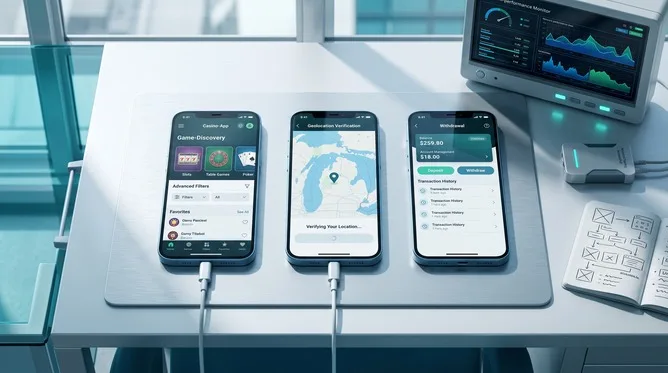
Michigan’s role is important because it combines scale with a broad operator structure. The Michigan Gaming Control Board said commercial and tribal operators reported $341.3 million in combined iGaming and online sports betting gross receipts in June 2026, with iGaming alone at $301.2 million. That makes Michigan one of the clearest examples of how mobile casino apps can become a central gambling product rather than a side channel.
For iPhone users, Michigan matters because the market tests app durability. Operators need stable lobbies, reliable geolocation, clear payment flows, visible responsible gambling tools, and enough game variety to keep users from jumping between brands. The state’s tribal and commercial structure also reminds app users that legal access is local, even when the operator name feels national.
Michigan’s app market also creates a useful standard for game discovery. A large mobile casino lobby can quickly become hard to use if search, filters, favorites, recent-play sections, live dealer tabs, and jackpot categories are not organized well. The iPhone screen makes that challenge sharper because every menu competes for limited space.
A strong Michigan casino app should help users answer practical questions quickly. Which games are available? Which payment methods work? Is the player physically inside the state? Where are the limits? How does the app explain pending withdrawals? When app competition is this large, these questions become ranking factors.
Why New Jersey Still Defines Mature iPhone Casino Competition

New Jersey remains a key mobile casino benchmark because it has years of online casino history and a dense app market tied to Atlantic City casinos and their partners. The New Jersey Division of Gaming Enforcement reported $271.0 million in Internet Gaming Win for June 2026, compared with $230.7 million in June 2025.
That growth matters because New Jersey is not a new launch market. It is a mature market still expanding. For iPhone casino apps, that means users expect more than basic functionality. They expect smooth navigation, strong game libraries, clear loyalty experiences, quick support, and better payment explanations.
New Jersey also shows how mobile and land-based casino identity can overlap. A user may recognize an Atlantic City casino brand, but the online app experience depends on partners, platform providers, digital wallets, and product design. The brand opens the door. The app decides whether the player can move through games, banking, limits, and account settings without confusion.
New Jersey’s maturity also makes payout clarity more important. Users in a mature app market are more likely to compare operators by cashout timing, payment method reliability, and account history. A large slot catalog may be expected. A clean cashier can become the real difference.
Why Pennsylvania Puts Cashier And Safety Design Under Pressure
Pennsylvania helps define the market because it combines large revenue with an active regulatory conversation. The Pennsylvania Gaming Control Board reported $242.5 million in online casino revenue for June 2026, with iGaming tax revenue of more than $111.3 million for the month.
That kind of scale makes app design a public-policy issue. Pennsylvania is not only asking whether online casino apps can produce revenue. It is asking how those apps should handle credit, self-exclusion, responsible gambling language, interactive gaming player accounts, and marketing controls.
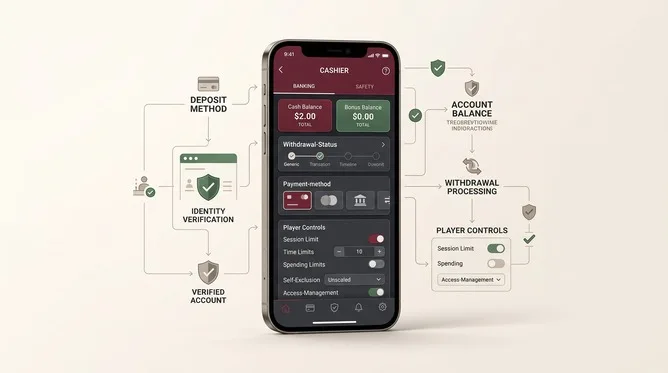
For iPhone users, Pennsylvania’s role is useful because it highlights the cashier. Casino app banking is no longer a background feature. It is where deposits, withdrawals, identity checks, bonus balances, payment restrictions, and responsible gambling tools all meet. If the cashier is unclear, the entire product feels weaker.
Pennsylvania also shows why state-specific rules matter. A national brand may operate in several states, but the rules around payment methods, responsible gambling wording, self-exclusion, and account controls can differ. An iPhone casino app needs to make those differences clear without overwhelming the user.
What The Big Three Teach About iPhone Casino UX
Michigan, New Jersey, and Pennsylvania show that mobile casino UX is no longer only about fast game loading. The strongest apps have to handle a full account experience.
| Market Lesson | Why It Matters For iPhone Casino Apps | What Players Should Compare |
|---|---|---|
| Michigan Shows Scale | Large monthly iGaming receipts test app stability | Geolocation, game discovery, payment flow, and support |
| New Jersey Shows Maturity | Older online casino markets create higher user expectations | Payout clarity, loyalty design, brand trust, and app navigation |
| Pennsylvania Shows Regulation | Big revenue brings closer review of account controls | Limits, self-exclusion, cashier transparency, and responsible gambling tools |
| All Three Shape National Standards | Most U.S. iGaming revenue comes from these states | State access, licensed operators, app safety, and withdrawal rules |
This table is useful because it separates the three markets by function. Michigan tests scale. New Jersey tests maturity. Pennsylvania tests compliance and account design. Together, they define what a strong mobile casino app should look like in 2026.
Why State Access Still Comes Before Brand Recognition
The dominance of Michigan, New Jersey, and Pennsylvania can make U.S. online casino gaming look broader than it is. That is a mistake. Legal online casino access remains state-based. A user in one of these states may have several regulated iPhone casino options. A user in a state without legal iGaming may see social casino apps, sweepstakes-style products, offshore sites, or sportsbook products instead.
The AGA report said seven states had lawful online casino markets in 2025, while Maine became the only state to pass legislation legalizing iGaming in 2025, with that legislation becoming law in early 2026. That means national app branding still needs state-level context.
For iPhone casino players, the review order should be simple. Confirm state access first. Confirm the licensed operator second. Review cashier and account tools third. Compare game libraries fourth. Consider bonuses last.
This order protects users from treating a familiar brand as proof of legal access. It also keeps app rankings honest. A strong casino app in Michigan may not be available in the same way in another state. A well-known operator may offer sportsbook products in more markets than online casino games. The product label matters.
Why Game Libraries Matter Less Without Cashier Clarity
Mobile slots, live dealer games, blackjack, roulette, baccarat, video poker, and jackpot titles remain central to iPhone casino apps. Players still care about game variety. Yet game libraries are less useful if the app does not handle money and account controls clearly.
The big three states show why. When Michigan, New Jersey, and Pennsylvania produce hundreds of millions in monthly online casino revenue, operators cannot rely on a crowded slot lobby alone. They need cashier systems that explain deposit methods, withdrawal timing, pending balance status, bonus balances, and account verification.
A casino app can offer hundreds of slots and still feel unreliable if a player cannot understand how to cash out. A live dealer section can look polished and still feel weak if limits are hidden. A bonus can look appealing and still create frustration if wagering rules are hard to find.
The strongest iPhone casino apps treat the cashier as part of UX, not a separate banking page. Players should be able to see how funds move, where limits live, what is withdrawable, and when support is available.
Why Responsible Gambling Tools Are Now Part Of Market Leadership
The big three states also set the standard for responsible gambling visibility. Large legal markets need more than a helpline footer. They need account-level controls that users can find during real sessions.
The National Council on Problem Gambling adopted 1-800-MY-RESET as the National Problem Gambling Helpline number in 2026 and said education and awareness efforts around that number will continue through 2026 and 2027. National Problem Gambling Helpline NCPG’s Internet Responsible Gambling Standards include recommendations involving informed decision-making, assisting players, self-exclusion, advertising and promotion, game and site features, and research. Internet Responsible Gambling Standards
For iPhone casino apps, those standards point to practical design choices. Deposit limits should not be hidden. Time reminders should be easy to understand. Self-exclusion should use clear language. Marketing controls should be accessible. Support links should appear near account and cashier tools.
Michigan, New Jersey, and Pennsylvania are large enough that these features should become competitive standards. A casino app that makes game access easy but makes account control difficult is not leading the market. It is falling behind the market’s own maturity.
Why Smaller States Still Matter, But Follow Different Signals
Delaware, Rhode Island, Connecticut, and West Virginia also matter to U.S. iGaming, but they do not define the mobile casino app market at the same scale as Michigan, New Jersey, and Pennsylvania. Smaller states can show growth, policy differences, or launch lessons, but the big three remain the primary benchmark for app quality because of revenue volume and operator competition.
That does not mean smaller states are unimportant. They can test different regulatory models, operator structures, and responsible gambling requirements. They can show how apps work in smaller legal markets. They can also influence state-by-state access maps.
Still, when app reviewers want to understand what a strong U.S. iPhone casino product should include, the most useful signals come from the states where the market is deepest. Michigan, New Jersey, and Pennsylvania show how apps behave when legal demand is large, competition is high, and users have enough choices to compare quality.
Why These Three States Still Set The App Standard
Michigan, New Jersey, and Pennsylvania continue to define the U.S. mobile casino app market because they combine scale, maturity, and regulatory pressure. Michigan shows how large app-driven iGaming can become. New Jersey shows how a mature market can keep growing. Pennsylvania shows why cashier clarity and responsible gambling design matter when revenue and regulation meet.
For iPhone casino players, these states provide the clearest checklist. A strong app should verify state access cleanly, organize games well, explain banking, display limits, support responsible gambling tools, and make withdrawals understandable. A weak app may still have recognizable branding and a large slot library, but that is no longer enough.
The U.S. mobile casino market is not national in the way app-store branding can make it appear. It is still state-based. Yet the standards are being set by the markets with the most pressure. In 2026, that still means Michigan, New Jersey, and Pennsylvania.
Leave a Reply