
Maine’s move toward regulated online casino gaming could become one of the most important changes in the U.S. iGaming market because it expands the map while reinforcing a trend that has defined American iGaming from the beginning: access depends on state rules, not national brand recognition.
In January 2026, Maine Gov. Janet Mills allowed LD 1164, the “An Act to Create Economic Opportunity for the Wabanaki Nations Through Internet Gaming,” to become law. The legislation authorizes Maine’s tribal governments to operate online gambling as part of economic development efforts for Wabanaki Nations.
For iPhone casino users, Maine matters because it changes how people understand legal casino apps in the United States. A national operator’s name does not automatically mean national access. A player may recognize Caesars, DraftKings, BetMGM, FanDuel, or another major brand, but the available casino products depend on state authorization, licensing, platform approval, and physical location.
Maine’s arrival also shows why online casino maps need more detail. A state can move from legislation to regulation to launch preparation over several stages. The difference between “legalized,” “licensed,” and “live” matters when someone is searching for an iPhone casino app.
Why Maine Expands The U.S. Online Casino Conversation
Before Maine’s legislation, the U.S. online casino market was concentrated in a small group of states. New Jersey, Delaware, Pennsylvania, Michigan, Connecticut, Rhode Island, and West Virginia built regulated iGaming markets with different operator structures, tax systems, and platform rules.
Maine adds a new model because LD 1164 gives exclusive online gaming rights to the state’s federally recognized Wabanaki Nations. The Maine Legislature lists the bill as enacted, with the law titled “An Act to Create Economic Opportunity for the Wabanaki Nations Through Internet Gaming”
That structure creates a different path compared with states where commercial casino companies dominate online casino launches. The four federally recognized Wabanaki Nations — the Passamaquoddy Tribe, Penobscot Nation, Houlton Band of Maliseet Indians, and Mi’kmaq Nation — gained a central role in Maine’s online gaming framework.
For mobile casino users, that means the app landscape may look different from larger markets such as New Jersey or Pennsylvania. Instead of dozens of commercial casino brands competing immediately, Maine’s market is shaped by tribal partnerships, state regulation, approved suppliers, and launch timing.
That difference matters because many online casino guides focus heavily on brands. Maine shows why the better question is not “Which national casino app is the biggest?” The better question is “Which licensed apps are available in this state?”
Why Legal Does Not Always Mean Live On iPhone
One of the biggest sources of confusion in U.S. online casino coverage is the difference between legalization and active availability.
A state can approve online casino gaming and still require months of regulatory work before consumers can download an app, create an account, complete identity verification, and play real-money games. Licensing rules, technical standards, geolocation systems, testing requirements, and responsible gambling programs all need to be completed before launch.
Maine’s Gambling Control Unit is responsible for administering and enforcing internet gaming rules, including licensing internet gaming operators, mobile operators, suppliers, management services, and employees.
Industry reporting in July 2026 noted that Maine’s legal framework was moving toward launch but that consumer-facing platforms were still dependent on regulatory preparation and operator partnerships. Caesars Entertainment announced expanded partnerships with three Wabanaki Nations — the Houlton Band of Maliseet Indians, Mi’kmaq Nation, and Penobscot Nation — for a planned Maine online casino launch that could include Caesars Palace Online Casino, Caesars Sportsbook & Casino, and Horseshoe Online Casino pending approvals.
For iPhone users, that creates a simple rule: check the launch status, not only the legal status.
| Online Casino Map Status | What It Means For iPhone Players | What To Verify |
|---|---|---|
| Legal And Live | Real-money casino apps are operating | Licensed operators, payment methods, app availability |
| Legal But Preparing Launch | Law exists but apps may not be available yet | Regulatory timeline and operator announcements |
| Under Consideration | Lawmakers are reviewing proposals | Bill status and state decisions |
| Not Authorized | Real-money casino apps are not permitted | Avoid assuming national brand access |
This distinction is becoming more important as more states consider iGaming expansion.
How Maine Could Change Casino App Competition
Maine’s launch could create a new test for casino app competition. In mature markets, operators compete through game libraries, promotions, loyalty programs, payouts, and brand recognition. Maine adds another factor: partnership structure.
Tribal gaming relationships have always played a major role in U.S. gambling regulation. Maine’s online casino model highlights how digital gaming expansion can connect technology companies with tribal economic development goals.
A successful Maine launch could influence future states that are considering online casino legislation. Lawmakers may look at how tribal exclusivity, tax structures, consumer protections, and operator partnerships work together.
The American Gaming Association’s State of the States 2026 report shows why states continue examining iGaming opportunities. Internet gaming revenue across the seven states with lawful online casinos exceeded $10 billion in 2025, reaching $10.73 billion after 27.6% year-over-year growth. Pennsylvania, Michigan, and New Jersey remained the largest contributors.
Maine enters that conversation as a smaller market, but its structure could become a reference point for future expansions.
Why National Casino Brands Still Need Local App Strategies
Maine also reinforces a lesson that applies across the U.S. casino market: national brands need local strategies.
A company may operate casino apps in multiple states, but each market can have different:
- Approved games
- Payment options
- Responsible gambling requirements
- Marketing rules
- Licensing relationships
- Account verification processes
That means the same casino brand may offer a different iPhone experience depending on where the player is located.
A user in New Jersey may see a mature market with many options. A user in Maine may see a smaller selection connected to tribal partnerships. A user in a state without legal iCasino may see social casino products or other gaming formats instead of regulated real-money apps.
That is why state access should come before app rankings. The best casino app is not the same everywhere because the legal environment changes the product.
The same principle appeared in the previous discussion about U.S. online casino maps and state access. Maine continues that conversation by showing how quickly the map can evolve.
Why iPhone Casino Players Need Better State Awareness
Mobile casino users often search by brand name. They may look for a familiar operator, download an app, and expect the same experience they see advertised nationally. U.S. iGaming does not work that way.
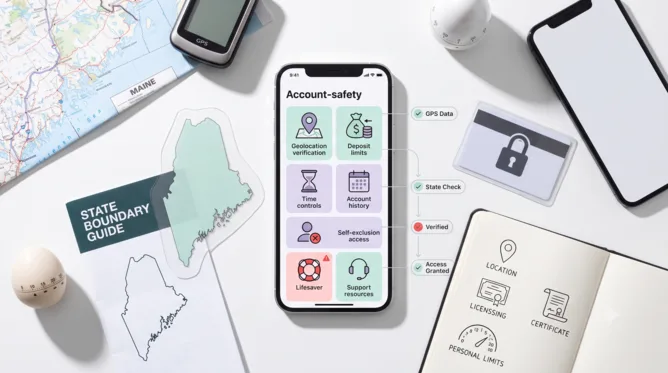
Geolocation is one of the biggest reasons. Legal casino apps verify where the player is physically located, not simply where they live. A person who lives in a legal state may lose access when traveling to a state without legal online casino gaming.
That makes state awareness a core part of mobile casino education. Before comparing games, users need to understand:
- Whether online casino gaming is legal where they are located
- Whether the market is live
- Which operators are approved
- What responsible gambling tools are available
- What payment and verification rules apply
Maine’s launch process shows why these questions matter.
How Responsible Gambling Tools Fit Into Maine’s Expansion
New online casino markets are judged by more than revenue. They are judged by consumer protections, account controls, and responsible gambling infrastructure.
The National Council on Problem Gambling says 1-800-MY-RESET is the National Problem Gambling Helpline number, providing free and confidential support through a nationwide network of contact centers. Existing access points, including 1-800-522-4700, remain available.
For iPhone casino apps, responsible gambling tools should be part of the main account experience. Players should be able to find deposit limits, time limits, self-exclusion information, account history, and support resources without searching through complicated menus.
Maine’s approach will likely be watched closely because the state is launching a regulated market with a strong emphasis on tribal participation and state oversight. The quality of the final app experience will depend on how well technology, regulation, and user protection work together.
Why Maine Could Become A Blueprint For Future iGaming States
Maine’s online casino launch is important because it adds another chapter to the U.S. iGaming map. It does not erase the state-by-state nature of online casinos. It strengthens it.
For iPhone casino users, the biggest lesson is simple: the brand on the screen is only part of the story. The state behind the app determines whether the product exists, which rules apply, which payments are available, and what protections are required.
As more states consider online casino expansion, users will need better maps, clearer app guides, and more accurate explanations of legal access. Maine’s entry could influence future markets, but the state-by-state model will remain the foundation of U.S. online casino gaming.
Leave a Reply