

The National Football League (NFL) has entered a major legal battle over the future of sports-related prediction markets in the United States, urging the U.S. Supreme Court to review whether platforms such as Kalshi should be governed by state gambling laws or federal financial-market regulations.
On October 8, 2026, the NFL filed a friend-of-the-court brief supporting New Jersey’s request for Supreme Court review in Flaherty v. KalshiEX, LLC, docket No. 26-299. The league argues that sports-event contracts offered through prediction markets function as gambling products rather than conventional financial swaps and should not automatically escape state-level gambling oversight.
The dispute comes as prediction markets expand across American sports, offering contracts linked to game winners, player performance, and other sporting outcomes. The outcome could affect how these products operate, which safeguards platforms must provide, and how their regulatory status differs from that of licensed online sportsbooks.
For readers following the U.S. online gambling industry, the case represents an important development in the ongoing debate over sports betting, consumer protection, and the division of regulatory authority between Washington and individual states.
Why the NFL Is Challenging Prediction-Market Sports Betting
The NFL’s legal position centers on how sports-event contracts should be classified under federal law. Platforms such as Kalshi argue that contracts listed on federally regulated exchanges fall under the jurisdiction of the Commodity Futures Trading Commission (CFTC). The NFL, by contrast, maintains that contracts tied directly to sporting outcomes resemble wagers and should be subject to state gambling regulations.
The distinction is significant because licensed sportsbooks generally operate under state-specific requirements covering matters such as age eligibility, prohibited wagers, responsible gambling, and monitoring for suspicious activity. Prediction-market operators have argued that their federal regulatory framework provides a different legal basis for offering event contracts.
In its October 8 brief, the NFL warned that the existing uncertainty creates risks for sports integrity and consumers. The league also criticized the level of oversight applied to sports-related prediction markets, arguing that protections should be comparable to those expected of traditional legal sports betting operators.
The NFL is not simply asking whether consumers should be allowed to predict sporting outcomes. The central question is whether companies offering contracts tied to those outcomes can rely on federal derivatives law to avoid certain state gambling restrictions.
That question has significant consequences for the wider gambling industry. If states retain authority over these products, prediction-market operators could face licensing requirements and restrictions similar to those imposed on sportsbooks. If federal law preempts state rules in this context, the regulatory structure could look substantially different.
The Supreme Court Case: Flaherty v. KalshiEX
The case stems from a dispute between New Jersey gambling regulators and Kalshi over the company’s ability to offer sports-related event contracts to customers in the state without complying with its sports wagering laws.
The U.S. Court of Appeals for the Third Circuit previously ruled in Kalshi’s favor, concluding that the contracts at issue fell within the federal derivatives framework and that relevant state restrictions were preempted. New Jersey officials subsequently asked the Supreme Court to review that decision. The NFL’s October 8 filing supports their request.
The case has become more significant because other federal appeals courts have reached different conclusions.

- Third Circuit: Ruled in Kalshi’s favor in its dispute with New Jersey.
- Sixth Circuit: Ruled against Kalshi in a September 25, 2026, decision involving Ohio and Tennessee.
- Ninth Circuit: Also issued rulings rejecting Kalshi’s position in related litigation involving state gambling laws.
These conflicting decisions have created a legal divide over whether sports-event contracts qualify as financial swaps under federal law and whether states can regulate them as gambling.
The Supreme Court has not yet ruled on the merits of the dispute. As of October 16, 2026, the immediate question is whether the justices will agree to hear New Jersey’s appeal, not whether Kalshi’s entire business model is lawful or unlawful nationwide.
Reuters reported that Kalshi had until November 9, 2026, to respond to the petition and that a decision on whether to take up the case was not expected before December. Those dates concern the pending petition and should not be confused with a final ruling on the underlying legal questions.
Why Sports Betting Volume Matters to the NFL
The NFL’s concerns come as prediction markets attract substantial trading activity tied to professional football.
In its Supreme Court brief, the league stated that on the first Sunday of the 2026 NFL season, $1.8 billion of $3.3 billion in total prediction-market trading volume was tied to NFL events. That means NFL-related contracts represented more than half of the reported volume for that day.
The NFL also cited figures showing that trading volume across CFTC-registered prediction markets exceeded $25 billion in 2025. The league’s brief referenced a separate figure of more than $173 billion in overall Kalshi trading volume by late August 2026. These are trading-volume figures, not company revenue, profit, or the amount of money users necessarily lost.
Prediction-market figures cited by the NFL
NFL-related volume, first Sunday
$1.8B
All prediction-market volume that day
$3.3B
Registered-market volume in 2025
$25B+
Kalshi volume by late August 2026
$173B+
Figures cited in the NFL’s October 8, 2026, Supreme Court brief. The time periods and measures differ, so they should not be compared as equivalent revenue figures.
The scale of activity helps explain why sports leagues are paying closer attention to prediction markets. When large volumes of contracts depend on individual games or player performances, leagues have an interest in ensuring that suspicious trading can be detected and that participants cannot exploit confidential information.
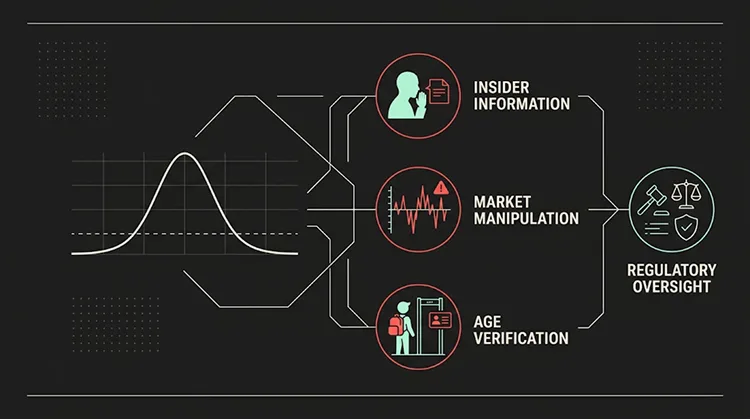
The NFL’s position is that comparable safeguards should apply regardless of whether a sports-related product is offered through a traditional sportsbook or a federally regulated prediction-market exchange.
The NFL’s Concerns: Consumer Protection and Game Integrity
The NFL has identified several safeguards it wants prediction-market operators and federal regulators to adopt. These include restrictions on wagers susceptible to manipulation, protections against trading by people with insider information, and a minimum age of 21 for sports-related contracts.
The age issue is particularly important because traditional sportsbooks in many U.S. jurisdictions require customers to be at least 21, while prediction-market platforms may operate under different eligibility rules. The NFL argues that inconsistent requirements create gaps in consumer protection.
Another concern involves contracts tied to highly specific events within a game. Markets focused on individual plays or player statistics can raise different integrity questions from contracts simply asking which team will win. The league argues that some event contracts may be more vulnerable to manipulation, particularly if a participant has access to nonpublic information or can influence the outcome.
The NFL also maintains that state gambling regulators have established systems for monitoring suspicious wagering activity, coordinating with sportsbooks, and sharing information relevant to game integrity. It questions whether the CFTC currently has the same specialized resources and enforcement structure for sports-related contracts.
The CFTC disputes the suggestion that cooperation has been absent. In a statement reported by Reuters, the agency said it had engaged with the NFL and noted that the league declined to sign a proposed memorandum of understanding intended to facilitate information sharing.
That disagreement illustrates a central feature of the case: the dispute is not only about which laws apply, but also about which regulatory framework can provide effective protections as sports-related trading expands.
What the Case Could Mean for Online Sports Betting
The Supreme Court dispute could have consequences well beyond New Jersey.
If the justices ultimately uphold a framework that permits states to regulate sports-event contracts, prediction-market platforms could face more state-specific restrictions, licensing obligations, and compliance requirements. Their ability to offer certain contracts could vary by jurisdiction.
If federal oversight is found to preempt relevant state gambling laws, prediction-market operators could gain a stronger basis for offering sports-related contracts across state lines under the federal derivatives framework. That outcome could intensify competition with established sportsbook brands, although it would not automatically exempt every product from every applicable law.

For operators such as DraftKings and FanDuel, the case could influence the competitive environment in which traditional sportsbooks operate. However, the exact commercial effects would depend on the Court’s reasoning, future regulatory decisions, and the products ultimately permitted.
For consumers, the most immediate issue is uncertainty. A product available in one state may be restricted in another, and a platform’s description of its regulatory status does not replace checking the current rules that apply to a specific location.
The case also highlights the importance of understanding the difference between a conventional sports wager and an event contract. Although both may involve predicting the outcome of a game, they can have different legal structures, settlement mechanisms, and regulatory requirements.
What Happens Next in the Kalshi Supreme Court Dispute?
As of October 16, 2026, the Supreme Court has not announced whether it will hear Flaherty v. KalshiEX, LLC.
The next procedural milestone is Kalshi’s response to New Jersey’s petition, due November 9, according to Reuters. The justices could subsequently decide whether to grant review, reject the petition, or take additional procedural steps. A decision to hear the case would not itself determine which side ultimately prevails.
In the meantime, the legal divide among the federal appeals courts remains important. Different rulings have created uncertainty over how the federal Commodity Exchange Act interacts with state gambling laws when sports-event contracts are offered on federally regulated exchanges.
For the gambling industry, developments in this case warrant close attention. Future court decisions or regulatory changes could affect product availability, compliance costs, consumer safeguards, and competition between prediction-market platforms and licensed sportsbooks.
Readers should rely on current state regulatory guidance and official court documents rather than assuming that the same rules apply nationwide.
Final Thoughts
The NFL’s October 8, 2026, Supreme Court filing has intensified a major debate over the future of sports-related prediction markets in the United States. The league argues that contracts tied to football games should be treated as gambling products subject to appropriate state oversight, while Kalshi maintains that its federally regulated exchange operates under a different legal framework.
The financial scale is substantial: the NFL’s brief cited $1.8 billion in NFL-related prediction-market trading on the first Sunday of the 2026 season, out of $3.3 billion in total market volume that day. Those figures help explain why questions about regulation, insider trading, and game integrity have become increasingly urgent.
The Supreme Court’s next steps could shape the legal boundaries between financial event contracts and conventional sports betting. Until the case develops further, both operators and consumers face an evolving regulatory environment.
The key takeaway: the dispute is about more than the classification of prediction markets. It concerns who regulates sports-related contracts, which consumer protections apply, and how the United States will oversee a rapidly changing segment of the gambling industry.
Leave a Reply