

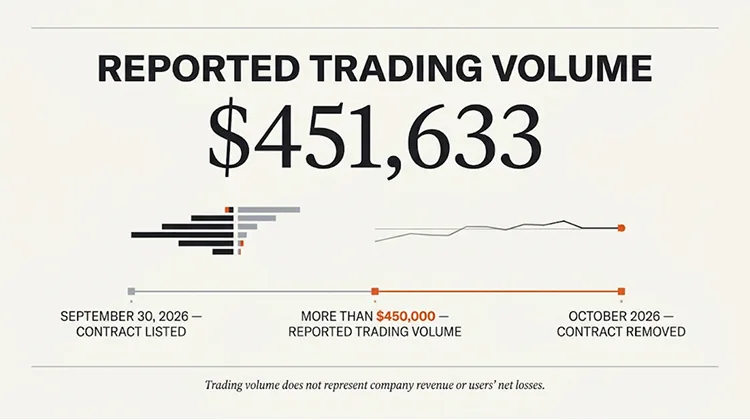
Polymarket has removed a controversial prediction-market contract tied to a sexual-assault case involving students at Cornell University after the market generated more than $450,000 in trading volume and drew widespread criticism over the ethics of allowing users to trade on the possible criminal charges in a serious legal case. The contract appeared on Polymarket’s international platform and was removed following public backlash in October 2026.
The market, launched on September 30, asked whether any of seven men accused in a civil lawsuit connected to an alleged 2024 sexual assault would face felony sex-crime charges by January 31, 2027. The allegations have not been established as facts in a criminal conviction, and the men have denied the accusations.
The episode has renewed scrutiny of prediction-market platforms, which allow users to trade contracts tied to future events. It also raises a difficult question for the online gambling industry: where should companies draw the line between forecasting public events and turning deeply personal legal proceedings into tradable markets?
Why Polymarket Removed the $450,000 Contract
The contract first appeared on September 30, 2026, and was originally scheduled to close on January 31, 2027. Before its removal, it had generated more than $450,000 in trading volume. Front Office Sports reported a specific total of $451,633 and said traders were assigning roughly a 28% probability to the market resolving “yes” at the time of its report.
The market was available on Polymarket’s international platform, not its U.S. app. Its removal followed public criticism that the contract treated a sensitive sexual-assault case as a financial opportunity.
In a statement reported by The Associated Press on October 20, a Polymarket spokesperson said the company’s goal was to provide objective, data-driven insight into important questions. The spokesperson also acknowledged that the market concerned whether authorities would take action in a serious case and said the company had heard the criticism and removed it.
The decision represents a response to public pressure, but it also raises questions about the platform’s internal review standards. Prediction markets can cover politics, economics, sports, and public affairs; determining which events are appropriate for trading becomes more complicated when contracts involve alleged violence, private individuals, or active legal proceedings.
The controversy is not simply about the amount of money traded. Critics argue that offering a market on whether criminal charges will be brought risks turning a potentially traumatic legal process into entertainment or speculation.
The Cornell Case Behind the Controversy
The contract was connected to a civil lawsuit filed on September 16, 2026, by a former Cornell student identified in court documents as Jane Doe. The lawsuit alleges that seven members of the Chi Phi fraternity sexually assaulted or exploited her in October 2024 and that Cornell mishandled the resulting complaints. The accused men have denied the allegations; the civil claims should not be treated as proof of criminal wrongdoing.
The case also developed beyond the civil proceedings. On September 28, Tompkins County District Attorney Matthew Van Houten announced that his office was reopening the criminal investigation after reviewing the lawsuit and speaking with Jane Doe and her attorneys. Van Houten said the case would be prepared for presentation to a grand jury, which would consider the evidence and determine whether an indictment was warranted.
That development helps explain why the market attracted attention. The contract did not merely ask about a distant political or sporting outcome; it assigned tradable probabilities to a possible decision by prosecutors in a highly sensitive case involving identifiable members of a university community.
Cornell has said its own investigation resulted in disciplinary action, including expulsions and suspensions. However, university discipline and criminal prosecution are separate processes with different standards and consequences.
For prediction-market operators, this distinction creates a serious editorial and compliance challenge. A question may concern a real public event, but that does not automatically mean turning it into a financial contract is appropriate—or that the market will avoid public criticism.
Why the International Platform Matters
One important detail is that the controversial contract was listed on Polymarket’s international platform, not its U.S. app. That distinction matters because the company’s U.S. exchange operates under oversight from the Commodity Futures Trading Commission (CFTC), while the international platform is a separate service.
The AP reported that the CFTC-regulated U.S. exchange prohibits trading related to activity that is unlawful under federal or state law. The existence of that restriction does not mean the controversial international contract was offered through the U.S. exchange; reports specifically distinguish the two platforms.
This separation is central to the wider prediction-market debate. Operators may offer different markets, controls, and access rules depending on the platform and jurisdiction. Consumers should not assume that every contract visible on an international service is available to U.S. customers or is governed by identical rules.
The controversy also illustrates a limitation of relying solely on formal market rules. Even if a contract is technically listed on a particular platform, operators may still face reputational pressure to remove it when its subject matter involves alleged violence, personal trauma, or a sensitive legal proceeding.
Celebrity Endorsements Bring More Scrutiny to Polymarket
The controversy quickly expanded beyond the contract itself to Polymarket’s public image and commercial partnerships.
The Associated Press reported that criticism was directed at several celebrities associated with the platform, including NBA star LeBron James and former professional athletes Derek Jeter, Eli Manning, and Sue Bird. The figures have appeared in promotional activity for Polymarket, and the controversy prompted questions about whether endorsers should remain associated with the company.
Advocacy organization UltraViolet also launched a petition calling on celebrity endorsers to cut ties with Polymarket. Critics argued that a contract tied to a sexual-assault case was degrading and inappropriate, while the company initially defended the market as a way to assess whether authorities would take action before ultimately removing it.
This creates a business risk that extends beyond trading volume. Celebrity partnerships can help prediction markets reach mainstream audiences, but they also expose sponsors and commercial partners to reputational consequences when a platform hosts controversial contracts.
For companies seeking partnerships with professional sports leagues, athletes, and entertainment figures, the episode highlights the importance of clear policies governing sensitive markets. Sponsors may increasingly want to know how a platform reviews contracts, handles public complaints, and decides when a market crosses an ethical boundary.
What the Controversy Means for Prediction-Market Regulation
Polymarket’s decision to remove the contract does not, by itself, establish that the market violated a law or regulatory rule. The episode instead raises questions about how prediction-market operators determine which events are suitable for trading and how they respond when users, advocacy groups, or the public object.
Several issues are likely to remain important as the industry grows:
- Market approval standards: Platforms may face pressure to introduce clearer restrictions for contracts involving alleged crimes, personal tragedies, or vulnerable individuals.
- Consumer and community protection: Operators must consider how trading activity could affect people connected to the events being discussed, not only whether a contract attracts volume.
- Regulatory differences: International platforms and U.S.-regulated exchanges may operate under different rules and access restrictions.
- Reputational risk: Controversial contracts can attract national attention, threaten sponsorship relationships, and undermine public trust.
- Transparency and accountability: Users and regulators may demand more information about how markets are approved, monitored, and removed.
The incident also raises a broader question about the purpose of prediction markets. Supporters argue that trading prices can aggregate information about future events. Critics counter that some subjects should not be turned into financial speculation, particularly when the people involved have not been convicted of a crime.

The challenge for operators is to establish standards that distinguish useful public forecasting from contracts that create unacceptable ethical or reputational risks.
Final Thoughts: A Warning Sign for the Prediction-Market Industry
Polymarket’s removal of the Cornell-related contract after it generated more than $450,000 in trading volume is a significant example of how public pressure can influence the prediction-market business. The contract was available on the international platform, launched on September 30, and removed in October after criticism over its subject matter.
The case also demonstrates why platform governance cannot be separated from the wider debate about prediction-market regulation. Formal compliance requirements are one part of the issue; ethical decisions about which events should be tradable are another.
For the broader U.S. online gambling industry, the episode could encourage more scrutiny of market approval policies, platform differences, celebrity partnerships, and consumer protections. It does not automatically mean that all prediction markets face new legal restrictions, but it shows how a single contract can trigger a much wider debate about accountability.
The central takeaway: Prediction markets may offer a new way to trade on future events, but growth in trading volume does not guarantee public acceptance. How platforms respond to sensitive cases could shape their reputations—and the industry’s future relationship with regulators, sponsors, and users.
Leave a Reply