

Pennsylvania’s casino industry reached an important milestone in September 2026 as online slot machines generated more revenue than traditional slot machines operating inside the state’s land-based casinos. The development highlights how regulated internet gaming is reshaping one of America’s largest gambling markets, with mobile casino platforms becoming an increasingly important part of the industry’s revenue structure.
Pennsylvania’s September 2026 revenue figures also highlight how the growing popularity of online slots is creating more opportunities for discussion about mobile gaming experiences, platform reliability, and responsible gambling practices. Beyond official regulatory reports, an online slot player community can provide a space for broader conversations about digital gaming trends, although individual opinions should not replace verified licensing information or regulatory guidance. As Pennsylvania’s online slot market continues expanding, understanding both industry performance and consumer perspectives can help readers better evaluate the evolving relationship between traditional casinos and mobile gaming platforms.
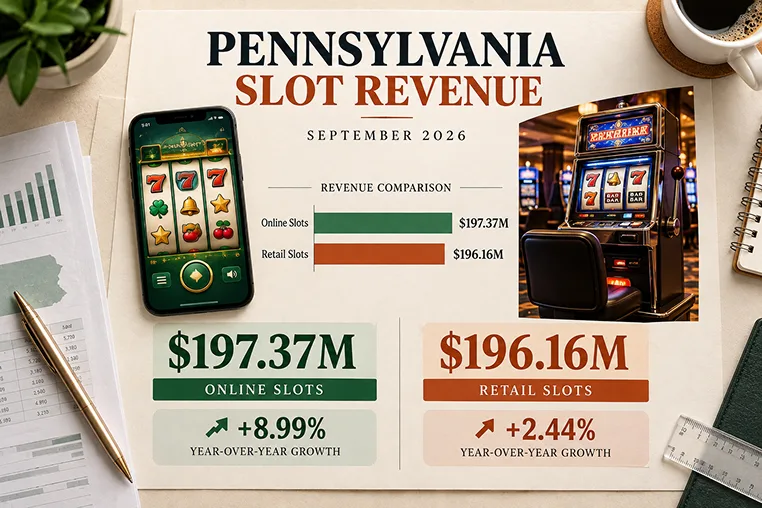
According to figures released by the Pennsylvania Gaming Control Board (PGCB) on October 19, 2026, online slots produced $197.37 million in September revenue, narrowly exceeding the $196.16 million generated by retail slot machines. The difference of approximately $1.22 million illustrates how closely the two segments now compete.
The annual growth rates reveal an even more significant development. Online slot revenue increased 8.99% compared with September 2025, while retail slot revenue grew 2.44%. Both segments expanded, but internet-based slots recorded a substantially faster rate of growth.
Pennsylvania’s overall gaming industry generated $555.04 million during September, representing a 4.07% increase from the same month in 2025. Internet casino gaming, including online slots, table games, and poker, contributed $249.31 million.
The results raise important questions about the future of Pennsylvania’s casino market, the growing role of mobile platforms, and whether online slots are becoming a primary revenue driver rather than a secondary option for traditional casino operators.
For iPhone users and other mobile casino customers, the figures also illustrate the importance of regulated digital access, although the state’s published revenue data does not distinguish between iOS, Android, and desktop gaming.
Pennsylvania Online Slots Surpass Retail Slot Revenue in September 2026
The Pennsylvania Gaming Control Board’s September revenue report provides a detailed comparison of online and land-based gaming performance. PGCB
Online slots generated $197,374,613 in September 2026, compared with $181,093,529 during September 2025. That represents an annual increase of approximately $16.28 million.
Retail slot machines generated $196,159,216, compared with $191,490,486 one year earlier, adding approximately $4.67 million.
The difference in annual growth is important because it demonstrates that online slots are expanding faster than their physical counterparts, even though both categories remain substantial contributors to Pennsylvania’s gaming economy.
| Gaming Category | September 2026 Revenue | September 2025 Revenue | Annual Change |
|---|---|---|---|
| Online slots | $197,374,613 | $181,093,529 | +8.99% |
| Retail slots | $196,159,216 | $191,490,486 | +2.44% |
| Online table games | $49,661,543 | $49,976,254 | -0.63% |
| Retail table games | $60,163,644 | $73,429,242 | -18.07% |
| Online poker | $2,270,481 | $2,311,202 | -1.76% |
| Total internet casino gaming | $249,306,637 | $233,380,985 | +6.82% |
The figures show that online slots accounted for approximately 79.2% of Pennsylvania’s reported internet casino revenue during September.
This concentration makes online slot performance particularly important for understanding the financial health of the state’s digital casino sector.
However, the September crossover should not be interpreted as proof that physical casino slots are entering a permanent decline.
Retail slots still generated more revenue in August 2026, when land-based machines produced approximately $213.90 million compared with $195.19 million from online slots.
The September result therefore represents a meaningful monthly development rather than evidence that online slots have permanently overtaken physical slot machines across every reporting period.
Why Online Slots Are Growing Faster Than Casino Floor Machines
Several structural characteristics help explain why online slots have become such an important part of Pennsylvania’s regulated gambling industry.
Traditional slot machines depend on physical casino locations, available gaming equipment, and customers traveling to those properties. Online slots operate through digital platforms that can be accessed remotely by eligible users physically located within Pennsylvania.
That distinction changes the practical availability of casino gaming.
A retail casino has a limited number of machines and must accommodate visitors within its physical facilities. An online casino can offer a digital library of games without requiring every customer to occupy a physical gaming position.
Mobile technology also allows operators to provide account management, game navigation, identity verification, and payment functionality through smartphones.
These features make online gaming accessible in different circumstances from a traditional casino visit, although access remains subject to age verification, geolocation, and other regulatory requirements.
The September data is consistent with the continued expansion of internet casino gaming, but it does not independently establish how much of that growth came from mobile convenience, promotional activity, new games, or changes in customer behavior.
Those distinctions matter because revenue statistics measure financial outcomes, not the motivations of individual customers.
Industry reporting published after the September results also identified online slots as the principal contributor to Pennsylvania’s internet casino revenue growth. playpennsylvania.com
The broader implication is that operators increasingly depend on digital slot performance as part of their overall gaming business.
Hollywood Casino and Valley Forge Lead Pennsylvania’s Online Slot Market
Pennsylvania’s online casino industry is not evenly distributed among licensed operators.
The September 2026 results show that a relatively small group of casino license holders generated most of the state’s online slot revenue.
Hollywood Casino at Penn National Race Course reported $75.41 million in online slot revenue, the largest individual total in the PGCB’s September figures.
Valley Forge Casino Resort followed with $51.84 million, while Rivers Casino Philadelphia generated $33.66 million.
Together, those three license holders accounted for approximately $160.91 million, or roughly 81.5% of statewide online slot revenue.
The concentration illustrates the importance of established operators and their associated online gaming businesses.
| Casino License Holder | September 2026 Online Slot Revenue |
|---|---|
| Hollywood Casino at Penn National Race Course | $75,406,659 |
| Valley Forge Casino Resort | $51,843,701 |
| Rivers Casino Philadelphia | $33,664,398 |
| Harrah’s Philadelphia | $11,441,349 |
| Golden Nugget | $7,585,129 |
| Parx Casino | $5,224,411 |
| Bally’s Pennsylvania | $4,755,769 |
These figures represent revenue attributed to casino license holders, not necessarily the performance of a single consumer-facing mobile casino brand.
That distinction is particularly important in Pennsylvania, where internet gaming operations may involve partnerships between licensed casinos and technology providers.
The PGCB’s official gaming revenue database provides the underlying regulatory reports for examining these relationships and comparing operator performance across reporting periods. PGCB
For consumers researching Pennsylvania online casinos, the revenue rankings should not be confused with independent assessments of game quality, mobile compatibility, payout reliability, or customer service.
A large operator revenue total indicates commercial scale, not that a particular platform is automatically the best option for every user.
What September’s Results Mean for iPhone Casino Gaming
For SlotOnlineCasinosIOS.com, one of the most relevant questions is how Pennsylvania’s expanding internet gaming industry relates to the experience of playing casino games on an iPhone.
Modern online casino platforms can provide access through dedicated mobile applications or mobile-optimized websites. However, the availability of a particular app, its supported devices, and its approved game library depend on the operator.
Pennsylvania’s September revenue report does not separate mobile gaming from desktop gaming. It also does not provide a breakdown of revenue generated specifically through Apple’s iOS operating system.

Therefore, the $197.37 million online slot total should not be described as iPhone casino revenue.
Nevertheless, the expansion of online gaming makes mobile usability an increasingly relevant area of competition.
For a licensed operator, an effective iOS experience involves more than displaying slot reels on a small screen. The platform must support secure account access, payment management, regulatory verification, and accurate presentation of game information.
An iPhone casino platform should also communicate its wagering requirements, account restrictions, and responsible gambling tools clearly.
These considerations are especially important because digital gaming removes the physical separation between a casino visit and ordinary daily activities.
The growth of Pennsylvania’s online slot sector creates a commercial incentive for operators to improve their mobile products, but it does not demonstrate that iPhone players are individually wagering more frequently or spending more money.
Pennsylvania’s Online Casino Revenue Reaches $249.3 Million
Online slots were not the only internet gaming category contributing to Pennsylvania’s September results.
The PGCB reported $249.31 million in total internet casino revenue, compared with $233.38 million in September 2025.
That represents annual growth of 6.82%.
Online table games contributed $49.66 million, while online poker generated $2.27 million.
The contrast between the categories is notable.
Online slot revenue increased 8.99%, but online table game revenue declined slightly by 0.63%. Online poker revenue also decreased by 1.76%.
Consequently, the expansion of Pennsylvania’s internet casino industry was not distributed evenly across every type of game.
Online slots provided the clearest growth contribution.
Industry analysis published on October 28 also highlighted the difference between gross online casino revenue before promotional deductions and the $249.3 million figure reported in the regulator’s principal revenue table.
According to PlayPennsylvania’s September market analysis, gross online casino revenue before promotional deductions was approximately $319.9 million. playpennsylvania.com
The distinction matters because the two figures describe different accounting measures.
The $249.3 million reported in the PGCB’s September summary reflects the revenue measure used in its official category comparison, while the larger gross figure includes revenue before the relevant promotional deductions.
Mixing those figures without explaining the difference can produce misleading comparisons between states, operators, and reporting periods.
For readers evaluating online casino industry performance, consistent accounting definitions are essential.
Retail Casinos Remain Important Despite Online Growth
Although online slots narrowly exceeded retail slot revenue in September, Pennsylvania’s physical casino industry remains a major part of the state’s gaming economy.
The PGCB reported that 24,523 slot machines were operating in Pennsylvania casinos during September 2026, compared with 24,331 in September 2025.
The number of operating machines therefore increased even as online slots generated slightly more revenue statewide.
Parx Casino led retail slot performance with $30.60 million in September revenue.
Wind Creek Bethlehem followed with $22.10 million, while Rivers Casino Pittsburgh generated $20.11 million.
Other major contributors included Mohegan Pennsylvania, Mount Airy Casino Resort, Hollywood Casino at the Meadows, and Live! Casino Philadelphia.
These results demonstrate that Pennsylvania’s physical casino market continues to generate substantial revenue across different regions.
The contrast is particularly interesting because online and retail casinos provide different experiences.
Physical casinos offer an in-person environment, hospitality services, restaurants, entertainment, and other amenities. Online platforms provide remote access to digital casino games.
Some customers may use both channels, but the September figures do not reveal how many individuals moved from physical slot machines to online gaming.
It would therefore be inaccurate to interpret the online crossover as direct evidence that digital platforms are replacing casino visits.
The more defensible interpretation is that Pennsylvania now has two large, established slot gaming channels capable of generating comparable monthly revenue.
Mobile Casino Growth Makes Regulation and Geolocation More Important
Pennsylvania legalized internet casino gaming through Act 42 of 2017, establishing a regulated framework for online slots, table games, and poker.
Under Pennsylvania’s interactive gaming law, participants generally must be at least 21 years old and physically located within Pennsylvania to place authorized internet casino wagers. AMUSEMENTS
The location requirement applies regardless of whether the customer uses an iPhone, another smartphone, or a desktop computer.
A person who lives in Pennsylvania but travels outside the state cannot assume that their Pennsylvania online casino account remains available for real-money play.
Likewise, being physically present in Pennsylvania does not eliminate the need for account verification or compliance with the operator’s eligibility requirements.
The state’s interactive gaming geolocation regulations require systems to identify players’ locations and prevent unauthorized wagering. pacodeandbulletin.
For mobile casino customers, location verification is therefore a fundamental part of legal access rather than an optional application feature.
Operators must also maintain systems addressing identity verification, account security, and other regulatory obligations.
The distinction between a licensed Pennsylvania online casino and an unlicensed gambling website is particularly important for consumers researching casino applications.
A mobile-friendly interface alone does not establish that a platform is authorized to accept real-money casino wagers in Pennsylvania.
Online Slot Revenue Also Generates Significant Tax Contributions
Pennsylvania’s September gaming report provides another perspective on the industry’s expansion: tax revenue.
The PGCB reported approximately $114.87 million in tax revenue generated from internet casino gaming during September 2026.
Across all regulated gaming categories included in the report, the state recorded approximately $242.63 million in tax revenue before subsequent adjustments by the Pennsylvania Department of Revenue.
These figures demonstrate that internet gaming contributes substantially to Pennsylvania’s regulated gambling tax base.
Online slots are particularly important because they account for most of the state’s reported internet casino revenue.
However, casino revenue and tax revenue should not be confused with economic benefits experienced by individual customers.
Gaming revenue represents money retained by operators under the applicable reporting rules. It is not a measure of customer winnings or evidence that participating in casino games produces a financial advantage.
The tax figures also should not be interpreted as proof that additional online gaming necessarily creates an equivalent amount of new economic activity.
Some gambling expenditure may shift between existing entertainment options or gaming channels.
Evaluating the broader economic impact requires more information than a single monthly revenue report can provide.
Responsible Gambling Matters as Online Slots Expand
The continued expansion of online slots also increases the importance of responsible gambling safeguards.
Unlike a visit to a physical casino, online gaming can take place through personal devices in private settings. That accessibility makes clear account controls and spending information especially important.
Customers should understand the financial risks of casino games, including the fact that slot machines are designed with a mathematical house advantage over time.
An individual game’s return-to-player percentage describes a theoretical long-term calculation, not a guarantee of how much a particular customer will receive during a session.
Short-term results can vary considerably.
Regulated online casino platforms should make game rules, financial transactions, and responsible gambling resources accessible to users.
For iPhone casino customers, useful protections include the ability to review account activity, establish spending limits where available, access self-exclusion information, and contact customer support.
The expansion of Pennsylvania’s online slot market should therefore be examined alongside the effectiveness of consumer protections rather than exclusively through operator revenue growth.
A growing industry creates additional responsibilities for regulators and licensed businesses, particularly when gaming products are accessible through devices used throughout the day.
Will Pennsylvania Online Slots Continue to Outperform Retail Machines?
September 2026 provides a clear example of online slots reaching a revenue level comparable to Pennsylvania’s physical slot machine market.
However, one month cannot establish a permanent shift in the industry’s hierarchy.
In August 2026, retail slots generated approximately $213.90 million, exceeding the $195.19 million reported for online slots.
By September, online slots had moved ahead by approximately $1.22 million.
The change reflects both the growth of internet gaming and the month-to-month variation that can occur across casino revenue categories.
The more important trend is the difference in annual growth rates.
Online slots increased 8.99% compared with September 2025, while retail slots increased 2.44%.
If that relative growth pattern continues over a longer period, internet slots could become a more consistent leader in statewide slot revenue.
That remains a possibility rather than a confirmed outcome.
Future PGCB reports will help determine whether September’s crossover represents a lasting structural change or a temporary monthly result.
For SlotOnlineCasinosIOS.com readers, the broader development is the increasing importance of regulated digital casino platforms within Pennsylvania’s gaming industry.
The state’s September results demonstrate that online slots are no longer a minor addition to the traditional casino business. They now operate at a scale comparable to the physical slot machine sector.
At the same time, the growth of internet gaming makes accurate reporting, legal mobile access, transparent game information, and responsible gambling protections more important than ever.
Pennsylvania’s September 2026 figures establish a significant revenue milestone. Whether online slots maintain that advantage will depend on future performance, consumer behavior, and the evolving relationship between digital and land-based casino gaming.
Leave a Reply