
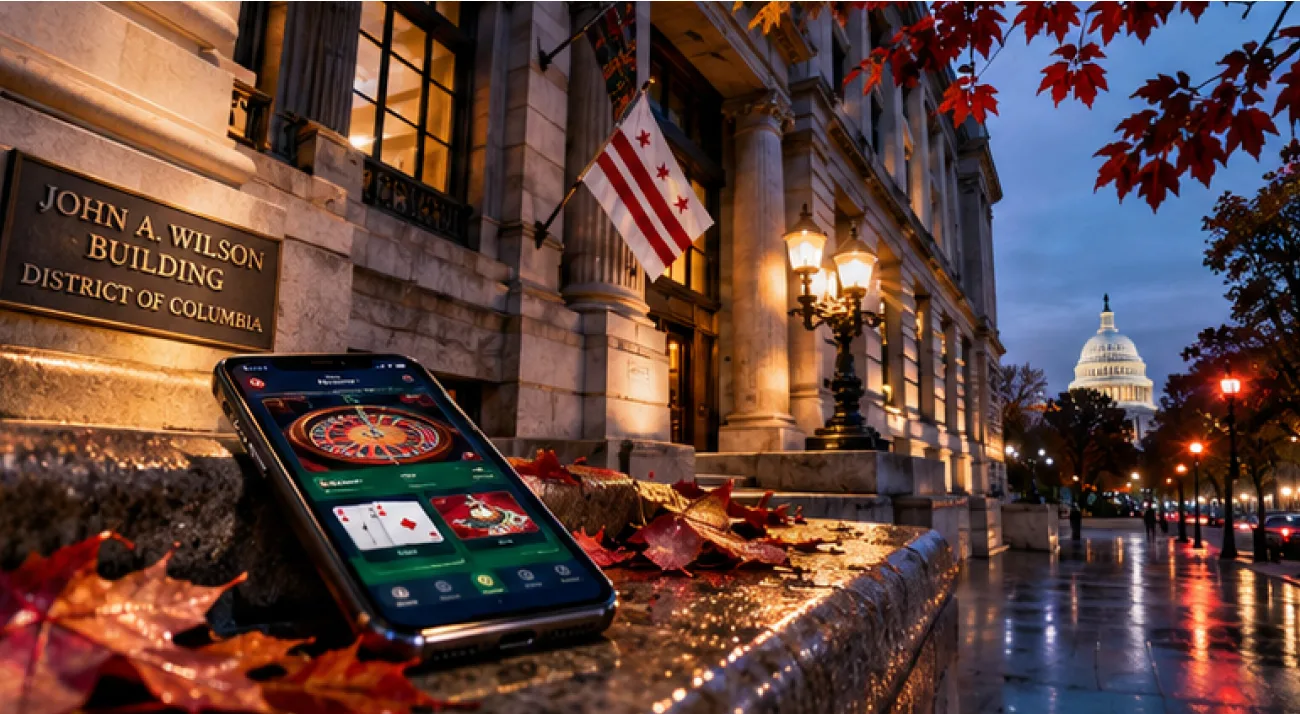
Washington, D.C., could become the next U.S. jurisdiction to authorize real-money online casinos, as lawmakers face a narrowing deadline to advance legislation before the end of 2026.
The proposed Internet Gaming and Consumer Protection Act of 2026, officially designated Bill B26-0656, would establish a regulated online casino market in the nation’s capital, introduce a 25% tax on adjusted gaming revenue, and require operators to pay a $2 million application fee for a five-year license.
Introduced by Ward 7 Councilmember Wendell Felder on April 9, 2026, the legislation would also prohibit certain dual-currency sweepstakes casino platforms and establish consumer protection requirements for licensed gambling operators.
On November 2, 2026, SBC Americas reported that industry sources still considered passage before 2027 possible, despite the bill remaining in committee following a May 4 public hearing.
However, the legislation faces a significant obstacle: the D.C. Council has only three regular legislative meetings remaining in 2026.
As of November 3, online casino gambling has not been legalized in Washington, D.C., under B26-0656. The bill has not passed the Council, and there is no approved launch date for regulated real-money online casino platforms.
The proposal raises important questions for the U.S. gambling industry: Can Washington, D.C., establish a regulated online casino market before 2027, how much revenue could legalization generate, and what would the legislation mean for major operators such as DraftKings, BetMGM, FanDuel, and Caesars?
Washington, D.C., Online Casino Bill: Key Provisions
The Internet Gaming and Consumer Protection Act would create a licensing, taxation, and enforcement framework overseen by the D.C. Office of Lottery and Gaming (OLG).
The proposal covers online casino-style gaming, including digital slots, blackjack, roulette, poker, and live-dealer games.
Washington, D.C., iGaming proposal — November 2026
Proposed gaming tax
25%
Adjusted gaming revenue
Operator application fee
$2M
Five-year license
Minimum player age
21
Identity verification required
License renewal fee
$500K
Each five-year renewal
These are proposed requirements, not currently operative online casino licensing rules. Sources: B26-0656 and SBC Americas, November 2, 2026.
The legislation would also establish an open licensing market without a fixed cap on the number of online casino operators.
Under the introduced framework, each operator could offer up to two gaming brands, with additional brands subject to regulatory approval.
Licensed operators could potentially offer shared accounts or wallets between sports betting and online casino products, provided the OLG approves those arrangements.
The bill would also allow reciprocal agreements with other jurisdictions, potentially supporting certain forms of interstate gaming cooperation.
These provisions are intended to create a competitive, regulated environment rather than a single-operator online casino monopoly.
Proposed licensing structure
| Requirement | Proposed provision |
|---|---|
| Regulator | D.C. Office of Lottery and Gaming |
| Operator application fee | $2 million |
| Initial license term | Five years |
| Operator renewal fee | $500,000 |
| Supplier application fee | $50,000 |
| Supplier renewal fee | $25,000 |
| Number of operators | No fixed cap |
| Gaming brands | Generally two per license, with exceptions possible |
| Minimum age | 21 |
| Tax rate | 25% of adjusted gross gaming revenue |
The licensing framework could attract companies already operating online casinos in states such as New Jersey, Pennsylvania, and Michigan.
However, no company has received a D.C. online casino license under the proposed legislation. SBC Americas
Why the D.C. Council Faces a Tight Deadline Before 2027
The biggest challenge facing B26-0656 is the legislative calendar.
Councilmember Felder introduced the bill on April 9, and it was referred to the Committee on Human Services on April 21.
The committee held a public hearing on May 4, chaired by Ward 3 Councilmember Matt Frumin.
As of November 3, the bill had not advanced beyond committee consideration to a full Council vote.

The remaining legislative calendar leaves limited time for committee action, possible amendments, Council consideration, and subsequent approval procedures.
Key dates in the D.C. online casino legalization process
- April 9, 2026 — Bill introducedCouncilmember Wendell Felder introduces B26-0656.
- April 21, 2026 — Committee referralThe proposal is assigned to the Committee on Human Services.
- May 4, 2026 — Public hearingLawmakers hear testimony from regulators, gambling companies, and consumer advocates.
- November 10, 2026 — Scheduled legislative meetingOne of the remaining opportunities for Council consideration, provided the bill advances.
- December 1 and 15, 2026 — Final scheduled legislative meetingsThe last regular legislative meetings currently listed for 2026.
- January 2, 2027 — New Council periodThe transition would require unfinished legislation to be reconsidered under the next Council.
Dates reflect the published Council calendar and the bill’s recorded legislative history as of November 3, 2026. Scheduled meetings do not guarantee the bill will be placed on the agenda. SBC Americas+1
Could the bill pass before December 31?
It remains possible, but passage is not assured.
For the legislation to advance, the Committee on Human Services would first need to complete its review and take the necessary action to move the proposal forward.
The full Council would then need to consider the legislation through the applicable legislative process.
Even if the Council approves the bill in 2026, additional steps may be required before it becomes effective, including mayoral review and the congressional review process applicable to D.C. legislation.
Passing a bill in 2026 would not necessarily mean that online casinos could begin operating before January 1, 2027.
Licensing, regulatory implementation, technical testing, and operator approvals could require additional time.
What happens if lawmakers miss the deadline?
If B26-0656 does not complete the legislative process during the current Council period, lawmakers would generally need to introduce legislation again in the new period.
That could delay online casino legalization and require renewed hearings, negotiations, or amendments.
The November 3 local elections also create a political transition, with voters choosing a successor to Mayor Muriel Bowser and filling several Council positions.
The incoming administration and Council could influence how the issue is considered in 2027, but their eventual decisions cannot be determined from the current bill’s status. SBC Americas
Why Wendell Felder Wants to Legalize Online Casinos in Washington, D.C.
Councilmember Wendell Felder has presented online casino legalization as an opportunity to regulate gambling activity that already occurs through offshore and unlicensed websites.
In April, Felder argued that the District could improve consumer protection while capturing tax revenue from an existing market.
During the May 4 hearing, lawmakers discussed an estimate that D.C. residents had wagered approximately $700 million on unlicensed online gambling platforms during 2024.
However, committee chair Matt Frumin questioned how that estimate had been calculated.
The $700 million figure should therefore be treated as an estimate presented during the legislative debate, not as independently verified revenue data.
It also refers to estimated gambling activity or wagering volume, rather than the amount operators retained as gaming revenue. Granicus+1
How much tax revenue could D.C. online casinos generate?
Felder’s office has projected that the proposed legislation could generate:
- More than $10 million in upfront licensing fees.
- Approximately $50 million in annual revenue.
- Potential annual revenue exceeding $75 million within five years.
These are estimates promoted by the legislation’s sponsor, not guaranteed government receipts.
Actual revenue would depend on the number of licensed operators, customer participation, promotional deductions, the final tax framework, and the timing of market implementation. Council Member Wendell Felder
Illustrative annual iGaming tax revenue under a 25% rate
$0$20M$40M$60M$80M$100M AGR$200M AGR$300M AGR
Illustrative calculation only: assumes a 25% effective tax on adjusted gross gaming revenue, excluding licensing fees and other assessments. Not an official forecast.
For example, if licensed online casinos collectively generated $200 million in annual adjusted gross gaming revenue, a 25% tax would produce approximately $50 million before accounting for other factors.
This is a mathematical illustration, not a prediction of D.C.’s future online casino market.
D.C. Online Casino Bill Includes a Proposed Sweepstakes Casino Ban
One of the legislation’s most consequential provisions would prohibit certain dual-currency sweepstakes casino products.
These platforms commonly use virtual currencies or credits, with some models allowing particular credits to be redeemed for cash or prizes.
Supporters of restrictions argue that some sweepstakes casino models closely resemble real-money gambling while operating outside the licensing and tax requirements imposed on regulated casinos.
Businesses in the sweepstakes sector dispute the characterization of their products as unauthorized gambling and have argued that legitimate promotional sweepstakes should not be treated the same way as conventional casino wagering.
B26-0656 would define prohibited dual-currency gaming products based on their currency structures and redemption features.
Proposed penalties for prohibited sweepstakes platforms
The bill would provide enforcement authority to the Office of Lottery and Gaming and the D.C. Attorney General.
According to the published proposal, enforcement measures could include cease-and-desist orders, injunctions, restitution, and financial penalties.
Penalties could reach $100,000 per violation, with higher amounts of up to $500,000 for certain patterns of violations.
Each day of continued noncompliance could constitute a separate violation under the proposed enforcement framework.
These are proposed penalties. They are not currently enforceable under B26-0656 because the bill has not been enacted.
Why sweepstakes regulation matters to the online casino industry
The proposed restrictions would affect the competitive landscape if D.C. legalizes online casinos.
Licensed operators would face significant application fees, gaming taxes, identity verification requirements, and responsible gambling obligations.
The sweepstakes prohibition is intended to prevent certain competing platforms from offering casino-style products without comparable regulatory obligations.
However, the scope and legal treatment of promotional gaming would depend on the final statutory language and its enforcement.
Responsible Gambling Protections Would Be Mandatory
Consumer protection is a major component of the proposed legislation.
Under the bill, licensed online casino operators would need to implement identity verification and safeguards intended to prevent underage gambling, fraud, and account misuse.
The legislation also includes responsible gambling measures such as deposit limits, spending limits, time limits, cooling-off periods, and self-exclusion options.
Operators would be required to protect customer funds and personal information.
The proposed minimum age of 21 is especially significant because it would establish a higher age threshold for online casino gaming than the District’s existing general sports betting minimum of 18.

The different age limits could create additional compliance requirements for companies offering both products.
Community reinvestment and gambling addiction services
Felder’s proposal also includes a 2% iGaming community reinvestment assessment intended to support programs addressing gambling-related harms and other community needs.
The sponsor has identified several intended uses, including financial literacy, debt management, domestic violence services, gambling research, and workforce development.
In addition, the District has already established an Internet Gaming Revenue Fund through separate budget legislation.
The fund’s statutory framework directs the first $750,000 in qualifying annual iGaming tax revenue, if such revenue is collected, toward the Department of Behavioral Health for gambling addiction prevention, treatment, referral, and recovery services.
It also specifies how community impact assessment receipts would be allocated:
| Program area | Share of community impact assessments |
|---|---|
| Financial counseling and consumer protection | 30% |
| Domestic violence and family stability services | 30% |
| Gambling behavior and addiction research | 10% |
| Youth development and technology workforce programs | 30% |
Source: D.C. Code § 36–681.01. Establishing this revenue fund does not itself authorize online casino gambling. D.C. Law Library
The distinction is important: the revenue fund exists in law, but the separate legislation required to establish the proposed licensed online casino market remains pending.
What Online Casino Legalization Could Mean for DraftKings, BetMGM, and Caesars
Washington, D.C., already has an established mobile sports betting market.
Its history provides useful context for the proposed online casino expansion.
The District legalized sports betting in 2019, initially relying on a lottery-centered citywide mobile model.
The GambetDC platform launched in May 2020, but its financial performance fell short of early projections.
In April 2024, FanDuel replaced GambetDC as the citywide mobile sportsbook provider under the previous operating arrangement.
Later that year, the District expanded its market to allow additional commercial mobile sportsbook operators to compete more broadly.
The expanded system enabled companies such as DraftKings, BetMGM, Caesars, Fanatics, and other operators to participate through applicable licensing and partnership arrangements. SBC Americas
Existing sportsbook operators could have a competitive advantage
If online casino gaming becomes legal, established sportsbook operators could benefit from existing customer relationships, brand recognition, and familiarity with the District’s regulatory environment.
Potential advantages might include:
- Established mobile gaming platforms and payment infrastructure.
- Experience operating in regulated U.S. online casino markets.
- Existing sports betting customers who may also be interested in casino products.
- Marketing relationships with local sports organizations and venues.
- Experience with identity verification, fraud prevention, and responsible gambling compliance.
However, these advantages would not guarantee licenses or market share.
Each company would still need to satisfy the requirements established by the final law and regulator.
DraftKings and BetMGM were among the operators that supported the legislation during the May hearing.
DraftKings described online casino authorization as a natural extension of the District’s expanded sports betting market.
BetMGM also highlighted its existing investment in the District, reportedly exceeding $65 million. SBC Americas
Could Washington, D.C., Become the Next Regulated U.S. Online Casino Market?
Real-money online casino gaming remains legal in a relatively small number of U.S. jurisdictions.
The seven states operating regulated online casino markets in 2026 are Pennsylvania, Michigan, New Jersey, Connecticut, West Virginia, Delaware, and Rhode Island.
Their combined gross online casino revenue reached approximately $1.02 billion in September 2026, according to an industry-wide compilation.
That total marked the third consecutive month above the billion-dollar threshold.
The existing market demonstrates the substantial revenue potential of regulated iGaming, although it does not establish how much a new D.C. market would generate.
Washington, D.C., has a much smaller population than the largest online casino states.
Its revenue potential would therefore depend on local participation, licensing conditions, competition, and other market-specific factors.
Unlike states with large geographic markets, the District would also need to enforce clear location-verification rules to ensure that real-money online casino activity occurs within its authorized jurisdiction.
A player living in neighboring Maryland or Virginia would not automatically become eligible to use a D.C.-licensed online casino merely because the platform operates in Washington.
How D.C.’s proposal differs from existing markets
The legislation’s proposed 25% tax rate, $2 million operator application fee, and open licensing structure would shape its competitiveness.
An unlimited number of potential licenses does not necessarily mean a large number of operators would enter the market.
Companies would need to evaluate whether the District’s expected customer base could support licensing expenses, gaming taxes, marketing costs, and ongoing regulatory obligations.
The final number of applicants would remain unknown until the legislation passes and the licensing process begins.
Why Some Groups Oppose the D.C. Online Casino Proposal
The legislation has generated disagreement among gambling companies, consumer advocates, and other stakeholders.
Supporters argue that legalization would replace some unregulated gambling activity with a supervised market that collects taxes and imposes consumer protection requirements.
Opponents raise concerns about increased gambling accessibility, potential financial harm, and the effectiveness of responsible gambling safeguards.
During the May hearing, Stop Predatory Gambling opposed the proposal.
Meanwhile, ARB Interactive, the company associated with Publishers Clearing House, testified against the proposed sweepstakes casino prohibition. SBC Americas
The debate involves two distinct policy questions.
The first is whether Washington, D.C., should authorize regulated real-money online casino gambling.
The second is whether certain sweepstakes gaming products should be prohibited, restricted, or regulated under a separate framework.
Lawmakers could amend either part of the legislation before a final vote.
What Happens Next? Three Possible Outcomes for 2026
The bill’s future depends on legislative action during the remaining weeks of the year.
| Scenario | What it would mean |
|---|---|
| Council approves the bill in 2026 | Legalization could advance through the remaining approval and implementation steps. |
| Lawmakers amend the proposal | Tax rates, licensing requirements, sweepstakes provisions, or consumer protections could change. |
| Bill does not advance before the new Council period | A new proposal would generally be needed in 2027. |
The next scheduled legislative meeting is November 10, followed by December 1 and December 15.
However, the key development to monitor is whether the Committee on Human Services schedules a markup and advances B26-0656.
Until that occurs, the proposal remains at an early legislative stage.
Even if lawmakers act quickly, an operational online casino market would still require licensing procedures, regulatory implementation, and technical compliance.
Consequently, a 2026 legislative approval and a 2026 casino launch are two very different possibilities.
Frequently Asked Questions About D.C. Online Casino Legalization
Are online casinos legal in Washington, D.C., in November 2026?
No. As of November 3, 2026, the District has not authorized a regulated real-money online casino market under B26-0656. Online sports betting is a separate, already regulated activity.
What is the Internet Gaming and Consumer Protection Act of 2026?
It is legislation introduced by Councilmember Wendell Felder that would authorize and regulate online casino games, establish operator licensing and taxation requirements, introduce responsible gambling protections, and restrict certain dual-currency sweepstakes casinos.
How much would online casino operators pay in taxes?
The proposed tax rate is 25% of adjusted gross gaming revenue. Operators would also face licensing fees and other applicable requirements.
Could DraftKings, BetMGM, or Caesars launch D.C. online casinos?
Potentially, if the legislation becomes law and those companies obtain the necessary approvals. Existing sportsbook licenses do not automatically authorize online casino operations.
When could legal online casinos launch in Washington, D.C.?
No official launch date has been established. Even if lawmakers approve legislation before 2027, regulatory preparations and licensing could extend into a later period.
Final Thoughts: D.C. Online Casino Legalization Remains Possible but Uncertain
Washington, D.C., has an opportunity to significantly expand its regulated gambling market through the Internet Gaming and Consumer Protection Act of 2026.
The proposed legislation would establish a 25% online casino tax, require $2 million operator application fees, introduce a minimum gambling age of 21, and prohibit certain dual-currency sweepstakes casino products.
Councilmember Wendell Felder has promoted the proposal as a way to strengthen consumer protections, generate tax revenue, and support community programs.
However, the legislation has not advanced beyond its committee hearing, and only three regular Council legislative meetings remain in 2026.
The central takeaway is that Washington, D.C., could still approve online casino legalization before 2027, but there is no guarantee of passage and no authorized launch date.
The next significant development will be whether the Committee on Human Services moves B26-0656 forward before the Council’s remaining legislative sessions conclude.
For the U.S. online casino industry, the proposal represents another example of how state and local governments are evaluating the financial opportunities, regulatory requirements, and consumer risks associated with legal iGaming.
Leave a Reply