

South Carolina’s long-running debate over legal online sports betting could enter a new phase in 2027 after Republican Attorney General Alan Wilson won the state’s November 3, 2026, gubernatorial election, defeating Democratic state representative Jermaine Johnson.
Wilson’s victory represents a potentially significant political development for sports betting advocates. Unlike outgoing Republican Governor Henry McMaster, who has consistently opposed gambling expansion, Wilson has expressed support for regulated online sports wagering while maintaining a much more restrictive position on commercial casinos.
The Associated Press called the race for Wilson, and election reporting indicated that he defeated Johnson by approximately 4.5 percentage points.
The result gives supporters of legalization a potentially more receptive governor ahead of the next South Carolina legislative session.
However, a change in the governor’s office does not automatically translate into a change in gambling law.
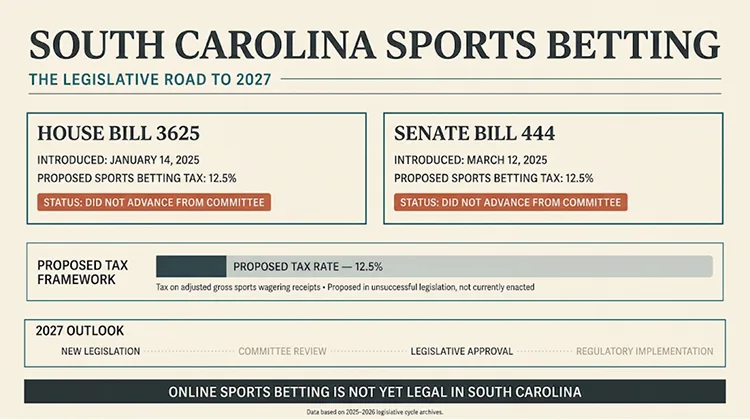
South Carolina lawmakers failed to advance sports betting legislation during the 2025–2026 legislative cycle. The state’s two principal proposals, House Bill 3625 and Senate Bill 444, remained in committee and did not become law.
As of November 5, 2026, conventional online sports betting, retail sportsbooks, and commercial real-money online casinos remain unauthorized in South Carolina.
The central question is whether Wilson’s election can help turn years of unsuccessful legislative proposals into a regulated sports betting market in 2027.
Alan Wilson Wins South Carolina’s 2026 Governor Election
Wilson’s election marks a change in leadership after Governor Henry McMaster’s tenure.
McMaster was term-limited and could not seek another full term, creating an open race for the governor’s office.
Wilson, a four-term state attorney general, defeated Democratic candidate Jermaine Johnson, who had also supported regulated sports betting but favored a more permissive approach toward casino development.
South Carolina governor election — November 3, 2026
Alan Wilson (Republican)
51.6%
Approximately 1,050,190 votes
Jermaine Johnson (Democrat)
47.1%
Approximately 959,001 votes
Reported vote share
0%15%30%45%60%Alan WilsonJermaine JohnsonOther candidates
Reported election figures as of November 4, 2026. Percentages are rounded and results remain subject to official certification.
The election was called on November 3, with Johnson conceding that evening.
South Carolina political reporting described Wilson’s victory as a continuation of Republican control of the governor’s office, although the candidates held different positions on gambling expansion.
Why does this election matter for sports betting?
The governor does not independently legalize gambling, but the office can influence legislative negotiations and determine whether to sign or veto legislation.
For several years, South Carolina sports betting supporters faced opposition from both lawmakers and the governor’s office.
Wilson’s willingness to consider regulated sports wagering removes one potential barrier.
That does not mean he has endorsed every proposed sports betting bill or committed to signing legislation with any particular tax rate, licensing system, or regulatory structure.
It means the political environment may be more favorable than it was under McMaster.
Alan Wilson Supports Sports Betting but Opposes Commercial Casinos
One of the most important distinctions in Wilson’s gambling policy is the difference between online sports betting and casino expansion.
During the 2026 campaign, Wilson signaled support for legalizing regulated mobile sports betting.
However, he also indicated that he would oppose legislation authorizing commercial casinos.
This creates two very different outlooks for the gambling industry.
| Gambling category | Wilson’s reported position | Current South Carolina status |
|---|---|---|
| Regulated online sports betting | Supportive of legalization | Not authorized |
| Retail commercial sportsbooks | Would require separate statutory authorization | Not authorized |
| Commercial casino resorts | Opposed; indicated willingness to veto | Not authorized |
| Real-money online casino slots and table games | No equivalent legalization commitment established | Not authorized |
| State lottery | Existing legal activity | Legal |
The distinction matters because sports betting legislation can be written narrowly to authorize wagering on sporting events without permitting traditional casino games.
Wilson’s support for sportsbooks should not be interpreted as support for online slots, blackjack, roulette, or destination casino resorts.
How Wilson differs from Henry McMaster
McMaster consistently resisted expanding gambling in South Carolina.
His position created an additional obstacle for lawmakers considering sports betting legislation.
Wilson has taken a more selective approach.
He appears willing to distinguish regulated sports wagering from broader commercial casino gambling, which could make a narrowly drafted sports betting proposal more politically viable.
The difference was highlighted in election coverage published by Covers and TheLines during October and November 2026.
Why South Carolina Failed to Legalize Sports Betting in 2025 and 2026
South Carolina lawmakers have considered multiple proposals to establish a regulated sports betting industry.
The most recent legislative cycle included two principal bills: H. 3625 in the House and S. 444 in the Senate.
Both proposed creating a legal framework for interactive sports wagering.
Neither advanced out of committee before the 2025–2026 legislative session ended.
South Carolina’s most recent sports betting proposals
| Legislative detail | House Bill 3625 | Senate Bill 444 |
|---|---|---|
| Introduced | January 14, 2025 | March 12, 2025 |
| Principal sponsors | Rep. Chris Murphy and others | Senators Tom Davis and Matt Leber |
| Proposed tax rate | 12.5% | 12.5% |
| Regulatory body | New Sports Wagering Commission | New Sports Wagering Commission |
| Final progress | Remained in House committee | Remained in Senate committee |
| Became law? | No | No |
Sources: Official South Carolina General Assembly legislative records.
House Bill 3625: The South Carolina Sports Wagering Act
H. 3625 was introduced by Republican Representative Chris Murphy, with a bipartisan group of additional sponsors.
The proposal would have created a regulatory framework for online sports betting through licensed operators.
Its provisions included licensing requirements, identity verification, geolocation, consumer protection measures, and a tax on adjusted gross sports wagering receipts.
The bill was referred to the House Ways and Means Committee and did not advance to a floor vote.
Senate Bill 444: A parallel legalization effort
S. 444 was introduced on March 12, 2025, by Senators Tom Davis and Matt Leber.
Like the House proposal, it sought to authorize interactive sports wagering and establish a new regulatory commission.
The Senate bill was referred to the Committee on Labor, Commerce and Industry.
It also failed to advance.
Because the 2025–2026 legislative cycle has ended, these proposals do not automatically carry forward into the next session. Supporters will need to introduce new legislation in 2027.
What a Legal South Carolina Sports Betting Market Could Look Like
Although the previous bills failed, they provide useful evidence of the regulatory framework lawmakers have already considered.
The 2025 proposals included a 12.5% tax on adjusted gross sports wagering receipts.
That figure is important because it was a proposed tax on a defined measure of sportsbook revenue, not a tax on every dollar wagered.
The proposed 12.5% sports betting tax
Under H. 3625, adjusted gross sports wagering receipts generally reflected wagers accepted minus winnings paid and applicable adjustments.
For example, if a licensed operator generated $10 million in taxable adjusted gross sports wagering receipts, a 12.5% tax would produce $1.25 million in state tax liability.
That is a hypothetical illustration, not a forecast of South Carolina’s potential revenue.
Key features of the previous legislative proposals
Proposed tax rate
12.5%
On adjusted gross sports wagering receipts
Proposed regulator
New commission
South Carolina Sports Wagering Commission
These were provisions in unsuccessful 2025 legislation. They are not current law or confirmed terms for a 2027 bill. H3625 2024-12-12 prefiled
Where would sports betting tax revenue go?
Senate Bill 444 proposed distributing tax proceeds among several purposes.
Its allocation provisions included:
- 82% to the state’s general fund.
- 10% for local governments to support infrastructure projects.
- 5% for mental health-related programs.
Other provisions addressed the remaining allocation.
A future bill could adopt different percentages or direct more funding toward education, public services, or responsible gambling programs.
There is no approved 2027 tax rate or revenue distribution plan. South Carolina Legislature Online
Responsible Gambling Rules Could Become Central to the 2027 Debate
Any serious legalization proposal would need to address how licensed sportsbooks protect customers.
South Carolina’s previous legislation included requirements for verifying customer identities, restricting access by minors, and confirming that bettors were physically located within the state.
The bills also addressed voluntary self-exclusion and procedures for identifying suspicious wagering activity.

Geolocation and age verification
A regulated mobile sportsbook would need technology to establish that a customer was eligible to wager and physically present in South Carolina.
A South Carolina resident traveling to another jurisdiction would not necessarily be able to place a wager under South Carolina rules.
Likewise, an out-of-state visitor physically present in South Carolina could potentially be eligible if the future law allowed it and the visitor satisfied the applicable requirements.
The precise minimum age and other eligibility standards would depend on enacted legislation.
Self-exclusion and consumer protection
Previous proposals included voluntary exclusion programs intended to help customers restrict their access to wagering.
They also addressed the use of credit, prohibited participants, and the reporting of irregular betting activity.
These protections could become important in negotiations with lawmakers concerned about gambling addiction and financial harm.
Supporters argue that a licensed market provides greater regulatory oversight than unauthorized gambling.
Opponents counter that legal mobile betting may increase the frequency and accessibility of wagering.
Both issues are likely to remain relevant in 2027.
Could South Carolina Generate New Revenue From Sports Betting?
Tax revenue is one of the principal arguments made by supporters of legalization.
A regulated market could create a taxable revenue stream from licensed sportsbook operators.
However, South Carolina has not established an operating legal sports betting market, so there is no actual state sportsbook revenue history from which to calculate future collections.
Revenue projections would depend on several factors, including the number of operators, customer participation, tax policy, promotional deductions, and overall market conditions.
Why neighboring states matter
South Carolina is bordered by two states with different sports betting rules.
North Carolina launched statewide online sports betting on March 11, 2024, creating a nearby regulated mobile wagering market.
Georgia, by contrast, has not authorized conventional statewide online sports betting.
This creates an important geographic distinction.
An eligible South Carolina resident physically present in North Carolina may be able to place a legal wager using a North Carolina-licensed sportsbook, subject to the state’s rules.
The same customer cannot legally use that North Carolina sportsbook while physically located in South Carolina.
Supporters of legalization argue that South Carolina could retain some taxable wagering activity by creating its own regulated market.
However, the amount of potential revenue currently leaving the state is uncertain.
There is no reliable basis for assuming that all wagers placed by South Carolina residents elsewhere would automatically transfer to a new domestic market.
What Would Legalization Mean for DraftKings, FanDuel, and Other Sportsbooks?
South Carolina could become another potential U.S. market for major sports betting operators.
Companies such as DraftKings, FanDuel, BetMGM, and Fanatics Sportsbook operate in various states where sports wagering is authorized.
A South Carolina law could provide opportunities for qualified companies to apply for licenses.
However, none of these companies should be described as holding an active South Carolina online sportsbook license under the unsuccessful proposals.
Licensing opportunities would depend entirely on the framework enacted by lawmakers.
Would South Carolina allow betting on college sports?
The state’s college sports culture could make this a particularly important policy question.
South Carolina is home to major athletic programs including the University of South Carolina Gamecocks and Clemson University Tigers.
Previous legislation contemplated wagers on collegiate sporting events, subject to applicable restrictions.
A new bill would need to define which college sports markets could be offered and whether certain player-specific bets would be restricted.
Lawmakers may also examine betting integrity, athlete harassment, and the protection of confidential team information.
Why Commercial Casino Legalization Faces a Different Outlook
Wilson’s election should not be interpreted as a general endorsement of gambling expansion.
While he has indicated support for regulated sports betting, his position on commercial casinos is substantially more restrictive.
That distinction could shape how legislation is drafted.
A proposal focused exclusively on mobile sports wagering may have a better chance of securing gubernatorial support than a bill combining sportsbooks with commercial casinos.
Online casinos are not part of an approved legalization plan
Real-money online casino games—including digital slots, roulette, and blackjack—remain unauthorized in South Carolina.
The state has not enacted an iGaming licensing framework comparable to those operating in New Jersey, Michigan, or Pennsylvania.
A sports betting law would not automatically legalize online casino gaming.
For South Carolina residents, the distinction between these products is especially important when evaluating websites claiming to offer legal local casino gambling.
The state’s existing lottery and certain other permitted gaming activities operate under separate rules.
What Must Happen Before South Carolina Can Legalize Sports Betting in 2027?
Wilson’s election changes the political environment, but the Legislature must still approve a new legal framework.
Unlike states pursuing constitutional amendments through statewide referendums, South Carolina’s recent sports betting proposals were introduced as ordinary legislation.
The precise legal requirements for any future proposal will depend on its provisions and applicable constitutional restrictions.
A realistic legislative pathway would involve several stages.
- January 2027 — New legislationLawmakers introduce a new sports wagering bill during the legislative session.
- Committee considerationHouse and Senate committees evaluate the proposed regulatory framework, taxes, consumer protections, and licensing requirements.
- Legislative approvalBoth chambers must approve legislation in the required form, resolving any differences between competing versions.
- Governor’s decisionThe legislation reaches Governor Wilson for consideration, subject to the state’s constitutional lawmaking procedures.
- Regulatory implementationIf enacted, the state establishes the applicable rules, processes licenses, and prepares operators for a possible launch.
A bill could pass in 2027 without sportsbooks launching that same year.
Licensing and regulatory implementation may take additional time.
There is currently no confirmed South Carolina sports betting launch date.
Three Possible Outcomes for South Carolina Sports Betting
| Scenario | What it would mean |
|---|---|
| Legislation passes in 2027 | The state could begin implementing a regulated sports betting framework. |
| A bill advances but fails to secure final approval | Sports betting remains unauthorized while supporters consider another attempt. |
| No bill advances from committee | The state continues under its existing gambling restrictions. |
The first scenario is more politically plausible following Wilson’s election, but the other outcomes remain possible.
Legislative support, tax negotiations, consumer protection requirements, and opposition to gambling expansion will all influence the result.
Frequently Asked Questions About South Carolina Sports Betting
Is sports betting legal in South Carolina in November 2026?
No. South Carolina has not legalized conventional commercial online or retail sports betting. The November 2026 governor’s election did not change existing gambling laws.
Did Alan Wilson win the South Carolina governor’s race?
Yes. Republican Alan Wilson defeated Democrat Jermaine Johnson in the November 3, 2026, gubernatorial election. Reported results showed Wilson winning by approximately 4.5 percentage points.
Does Alan Wilson support legal sports betting?
Wilson has expressed support for regulated online sports betting, distinguishing it from commercial casino expansion, which he opposes.
Could South Carolina legalize sports betting in 2027?
Yes, lawmakers could introduce and approve new legislation during the 2027 session. However, no legalization bill has been enacted, and passage remains uncertain.
What happened to South Carolina House Bill 3625?
H. 3625 was introduced in January 2025 and proposed a regulated interactive sports wagering system with a 12.5% tax on adjusted gross receipts. It remained in committee and did not become law.
Would DraftKings and FanDuel be legal in South Carolina?
Not under current law as conventional state-licensed sportsbooks. If South Carolina legalizes sports betting, eligible operators could potentially apply for licenses under the new rules.
Are online casinos legal in South Carolina?
No. South Carolina has not authorized conventional real-money online casino gaming, including digital slots, blackjack, and roulette.
When will South Carolina sports betting apps launch?
There is no official launch date. Any launch would depend on legislative approval, enactment, licensing, and regulatory implementation.
Final Thoughts: Alan Wilson’s Victory Creates an Opening for 2027
South Carolina’s November 3 election could prove to be a significant turning point for the state’s sports betting industry.
Alan Wilson’s victory over Jermaine Johnson brings a governor-elect who has expressed support for regulated mobile sports wagering, contrasting with outgoing Governor Henry McMaster’s opposition to gambling expansion.
The change is important because previous legalization proposals failed to advance during the 2025–2026 legislative cycle.
H. 3625 and S. 444 demonstrated that some lawmakers were prepared to consider a regulated market, including a proposed 12.5% tax, licensing requirements, geolocation protections, and responsible gambling provisions.
But neither bill became law.
Wilson’s election may make future negotiations easier, especially for legislation focused narrowly on sports betting rather than commercial casinos.
The central takeaway is that South Carolina sports betting legalization has a stronger political opportunity in 2027, but the state has not approved online sportsbooks or established a launch timetable.
For gambling operators, lawmakers, and residents, the next major development will be whether a new bill is introduced and advances beyond the committee stage when the Legislature reconvenes.
Until then, South Carolina remains outside the regulated U.S. commercial sports betting market.
Leave a Reply