
Utah has escalated its fight against prediction markets by filing a lawsuit against Kalshi, seeking to stop the platform from offering contracts to Utah residents and recover millions of dollars the state alleges were generated through illegal gambling. The case, announced on October 20, 2026, could become another major test of whether federally regulated prediction markets can operate in states that prohibit gambling.
Utah Attorney General Derek Brown says Kalshi’s event contracts function like bets under state law, regardless of how the company classifies them. Kalshi maintains that it operates as a federally regulated derivatives exchange overseen by the Commodity Futures Trading Commission (CFTC), rather than as a conventional sportsbook.
The dispute arrives after a federal judge ruled in August that federal commodities law does not prevent Utah from enforcing its anti-gambling laws against Kalshi. The new lawsuit shifts the fight toward enforcement and potential financial penalties, raising questions about whether the platform may ultimately have to block Utah users.
Utah Seeks to Stop Kalshi’s Operations in the State
Utah filed its lawsuit on October 20 in the Third District Court in Salt Lake City. The 63-page complaint seeks to stop Kalshi from offering event contracts in Utah and asks the court to require the company to surrender alleged profits, compensate affected residents and address what state officials describe as an ongoing public nuisance.
Brown announced the action at the Utah State Capitol. His office argues that contracts tied to sports results, elections, political developments, cultural events and public figures’ mentions amount to gambling prohibited by Utah law.
The lawsuit names five Kalshi-related companies, along with Susquehanna International Group and Susquehanna Government Products. The state is therefore targeting not only the platform but also firms it alleges participate in the trading structure by taking positions against users. These remain allegations in a civil case, not final judicial findings.
Utah’s central argument is that the economic substance of a transaction matters more than the label attached to it. In the state’s view, a customer risking money on whether a team wins or an event occurs is effectively wagering, even when the transaction is presented as a financial contract.
That distinction could prove decisive. If courts accept Utah’s interpretation, the state may be able to restrict categories of Kalshi contracts that it considers gambling, even while the company continues to operate under federal oversight elsewhere.
How Much Money Does Utah Say Kalshi Made?
A major part of the lawsuit concerns the amount of money Utah residents have traded through the platform and the fees the company allegedly collected.
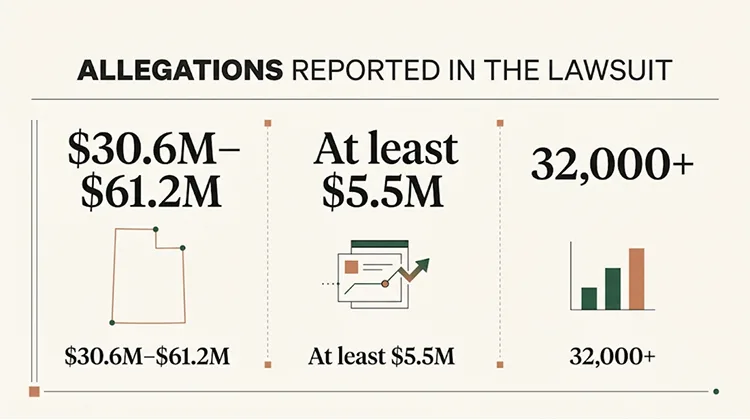
According to reporting on the complaint, Utah estimates that Kalshi collected approximately $30.6 million to $61.2 million in fees from accounts associated with the state through October 19, 2026. The state has indicated that the estimate could change as the case proceeds and more financial information becomes available.
The lawsuit also estimates that Utah residents lost at least $5.5 million based on the state’s calculation of its share of reported nationwide retail losses. Those losses are separate from the estimated platform fees, and the figures should not be treated as a final court-verified accounting.
| Figure cited in reporting | What it represents |
|---|---|
| $30.6 million–$61.2 million | Estimated fees collected from Utah-associated accounts |
| At least $5.5 million | Estimated losses attributed to Utah users |
| More than 3 billion | Wagers or contract transactions attributed to Utah accounts in the complaint’s estimates |
| More than 32,000 | Verified Utah accounts reported as of February 2026 |
These numbers help explain why the dispute extends beyond whether a particular contract should be classified as gambling. Utah is also seeking financial remedies that could make the consequences significant for the companies named in the lawsuit.
The state has asked for restitution and other damages, while also seeking restrictions that would prevent Utah residents from accessing the contested markets. The final amount, if any, would depend on the evidence, the court’s findings and the relief ultimately granted.
Why Utah’s Gambling Ban Matters
Utah is one of the most restrictive states for gambling in the United States. Its constitution prohibits gambling, making the state an important test case for prediction-market companies seeking to expand their products nationally.
Unlike licensed sportsbooks in states where sports betting is legal, Kalshi argues that its event contracts fall under federal commodities regulation. The company says users trade contracts with one another and that prices reflect market expectations about future outcomes.
Utah rejects that distinction when the contracts resemble wagers on sports and other events. Its lawsuit asks the court to stop Kalshi from offering several categories of contracts and to require the use of a court-approved geolocation provider to help ensure Utah residents cannot access them.
Geolocation is important because online platforms can serve customers across state borders. If a court orders stricter location controls, Kalshi could need to verify users’ physical locations more rigorously and prevent restricted contracts from being accessed within Utah.
The case also puts the spotlight on the difference between federal oversight of a financial product and a state’s authority to prohibit gambling within its borders. Federal regulation does not automatically settle every question about whether a particular product may be offered to residents of every state.
Kalshi Already Lost a Key Federal Court Fight in Utah
The new state lawsuit follows an important ruling in Kalshi’s earlier legal challenge.
In February 2026, Kalshi sued Utah in federal court, arguing that its registration as a federally regulated exchange prevented the state from applying its gambling laws to the company’s sports contracts. The dispute was heard by U.S. District Judge Robert J. Shelby.
On August 4, 2026, Shelby granted summary judgment to Utah. The court concluded that the Commodity Exchange Act did not preempt Utah’s enforcement of its anti-gambling laws against Kalshi. The judge denied Kalshi’s request for a preliminary injunction and closed the case.
That ruling is a significant setback for the argument that federal exchange status alone protects prediction-market operators from state gambling restrictions. It does not, however, mean that every dispute involving Kalshi or other prediction markets nationwide has been conclusively resolved.
Kalshi has maintained that it is governed by federal law and has indicated that it intends to challenge adverse legal outcomes. Its spokesperson, Jacki McGavick, said the new state-court action did not affect the company’s ongoing federal litigation.
The distinction matters: the August ruling addressed Kalshi’s federal preemption challenge, while the new case asks a state court to grant specific enforcement and financial remedies. The latest lawsuit still needs to proceed through the court process.
Could Utah Force Kalshi to Close?
The lawsuit could lead to a substantial restriction on Kalshi’s Utah business, but a filing does not automatically shut down the platform.
Utah is asking the court to stop the company from offering the contested contracts in the state. If the court grants that relief, Kalshi could be required to block Utah-based customers from trading specified event contracts and strengthen its location-verification systems. The state is also seeking the recovery of alleged profits and additional compensation.
Several possible outcomes remain:
- A court-ordered restriction: Kalshi could be required to stop offering some or all contested markets to Utah residents.
- Financial remedies: If the state proves its claims, the court could order restitution or other damages within the scope of applicable law.
- Further litigation: Kalshi could continue to argue that federal commodities regulation limits state authority and challenge adverse decisions through the appeals process.
- A negotiated resolution: The parties could potentially reach an agreement on access restrictions or other terms, although no settlement should be assumed.
The broader business implications could extend beyond Utah. If state courts consistently accept the argument that certain event contracts amount to unlicensed gambling, prediction-market operators may face growing pressure to adjust their products and location controls in additional jurisdictions.
However, Utah’s case does not by itself establish a nationwide ban. Any broader effect would depend on later decisions, the legal issues involved and whether other courts reach similar conclusions.
A Growing National Conflict Over Prediction Markets
Utah’s lawsuit is part of a broader wave of state-level challenges to prediction markets. Regulators and attorneys general in several jurisdictions have argued that contracts linked to sports outcomes should be treated as sports wagering, while Kalshi and other operators have relied on federal derivatives regulation to defend their business models.
The dispute also creates uncertainty for users. Market availability may differ by state, and legal challenges can change which contracts are accessible. Customers should not assume that a platform’s presence online—or its description of itself as a federally regulated exchange—means every product is permitted in every state.
For the wider gambling industry, the key question is whether prediction markets will remain a distinct federally regulated category or face restrictions similar to those applied to traditional sportsbooks. The answer could affect market access, compliance spending, product design and competition between established betting companies and prediction-market platforms.
Utah’s demand for court-approved geolocation controls illustrates how enforcement could work in practice. Instead of relying only on broad legal arguments, a court could require specific technical steps to prevent residents from accessing restricted contracts.
Final Thoughts: Utah’s Lawsuit Could Set an Important Example
Utah’s October 20, 2026, lawsuit puts fresh pressure on Kalshi by combining a demand to halt contested markets with claims for millions of dollars in alleged fees, losses and other damages. Attorney General Derek Brown is arguing that prediction contracts cannot avoid Utah’s gambling restrictions simply by being presented as financial products.
Kalshi’s federal-regulation argument remains central to the dispute, but its August loss in federal court has made the legal environment more difficult in Utah. The new case will determine whether the state can secure the specific restrictions and financial remedies it is requesting.
Could Utah force prediction markets to close? It could potentially force Kalshi to stop offering the contested contracts to Utah residents if the court grants the state’s requested relief. That would not automatically close Kalshi nationwide, but it could become another important precedent in the evolving conflict between state gambling laws and federally regulated prediction markets.
For online gambling operators, prediction-market platforms and consumers, the case is worth watching as courts continue to define where financial-market regulation ends and state gambling authority begins.
Leave a Reply