

Caesars Entertainment’s online gambling business delivered another quarter of revenue growth and improving profitability, even as the company’s overall financial losses increased.
On October 27, 2026, Caesars Entertainment reported that Caesars Digital generated $326 million in third-quarter revenue, representing a 4.8% increase from the $311 million recorded during the same period in 2025.
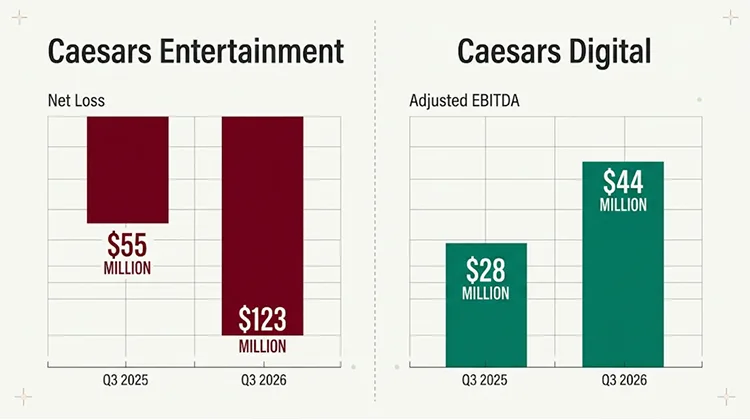
The digital division, which includes Caesars Palace Online Casino and Caesars Sportsbook, also reported $44 million in adjusted EBITDA, compared with $28 million a year earlier. That represents a 57.1% improvement in the division’s adjusted operating earnings.
However, the parent company’s financial results tell a different story.
Caesars Entertainment recorded a $123 million net loss attributable to the company for the quarter ending September 30, 2026, more than double its $55 million loss from the previous year.
The contrasting results highlight an increasingly important question for the U.S. gambling industry: Can growing online casino and sportsbook operations help offset financial pressure across traditional casino resorts?
Caesars’ latest earnings suggest its digital division is becoming more profitable, but the company’s wider financial challenges remain significant.
Caesars Digital Q3 2026 Results: Revenue and Earnings Increase
The third-quarter figures show that Caesars Digital improved both revenue and profitability despite a competitive U.S. online gambling market.
Caesars Digital — Q3 2026 performance
Digital net revenue
$326M
+4.8% YoY
Digital adjusted EBITDA
$44M
+57.1% YoY
Digital GAAP net income
$4M
Versus $21M loss
Nine-month digital revenue
$1.05B
+6.3% YoY
The increase in adjusted EBITDA was substantially faster than revenue growth, indicating that the division generated more adjusted earnings from each dollar of revenue than it did a year earlier.
Based on the company’s reported figures, Caesars Digital’s adjusted EBITDA margin increased from approximately 9.0% in Q3 2025 to 13.5% in Q3 2026.
That improvement is significant because digital gambling businesses must manage substantial technology, marketing, promotional, and regulatory costs while competing for customers.
Even more importantly, the division moved from a GAAP net loss of $21 million in Q3 2025 to GAAP net income of $4 million in Q3 2026.
Unlike adjusted EBITDA, GAAP net income incorporates accounting expenses that adjusted measures exclude.
Together, these results show that Caesars Digital’s improving performance is visible in both its adjusted earnings and its reported net income.
Why Caesars Entertainment Lost $123 Million Despite Higher Revenue
While Caesars Digital delivered stronger results, the company’s consolidated financial performance weakened.
Caesars Entertainment generated $2.94 billion in total net revenue during Q3 2026, compared with $2.87 billion a year earlier.
That represents approximately 2.5% revenue growth.

However, the company reported a net loss attributable to Caesars of $123 million, compared with $55 million in Q3 2025.
Caesars Entertainment: Q3 2026 versus Q3 2025
| Financial metric | Q3 2026 | Q3 2025 | Change |
|---|---|---|---|
| Total net revenue | $2.94B | $2.87B | +2.5% |
| Net loss attributable to Caesars | $123M | $55M | Loss widened |
| Consolidated adjusted EBITDA | $865M | $884M | −2.1% |
| Caesars Digital revenue | $326M | $311M | +4.8% |
| Caesars Digital adjusted EBITDA | $44M | $28M | +57.1% |
The company’s financial statements help explain why revenue growth did not translate into overall profitability.
Net interest expense remained substantial at $570 million for the quarter, compared with $576 million a year earlier.
Depreciation and amortization totaled $366 million, up from $352 million.
Meanwhile, consolidated adjusted EBITDA declined by $19 million.
Caesars also reported a larger negative contribution from its Corporate and Other segment, including a $288 million net loss attributable to that segment, compared with $240 million a year earlier.
These figures illustrate how financing costs, accounting expenses, corporate-level items, and weaker performance in certain casino operations can outweigh improvements in the digital business.
The $123 million loss should therefore not be interpreted as evidence that Caesars Digital itself was losing money during the quarter. The digital segment reported positive GAAP net income.
Las Vegas Casino Revenue Declines While Regional Properties Improve
Caesars’ latest results reveal a noticeable difference between its Las Vegas properties and regional casino operations.
The Las Vegas segment generated $930 million in Q3 2026 revenue, down from $952 million in the same quarter of 2025.
Its adjusted EBITDA declined 9.5%, from $379 million to $343 million.
By comparison, Caesars’ regional casino segment reported stronger performance.
Regional revenue increased 5.9% to $1.63 billion, while adjusted EBITDA improved 3.6% to $524 million. Caesars Entertainment, Inc.
Caesars’ operating segments — Q3 2026
Q3 2025
Q3 2026
The contrast matters because Caesars operates a diversified portfolio of physical casino resorts and digital gambling products.
Regional properties contributed the largest share of reported segment revenue, while the digital division recorded the fastest percentage growth in adjusted EBITDA among these three segments.
Las Vegas, meanwhile, remained an important source of earnings but experienced weaker quarterly performance.
The results demonstrate why investors cannot evaluate Caesars Entertainment solely through its online casino business.
Caesars Palace Online Casino and Caesars Sportsbook Become More Important
Caesars Digital includes the company’s online casino and sports betting activities, operating through brands such as Caesars Palace Online Casino and Caesars Sportsbook.
The $326 million quarterly revenue figure represents the digital segment as a whole. It should not be interpreted as revenue generated exclusively by online casino games.
Caesars’ earnings release does not provide a separate quarterly revenue breakdown for Caesars Palace Online Casino and Caesars Sportsbook.
Nevertheless, the improvement in digital profitability is meaningful for both businesses.
Online casino operations can provide revenue from products such as digital slots, roulette, blackjack, and live-dealer games in states where regulated iGaming is permitted.
Sports betting generates revenue from wagers on professional and collegiate sports, subject to state-specific licensing and regulatory requirements.
Although these products share some technology, customer accounts, and marketing infrastructure, their economics differ.
Sportsbook revenue can fluctuate significantly depending on game outcomes and betting margins, while online casino revenue is influenced by player activity, game performance, competition, and promotional costs.
The combination allows Caesars to participate in different areas of the regulated U.S. online gambling market.
Caesars Digital Surpasses $1 Billion in Revenue Through September
The digital division’s performance is not limited to one quarter.
For the first nine months of 2026, Caesars Digital generated $1.051 billion in net revenue, compared with $989 million during the equivalent period in 2025.
That represents a 6.3% increase.
The division also reported $181 million in adjusted EBITDA for the nine-month period, up from $151 million.
More significantly, nine-month GAAP net income attributable to Caesars Digital increased from $18 million to $53 million.
| Caesars Digital metric | First nine months of 2026 | First nine months of 2025 |
|---|---|---|
| Net revenue | $1.051B | $989M |
| Adjusted EBITDA | $181M | $151M |
| GAAP net income | $53M | $18M |
Source: Caesars Entertainment’s nine-month financial results through September 30, 2026. Caesars Entertainment, Inc.
The figures suggest that Caesars Digital’s improved profitability is part of a broader year-to-date trend rather than an isolated quarterly result.
However, the company’s digital growth rate remains relatively modest compared with the double-digit revenue growth reported across the wider U.S. iGaming market in some recent periods.
This makes profitability and operating efficiency particularly important measures of Caesars Digital’s performance.
Caesars’ $11.7 Billion Debt Remains a Major Financial Challenge
One of the most important factors affecting Caesars Entertainment’s overall results is its debt burden.
As of September 30, 2026, the company reported approximately $11.66 billion in outstanding indebtedness, compared with $11.91 billion at the end of 2025.
Caesars also held $864 million in cash and cash equivalents, excluding restricted cash.
Its reported net debt stood at approximately $10.80 billion.
The company’s financial statements recorded $570 million in net interest expense during the third quarter alone. Caesars Entertainment, Inc.
These financing obligations place considerable pressure on consolidated profitability.
Although Caesars Digital’s $44 million in quarterly adjusted EBITDA represents an improvement, it remains relatively small compared with the company’s total interest expense and outstanding debt.
The distinction between adjusted EBITDA and net income is especially important here.
Adjusted EBITDA excludes interest expense, depreciation, amortization, and certain other costs. It can help compare operating performance, but it does not represent cash available to shareholders or the company’s final accounting profit.
For Caesars, improving digital earnings is encouraging, but sustainable financial improvement also depends on debt management, capital requirements, and performance across its physical casino properties.
Fertitta Entertainment Acquisition Adds Another Major Development
Caesars’ earnings announcement also arrived during an important corporate transition.
On May 28, 2026, Caesars announced a definitive agreement to be acquired by Fertitta Entertainment, Inc.
Because the acquisition remained pending when the third-quarter results were released, Caesars did not schedule its usual quarterly earnings conference call.
The company stated that, upon completion of the transaction, Caesars Entertainment common stock would no longer be listed on Nasdaq and the business would become privately held. Caesars Entertainment, Inc.
This creates an additional layer of uncertainty around the company’s future strategy.
A change in ownership could influence investment priorities, financing decisions, and the allocation of resources between physical casinos and digital gambling.
However, Caesars’ October 27 earnings release did not establish any new commitments concerning the future expansion of Caesars Palace Online Casino or Caesars Sportsbook under the proposed ownership structure.
The acquisition also remained subject to completion. It should not be described as finalized.
What Caesars’ Q3 Results Mean for the U.S. Online Casino Industry
Caesars Digital’s performance reflects several important trends affecting American online gambling.
First, revenue growth and profitability do not necessarily move at the same pace.
The division’s revenue increased 4.8%, but adjusted EBITDA improved 57.1%. This shows how a business can generate substantially stronger adjusted earnings without a comparable increase in sales.
Second, online gambling is becoming an increasingly important component of diversified casino companies.
Traditional casino resorts remain major revenue contributors, but digital platforms can provide additional growth opportunities in states where online gambling is regulated.
Third, strong digital performance does not automatically eliminate broader corporate financial challenges.
Caesars’ $123 million quarterly net loss demonstrates how debt, corporate expenses, and weaker results in other operating segments can outweigh improvements from online gambling.
Finally, the results highlight the importance of distinguishing between company-wide revenue, digital segment revenue, and individual online casino brands.
The $326 million figure covers Caesars Digital as a whole, not Caesars Palace Online Casino alone.
For readers comparing online casino operators, this distinction prevents misleading conclusions about individual brands’ market performance.
What to Watch in Caesars Digital’s Next Earnings Report
Several indicators will help determine whether Caesars Digital can maintain its improved performance.
The most important will be whether adjusted EBITDA continues growing faster than revenue.
Investors and industry analysts will also be watching the division’s GAAP net income, the performance of Caesars’ Las Vegas and regional properties, and any changes to the company’s substantial debt obligations.
Another major factor will be the status of the Fertitta Entertainment acquisition and any resulting changes in corporate strategy.
Competition in the U.S. online casino and sports betting markets will remain relevant as well.
Caesars faces established competitors including DraftKings, FanDuel, BetMGM, and BetRivers, all of which are competing for customers in regulated gambling jurisdictions.
Future results will depend on factors such as consumer spending, regulatory changes, customer retention, promotional costs, and sports wagering outcomes.
Although the digital division’s latest results are encouraging, they do not guarantee continued earnings growth.
Final Thoughts: Digital Growth Offers Caesars an Opportunity, Not a Complete Solution
Caesars Entertainment’s third-quarter 2026 results reveal two different financial stories.
On one side, Caesars Digital generated $326 million in revenue, increased adjusted EBITDA to $44 million, and returned to positive quarterly GAAP net income.
On the other, Caesars Entertainment reported a $123 million consolidated net loss, lower overall adjusted EBITDA, weaker Las Vegas results, and continued pressure from substantial financing obligations.
The company’s online gambling business is becoming more profitable, but it remains one part of a much larger casino and hospitality operation.
The most important takeaway is that Caesars Digital is improving its financial contribution even as the parent company continues facing significant challenges.
Whether that improvement translates into stronger long-term performance will depend on continued digital profitability, results at physical casino properties, debt management, and the outcome of the pending Fertitta Entertainment acquisition.
For the wider U.S. online casino industry, Caesars’ results provide another example of why revenue growth alone does not tell the full story.
Leave a Reply