
Illinois has appealed a federal court ruling that temporarily prevents the state from enforcing key gambling laws against federally regulated prediction market operators, escalating a legal dispute that could reshape the regulation of sports event contracts across the United States.
On October 30, 2026, U.S. District Judge Martha M. Pacold issued a preliminary injunction blocking Illinois officials from applying certain licensing requirements, taxes, fees, and enforcement measures to qualifying event contracts traded through markets regulated by the Commodity Futures Trading Commission (CFTC).
Illinois Attorney General Kwame Raoul, Governor JB Pritzker, and state gaming officials appealed the decision to the U.S. Court of Appeals for the Seventh Circuit that same day.
The ruling represents a significant legal victory for prediction market companies, including Kalshi and Coinbase, which argue that federal commodities law governs their sports event contracts.
Illinois maintains that states have authority to regulate gambling activity occurring within their borders, including products that resemble traditional sports betting.
As of November 4, 2026, the injunction remains preliminary, and Illinois’ appeal has not overturned it. The case is therefore far from resolved.
The dispute raises a question with consequences extending well beyond Illinois: Can states require prediction market operators to obtain sports betting licenses and pay gambling taxes when their contracts trade on federally regulated exchanges?
Illinois Prediction Market Court Ruling: Key Facts
The latest decision follows months of litigation involving Illinois regulators, prediction market companies, and the federal government.
Illinois prediction markets dispute — November 2026

Federal injunction entered
Oct. 30
2026
Appeals court
7th Circuit
Federal appellate review
Initial exchange-wager tax
1.75%
First 5 million qualifying wagers
Higher exchange-wager tax
3.5%
Subsequent qualifying wagers
The injunction concerns specified Illinois gambling requirements as applied to covered federally regulated contracts. It does not repeal the state’s gambling laws generally.
| Key issue | Current position |
|---|---|
| Federal judge | Martha M. Pacold |
| District court | Northern District of Illinois |
| Injunction date | October 30, 2026 |
| State appealing | Illinois |
| Attorney general | Kwame Raoul |
| Federal regulator | CFTC |
| Major industry plaintiffs | Kalshi and Coinbase |
| Appeal destination | Seventh Circuit |
| Legal status | Preliminary injunction in effect; appeal pending |
The injunction temporarily restricts Illinois’ enforcement powers in the covered circumstances while the underlying litigation proceeds.
It does not constitute a final judgment establishing that every sports prediction contract is lawful in every U.S. state.
What Did the Federal Judge Decide?
Judge Pacold’s October 30 order implemented legal conclusions she had outlined in an earlier October 2, 2026 memorandum opinion.
The court found that the plaintiffs were likely to succeed, at least in part, in arguing that federal commodities law preempts Illinois’ attempt to regulate certain sports event contracts through state gambling laws.
The court also concluded that the plaintiffs had demonstrated a risk of irreparable harm without preliminary relief.
In the October 2 opinion, Pacold wrote:
“Many of the financial instruments at issue are likely swaps as defined by the Commodity Exchange Act.”
That classification is central to the dispute.
Under the federal Commodity Exchange Act, swaps and other derivatives traded on registered exchanges fall within a regulatory framework administered by the CFTC.
The prediction market companies argue that this federal framework prevents states from imposing separate sportsbook licensing requirements on the same trading activity.
Illinois disputes the scope of that federal authority and seeks to preserve its power to regulate gambling within the state.
The judge’s analysis favored the plaintiffs at the preliminary stage, but the court has not issued a final ruling on every legal issue in the case. Justia Law+1
Which Illinois gambling laws are affected?
The October 30 injunction prevents the state defendants from applying specified provisions to covered contracts, including relevant parts of:
- The Illinois Sports Wagering Act.
- The state’s criminal gambling laws.
- The Illinois Gambling Act.
- Illinois Gaming Board rules concerning internet wagering.
The order also restricts related licensing enforcement, fees, taxes, criminal or civil actions, and compulsory investigations within its defined scope.
Crucially, the injunction applies to qualifying swaps, including sports event contracts, listed on or available through CFTC-regulated designated contract markets and futures commission merchants.
It does not mean that all online gambling activity in Illinois is exempt from state regulation.
Conventional sportsbooks remain subject to applicable Illinois licensing and regulatory requirements.
Why Illinois Passed a New Prediction Market Law in 2026
Illinois lawmakers adopted new restrictions as part of the state’s fiscal year 2027 budget legislation, approved in June 2026.
The changes expanded the Sports Wagering Act to address sports exchange wagers, a category intended to include certain event contracts offered through prediction market exchanges.
The legislation sought to bring those products within the state’s existing sports betting regulatory framework.
Under that approach, companies offering covered sports event contracts would face Illinois licensing requirements and additional taxes.
For state regulators, the central concern is that prediction markets may offer products economically similar to sports bets without meeting the requirements imposed on licensed sportsbooks.
For prediction market operators, the concern is that individual states could impose conflicting requirements on federally regulated financial exchanges.
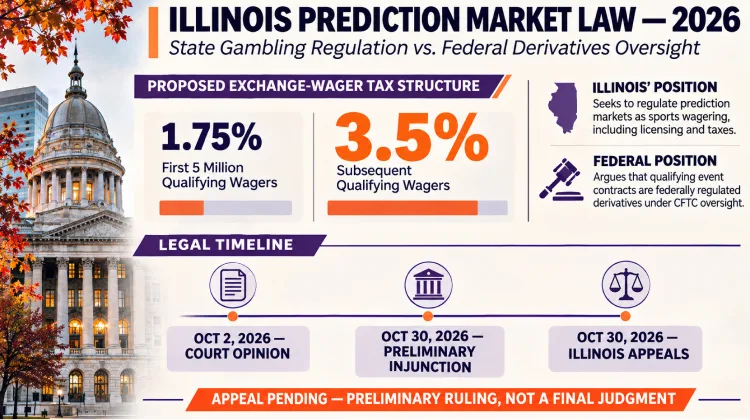
Illinois proposed a two-tier exchange-wager tax
The legislation introduced a tax structure that increased after an operator reached a specified number of qualifying transactions.
| Exchange wagers in a fiscal year | Statutory rate |
|---|---|
| First 5 million | 1.75% |
| Above 5 million | 3.5% |
These rates were part of a broader sports wagering tax and fee framework.
The exchange-wager provision was tied to transactions conducted by state licensees, rather than establishing an independent federal exchange tax.
That distinction became critical to the court’s treatment of the tax.
Illinois’ statutory exchange-wager rates
0%0.95%1.9%2.85%3.8%First 5M wagersLater wagersThese are statutory rates, not amounts of tax collected or an estimate of state revenue. Their enforcement against the covered plaintiffs is currently blocked. Holland & Knight
Why the prediction market tax was blocked
The court did not establish that every possible state tax on prediction markets violates federal law.
Instead, the Illinois provision had a particular legal weakness: the tax applied to operators holding a state license.
Because the judge found that the licensing requirements were likely preempted as applied to the covered federal exchange activity, the associated tax could not be enforced against those operators through that licensing framework.
A legal analysis published by Holland & Knight on October 22 explained that a differently designed tax might raise separate questions.
That leaves an important distinction between regulating a federally supervised trading market and imposing a tax that does not depend on a conflicting licensing requirement.
Kalshi, Coinbase, and the CFTC Challenge Illinois
The Illinois ruling combines three related federal lawsuits involving different plaintiffs.
| Federal case | Principal plaintiff | Central issue |
|---|---|---|
| Coinbase Financial Markets v. Raoul | Coinbase | Application of Illinois gambling requirements to federally regulated event contracts |
| United States v. Illinois | United States and CFTC | Federal regulatory authority and state enforcement |
| KalshiEX v. Raoul | KalshiEX | State licensing and restrictions on sports event contracts |
The cases were considered together by Judge Pacold because they raised overlapping questions about the Commodity Exchange Act and Illinois gambling regulation.
Other prediction market interests also participated in the litigation.
The Coalition for Fair Markets, whose membership includes Kalshi, Polymarket, and Crypto.com, intervened in the federal government’s case.
North American Derivatives Exchange, operating under the OG brand, also participated as an intervenor. SBC Americas+1
Kalshi’s argument: Event contracts are federally regulated derivatives
Kalshi operates a CFTC-designated contract market where customers trade contracts based on the outcomes of future events.
The company argues that its contracts are financial derivatives regulated under federal law.
Unlike a conventional sportsbook that establishes odds and accepts wagers as the counterparty, an exchange generally facilitates trading between market participants.
Contract prices fluctuate according to supply, demand, and market expectations.
For example, a contract might pay $1 if a particular team wins a championship and $0 if it does not.
A contract trading at $0.40 may reflect the market’s current assessment of the likelihood of that outcome, although market prices are not guaranteed accurate probabilities.
Kalshi maintains that this exchange structure falls within federal commodities regulation.
Illinois’ argument: Sports contracts resemble gambling
Illinois regulators take a different position.
They argue that sports event contracts can function similarly to conventional sports wagers because customers risk money on uncertain sporting outcomes.
From the state’s perspective, allowing prediction market operators to avoid state sportsbook licensing could undermine the rules applied to traditional gambling companies.
Those rules include requirements relating to licensing, taxation, consumer protection, and enforcement.
The disagreement is not simply about whether a product involves financial risk.
It is about which government has the authority to regulate the product and whether federal derivatives law displaces particular state gambling requirements.
Illinois Appeals to the Seventh Circuit
Illinois officials filed their appeal on October 30, the same day the preliminary injunction was entered.
Attorney General Kwame Raoul, Governor JB Pritzker, and the Illinois Gaming Board are among the officials involved in the challenge.
The appeal asks the Seventh Circuit to reverse the district court’s preliminary injunction.
The appellate court will review the relevant legal issues, including whether the district judge correctly assessed the plaintiffs’ likelihood of success and the standards for preliminary relief.
A notice of appeal does not automatically suspend a preliminary injunction.
Consequently, Illinois remains subject to the district court’s order unless a court modifies, stays, or reverses it.
Key dates in the Illinois prediction market dispute
- December 2025 — Coinbase litigation beginsCoinbase challenges Illinois’ application of state gambling requirements to its prediction market business.
- April 2026 — Federal government challenges IllinoisThe United States and CFTC bring litigation concerning state enforcement against federally regulated event contracts.
- June 2026 — Illinois expands its sports wagering lawState lawmakers approve new exchange-wager provisions, including additional transaction taxes. Kalshi also brings its federal challenge.
- October 2, 2026 — Judge Pacold issues memorandum opinionThe court finds that the plaintiffs are likely to succeed on significant federal preemption arguments.
- October 30, 2026 — Injunction takes effectThe court formally restricts enforcement of the specified Illinois laws against covered contracts.
- October 30, 2026 — Illinois appealsState officials seek review by the Seventh Circuit.
- November 12, 2026 — Scheduled status reportThe parties are directed to propose further district court proceedings.
Compiled from the district court opinion, subsequent court reporting, and the recorded appeal. RG+2
Why the Seventh Circuit Decision Could Affect Other States
The Seventh Circuit hears federal appeals from Illinois, Indiana, and Wisconsin.
That makes the Illinois appeal particularly important because a separate prediction market dispute from Wisconsin is already before the same appellate court.
In July 2026, a federal district judge in Wisconsin denied the CFTC’s request for preliminary relief in litigation involving sports event contracts.
The Wisconsin court reached a different preliminary conclusion about the federal-law arguments than Judge Pacold did in Illinois.
This disagreement creates an opportunity for the Seventh Circuit to clarify how the Commodity Exchange Act applies to sports prediction contracts.
Illinois and Wisconsin reached different preliminary conclusions
| Legal question | Illinois federal court | Wisconsin federal court |
|---|---|---|
| Are the relevant sports contracts likely protected under the federal derivatives framework? | Court found substantial support for that position | Court was not persuaded at the preliminary stage |
| Should state enforcement be temporarily blocked? | Yes, for specified covered activity | No, in the CFTC proceeding |
| Is the dispute resolved? | No | No |
| Appellate jurisdiction | Seventh Circuit | Seventh Circuit |
These are preliminary procedural outcomes, not final nationwide determinations of the law.
The Seventh Circuit could provide important guidance on the meaning of swaps, the limits of federal preemption, and the extent of state gambling authority.
Its decision could also influence other pending cases, although the exact impact would depend on the ruling’s scope. SBC Americas+1
How Illinois Fits Into the Nationwide Prediction Market Regulation Battle
The Illinois appeal is part of a much broader dispute involving federal regulators, state gambling authorities, and financial technology companies.
Prediction market operators have expanded their offerings beyond economic indicators and political events to include sports-related contracts.
That expansion has intensified questions about whether the products should be regulated as derivatives, gambling, or some combination of the two.
Utah: Criminal charges and federal intervention
In October 2026, Utah authorities escalated their enforcement dispute with Kalshi.
Utah Attorney General Derek Brown pursued criminal charges involving Kalshi and its cofounders, Tarek Mansour and Luana Lopes Lara.
The allegations remain contested and do not constitute convictions.
The CFTC and federal government separately sought judicial intervention to prevent Utah from enforcing certain state gambling restrictions against federally regulated prediction markets.
The Utah proceedings illustrate the potential consequences when states treat sports event contracts as unlawful gambling rather than federally regulated trading instruments.
Ohio: State enforcement and proposed legislation
Ohio has also pursued restrictions on sports prediction markets.
State Senator Bill DeMora has advocated legislation that would impose additional requirements on sports event contracts and restrict certain election-related markets.
Ohio’s approach demonstrates that states are considering both enforcement actions and new legislation.
New Jersey: A potential Supreme Court dispute
New Jersey’s litigation over Kalshi has also attracted national attention.
The legal disagreement concerns the relationship between federal commodities regulation and state gambling authority.
Because courts have reached differing conclusions in related cases, the U.S. Supreme Court may eventually need to clarify the governing legal standards.
However, the Supreme Court has not issued a final nationwide ruling resolving the legality of all sports prediction markets.
Each state’s litigation must be evaluated according to its particular laws, court orders, and procedural status.
What the Illinois Ruling Means for DraftKings, FanDuel, and Licensed Sportsbooks
The Illinois injunction could have important competitive implications for the regulated sports betting industry.
Traditional sportsbook operators such as DraftKings, FanDuel, BetMGM, and Caesars Sportsbook generally must obtain state licenses before offering sports wagering in Illinois.
Those operators are subject to the state’s applicable gaming taxes, compliance obligations, and consumer protection rules.
Prediction market exchanges, by contrast, argue that federal registration provides the relevant regulatory authorization for their event contracts.
If courts ultimately uphold that position, the industry could face a regulatory environment in which products tied to similar sporting outcomes operate under different licensing systems.
Could prediction markets avoid state sports betting taxes?
Under the current Illinois injunction, the state cannot enforce the specified licensing-dependent taxes against the covered federal exchange activity.
That does not establish a blanket exemption from every state or federal tax.
It also does not determine whether Illinois could enact a different tax that complies with federal law.
The eventual outcome could affect how state legislatures design future taxes on prediction market transactions.
Would the ruling affect online casinos?
The Illinois litigation primarily concerns sports event contracts and federally regulated derivatives, not conventional online casino games.
Illinois has regulated online sports betting, but it has not authorized a general statewide real-money online casino market comparable to those operating in New Jersey, Michigan, or Pennsylvania.
The injunction does not legalize online slots, blackjack, roulette, or other conventional real-money online casino games in Illinois.
For the broader iGaming industry, the ruling is important because it illustrates how digital gambling-related products can fall under different and disputed regulatory classifications.
Consumer Protection Questions Remain Unresolved
Beyond licensing and taxation, the litigation raises questions about customer protections.
State gambling regulators typically oversee safeguards involving minimum age requirements, identity verification, responsible gambling tools, advertising, and enforcement against unauthorized operators.
Federally regulated derivatives exchanges operate under a different framework that emphasizes market integrity, surveillance, trading rules, and financial regulation.
Both frameworks contain compliance requirements, but they are not identical.
The legal question is whether states can apply additional gambling-specific requirements to federally regulated event contracts without conflicting with the Commodity Exchange Act.
Judge Pacold’s ruling focused on the federal preemption arguments and standards for preliminary relief.
It did not establish that prediction market trading is risk-free or that consumer protection concerns are irrelevant.
Instead, the court’s reasoning addressed which regulatory authority Congress assigned responsibility for the covered financial instruments.
For consumers, the practical lesson is that the regulatory status of a sports event contract may differ from that of a wager placed with a state-licensed sportsbook.
What Happens Next in the Illinois Prediction Market Appeal?
Several developments could determine the next phase of the dispute.
The Seventh Circuit will consider the state’s appeal and any related procedural requests.
The district court has also directed the parties to submit a joint status report by November 12, 2026, outlining proposed next steps.
The appeal could lead to several outcomes:
| Possible outcome | Potential consequence |
|---|---|
| Seventh Circuit upholds the injunction | Illinois remains restricted from enforcing the specified laws while the case continues. |
| Seventh Circuit reverses the injunction | Illinois could regain some enforcement authority, subject to further court orders. |
| Court narrows the injunction | Some contracts or enforcement measures could receive different treatment. |
| Litigation continues toward a final judgment | The underlying federal preemption questions remain unresolved until further rulings. |
There is no confirmed date for a final appellate decision.
The Seventh Circuit’s consideration of related Wisconsin cases may also influence how the broader legal questions are addressed.
A preliminary injunction can remain in effect during litigation, but it does not guarantee the plaintiffs will ultimately win.
Frequently Asked Questions About Illinois Prediction Markets
Are prediction markets legal in Illinois in November 2026?
A federal preliminary injunction currently prevents Illinois from enforcing specified gambling laws against covered sports event contracts offered through CFTC-regulated markets. That does not mean every prediction market product is automatically legal or available to Illinois residents.
Why did Illinois appeal the Kalshi ruling?
Illinois is challenging the district court’s decision to block state licensing, taxation, and enforcement measures. The state seeks to preserve its authority to regulate activity it considers sports gambling.
What is the CFTC’s role in prediction markets?
The Commodity Futures Trading Commission regulates U.S. derivatives markets, including designated contract markets. The central legal dispute concerns whether qualifying sports event contracts fall under federal derivatives regulation in a way that preempts certain state gambling laws.
Does the injunction eliminate Illinois’ prediction market tax?
It temporarily prevents enforcement of the specified licensing-dependent tax against the covered activity. It does not invalidate every possible state tax on prediction markets.
Does the Illinois ruling legalize online casinos?
No. The ruling concerns certain sports event contracts and federal commodities regulation. It does not authorize conventional real-money online casino gambling in Illinois.
Could the case reach the U.S. Supreme Court?
It is possible that unresolved federal-law disputes could eventually reach the Supreme Court, particularly if appellate courts continue to disagree. However, Supreme Court review is not automatic.
Final Thoughts: Illinois’ Appeal Could Shape the Future of U.S. Prediction Markets
Illinois’ decision to appeal the October 30 federal injunction marks another important development in the nationwide battle over prediction market regulation.
Judge Martha Pacold’s ruling temporarily protects specified federally regulated event-contract trading from Illinois gambling licensing requirements and related taxes.
Attorney General Kwame Raoul and other state officials are now asking the Seventh Circuit to reverse that decision.
The outcome could influence how states regulate sports event contracts, whether prediction market operators must obtain sportsbook licenses, and how governments design taxes on exchange-based sports trading.
The case also highlights the growing tension between traditional sports betting regulation and the federal financial framework governing prediction market exchanges.
The central takeaway is that Illinois has suffered a significant preliminary legal setback, but the state has not lost its case permanently.
With related disputes already pending in Wisconsin and elsewhere, the Seventh Circuit’s eventual decision could become one of the most consequential rulings in the U.S. prediction market industry.
As of November 4, 2026, the injunction remains in effect, the appeal is pending, and the broader question of federal versus state authority remains unresolved.
Leave a Reply