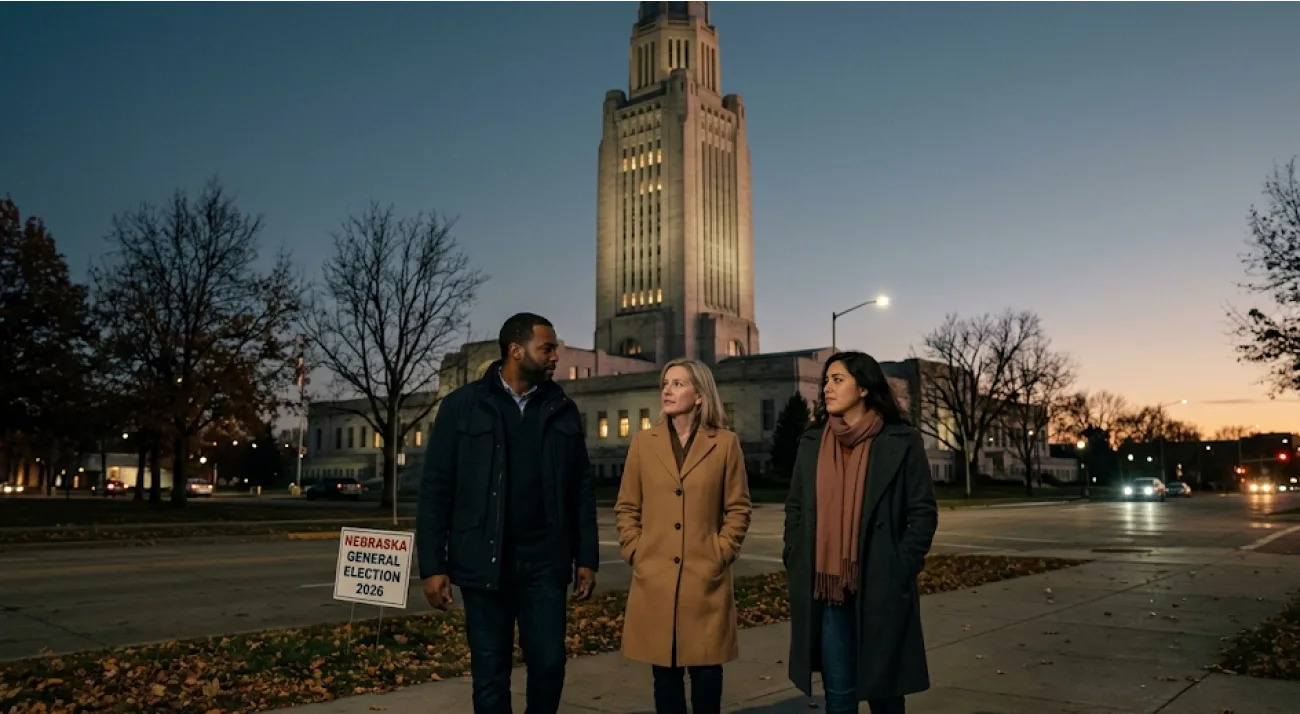
Nebraska voters have rejected an effort to legalize statewide online sports betting, delivering a significant setback to gambling operators that invested more than $20 million in a campaign to expand the state’s regulated wagering market.
During the November 3, 2026, general election, voters opposed two related ballot measures, Initiative 440 and Initiative 441, that would have created a constitutional and statutory framework for mobile sports betting.
The measures faced approximately 54% opposition, according to unofficial election results reported after polls closed.
The outcome is particularly significant because major sportsbook operators, including DraftKings and FanDuel, provided most of the financial support behind the legalization campaign.
Supporters argued that Nebraska could capture tax revenue from residents who already place sports wagers through neighboring states or unauthorized offshore platforms.
Opponents questioned whether expanding gambling access through smartphones would create additional financial and social risks for Nebraska residents.
As of November 5, 2026, statewide mobile sports betting remains illegal in Nebraska. In-person sports wagering at authorized racetrack casinos continues to be permitted.
The election result raises an important question for the U.S. gambling industry: Why did Nebraska voters reject mobile sports betting despite extensive industry spending, and what happens to legalization efforts now?
Nebraska Election Results: Initiatives 440 and 441 Both Fail
The unofficial vote totals published on November 4 show that the two measures lost by similar margins.
| Ballot measure | Yes votes | No votes | Result |
|---|---|---|---|
| Initiative 440 | 329,309 (45.11%) | 400,671 (54.89%) | Rejected |
| Initiative 441 | 332,342 (45.53%) | 397,583 (54.47%) | Rejected |
Source: Ballotpedia, reporting November 4 unofficial election returns. Results remain subject to official certification. Ballotpedia+1
Nebraska’s vote on online sports betting
Yes
No
The results demonstrate that opposition was not limited to one aspect of the proposal. Voters rejected both the constitutional authorization and the accompanying regulatory framework.
The two measures were designed to operate together, meaning that both needed approval for the proposed system to take effect.
What was Initiative 440?
Initiative 440 was a proposed amendment to the Nebraska Constitution.
It would have authorized the Legislature to enact laws allowing online sports wagering by individuals physically located within Nebraska.
The amendment was necessary because the state’s existing constitutional and statutory gambling framework did not permit statewide mobile sports betting.
What was Initiative 441?
Initiative 441 was a proposed state law that would have established the regulatory framework for mobile sports wagering.
It would have authorized the Nebraska Racing and Gaming Commission to develop rules governing licensed operators, online platforms, and wagering activity.
The proposal also included taxation and revenue allocation provisions.
Because voters rejected both measures, neither proposed change will take effect. Nebraska Secretary of State+2
DraftKings and FanDuel Funded Most of the $22.5 Million Campaign
The campaign’s financial scale was one of the most notable features of Nebraska’s 2026 gambling debate.
The pro-legalization committee, Tax Relief Nebraska, raised approximately $22.5 million through October 29, according to campaign finance reporting.
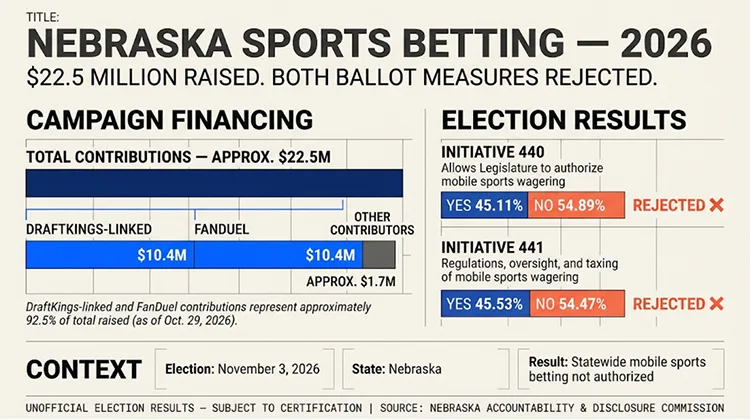
Two major sportsbook companies provided most of that funding.
Nebraska online sports betting campaign financing
Total campaign contributions
$22.5M
Approximately, through Oct. 29
DraftKings-linked contribution
$10.4M
DK Crown Holdings
FanDuel contribution
$10.4M
FanDuel Inc.
Combined share from two operators
~92.5%
Of reported contributions
Campaign finance figures are rounded. Contributions represent money raised, not necessarily identical amounts spent.
Other gambling companies, including BetMGM and Fanatics, also contributed to the legalization effort.
The financial support reflected the commercial significance of a potential Nebraska mobile sports betting market.
DraftKings and FanDuel already operate in numerous regulated U.S. jurisdictions. Legalization would have created another opportunity to expand their customer bases.
Why did the industry spend so much?
Nebraska represented a market that sportsbook operators could not fully access under existing state law.
Although residents can place legal sports wagers at authorized racetrack casinos, they cannot use conventional state-licensed sportsbook apps to wager remotely from elsewhere in Nebraska.
That restriction limits the convenience and geographic reach of the regulated market.
For operators, a statewide mobile framework could have created new opportunities through licensed racetrack partnerships.
However, the scale of the campaign’s funding did not translate into voter approval.
The result demonstrates that financial resources and advertising reach do not necessarily overcome concerns about expanding gambling access.
Why Nebraska Voters Rejected Mobile Sports Betting
The election outcome does not establish a single explanation for how every voter made their decision.
However, campaign messaging, public testimony, and reactions from gambling industry analysts point to several important areas of disagreement.
1. Concerns about gambling addiction and financial harm
Opponents argued that allowing sports wagers through smartphones would make gambling more accessible and potentially increase financial risks.
Unlike in-person wagering, mobile betting would allow eligible customers to place bets from almost anywhere within the state.
Critics expressed concern about the effects of widespread sports betting advertising, particularly on younger adults and people vulnerable to gambling-related harm.
These concerns formed an important part of the campaign against legalization.
2. Skepticism about promised property tax relief
Tax Relief Nebraska emphasized the possibility of using gambling tax revenue to reduce property tax burdens.
However, critics questioned whether the projected revenue would be substantial enough to make a meaningful difference.
Nebraska residents have faced persistent debates over property taxes, school funding, and state revenue.
For some opponents, the proposed gambling expansion did not appear to offer a sufficiently compelling solution.
3. Opposition to out-of-state gambling companies
DraftKings and FanDuel’s substantial campaign contributions became a prominent issue.
Opponents argued that much of the financial benefit from mobile sports betting would flow to large gambling companies headquartered outside Nebraska.
Supporters countered that regulated operations would create taxable activity within the state and retain revenue that might otherwise go to neighboring jurisdictions.
4. Doubts about previous casino revenue projections
Nebraska voters approved casino gambling at licensed racetracks in 2020.
However, subsequent gaming revenue did not immediately reach the levels some supporters had anticipated.
Industry analyst Brendan Bussmann, managing partner of B Global, argued after the November 3 election that the mobile sports betting campaign relied too heavily on revenue projections that voters might not find convincing.
The experience of Nebraska’s earlier casino expansion therefore became part of the broader debate about the credibility of new gambling revenue forecasts. SBC Americas+1
The $166 Million Property Tax Relief Promise
One of the campaign’s central arguments was that legal online sports betting could provide more than $166 million in property tax relief over 10 years.
Tax Relief Nebraska promoted that projection as a reason to support the two initiatives.
The proposed framework would have applied a 20% tax rate to qualifying sports betting revenue and directed 70% of the relevant tax proceeds toward property tax relief, following the approach used for casino gaming in Nebraska.
That proposed allocation was central to the campaign’s messaging.
How would the tax revenue have been distributed?
The proposal was designed to connect mobile sports betting with the state’s existing gambling tax structure.
| Proposed feature | Description |
|---|---|
| Gaming tax rate | 20% |
| Property tax relief allocation | 70% of applicable tax proceeds |
| Regulator | Nebraska Racing and Gaming Commission |
| Operator model | Online platforms linked to licensed racetrack casinos |
| Campaign’s projected tax relief | More than $166 million over 10 years |
The projected $166 million was a campaign estimate, not guaranteed tax revenue.
It depended on assumptions about how much Nebraskans would wager, how much sportsbooks would retain after paying winnings, and how quickly the market would develop.
Why the revenue projections faced criticism
Nebraska State Senator Mike Jacobson questioned the significance of the expected tax revenue relative to the state’s overall property tax burden.
Jacobson estimated that mobile sports betting might generate approximately $17 million annually, a small amount compared with the approximately $5.6 billion in property taxes paid by Nebraskans in 2025.
Gaming industry analysts also noted that Nebraska’s 2020 casino legalization campaign had created expectations that actual revenue took time to approach.
For example, property tax relief receipts from casino gaming were reported at approximately $8 million in fiscal year 2022–23 and $14 million in the following fiscal year, below an earlier estimate of roughly $34 million for 2022–23. SBC Americas
These comparisons do not establish that mobile sports betting would have generated no meaningful revenue.
They do explain why opponents questioned whether the financial benefits justified expanding access to gambling.
Nebraska Sports Betting Remains Legal Only at Racetrack Casinos
The November 3 vote does not prohibit every form of sports betting in Nebraska.
The state already allows in-person sports wagering at licensed racetrack casinos.
Nebraska voters approved casino gambling at racetracks in 2020, and the Legislature subsequently authorized retail sports betting in 2021.

The first legal retail sportsbooks began operating in June 2023.
As of November 2026, residents can place authorized sports bets only while physically present at eligible racetrack casino locations.
What Nebraska residents can and cannot do
| Gambling activity | Nebraska legal status |
|---|---|
| In-person sports betting at authorized racetrack casinos | Legal |
| Statewide mobile sportsbook betting | Not authorized |
| Real-money online casino slots and table games | Not authorized |
| Casino gambling at licensed racetrack casinos | Legal |
| Online wagering through the rejected Initiatives 440 and 441 | Not authorized |
Nebraska’s retail sports betting market operates under the oversight of the Nebraska Racing and Gaming Commission.
The rejection of mobile wagering does not revoke existing retail sportsbook authorizations.
It simply prevents the proposed statewide online expansion from taking effect.
Which Nebraska casinos offer retail sports betting?
Nebraska’s regulated racetrack casino market includes properties such as WarHorse Casino Lincoln, WarHorse Casino Omaha, and Grand Island Casino Resort.
Customers must follow the individual property’s applicable wagering requirements.
The November election does not authorize those businesses to accept remote mobile wagers statewide.
Nebraska Could Continue Losing Sports Betting Activity to Neighboring States
Supporters of legalization argued that Nebraska residents already participate in mobile sports betting by traveling to states where it is legal.
Iowa, for example, permits statewide mobile sports betting through licensed operators.
A Nebraska resident who physically travels into Iowa may be eligible to place a legal mobile wager there, provided the person meets Iowa’s age, identity verification, and other requirements.
Sportsbook apps typically use geolocation technology to confirm that customers are physically present within an authorized jurisdiction.
That means a customer cannot simply use an Iowa-licensed sportsbook from a Nebraska address.
Would legalization have brought gambling revenue back to Nebraska?
Potentially, but the exact amount is uncertain.
Supporters argued that legalization could capture taxable activity that currently occurs outside Nebraska.
However, there is no definitive public accounting of how much money Nebraska residents wager through neighboring states or unauthorized platforms.
It would therefore be misleading to assume that every dollar currently wagered elsewhere would automatically move to a regulated Nebraska market.
Consumer preferences, available products, sportsbook promotions, and tax rates could all influence participation.
The election result leaves Nebraska’s existing geographic restrictions unchanged, even as mobile sports betting continues to operate in many other U.S. states.
FanDuel CEO Dan Taylor Responds to Nebraska’s Defeat
The election result quickly attracted attention from national gambling industry executives.
On November 4, Dan Taylor, CEO of Flutter Entertainment, the parent company of FanDuel, addressed the defeat during the company’s third-quarter earnings call.
Taylor acknowledged disappointment with the outcome while maintaining that Flutter sees longer-term opportunities for additional U.S. sports betting and iGaming legalization.
His remarks reflected a broader industry position: regulated gambling can generate tax revenue and establish consumer protection standards, but political approval remains a necessary condition for market expansion. SBC Americas
What the result means for DraftKings and FanDuel
The two companies provided approximately $20.8 million in combined contributions to the Nebraska campaign.
That investment did not result in the legalization they supported.
For DraftKings and FanDuel, the immediate consequences include a continued inability to offer conventional statewide mobile sportsbooks in Nebraska under the proposed framework.
The defeat may also encourage operators to reconsider how they communicate the potential benefits and risks of gambling expansion in future campaigns.
However, the outcome does not establish that the companies will abandon Nebraska permanently.
Their future strategies will depend on political developments, regulatory opportunities, and business priorities.
Nebraska’s Vote Could Influence Gambling Legalization Campaigns in Other States
Nebraska was not the only jurisdiction where voters rejected gambling expansion on November 3.
In northeastern Indiana, voters in Allen, DeKalb, and Steuben counties rejected a proposal connected to a potential casino development.
A separate horse racing-related measure also failed in Virginia.
These outcomes attracted attention because they occurred during the same election cycle, despite substantial commercial interest in expanding regulated gambling. SBC Americas
However, the results should not be interpreted as proof that Americans nationwide oppose all forms of gambling legalization.
Each measure involved different regulations, economic considerations, and local circumstances.
Nebraska’s result is particularly relevant to mobile sports betting because it was a direct statewide vote on expanding an existing retail wagering market.
Could the result affect online casino legalization?
Nebraska’s measures concerned online sports betting, not real-money online casino gaming.
The two products have different regulatory structures and economic characteristics.
Nevertheless, the election may influence how lawmakers and gambling operators approach proposals for other forms of online gaming.
States considering iGaming expansion may pay closer attention to public attitudes, responsible gambling concerns, tax projections, and campaign financing.
The lesson for the industry is that expanding an existing gambling market requires more than demonstrating potential revenue.
Supporters must also convince voters or lawmakers that the regulatory framework adequately addresses consumer risks.
What Happens Next for Nebraska Online Sports Betting?
With Initiatives 440 and 441 rejected, Nebraska has no approved statewide mobile sports betting launch date.
Any future legalization effort would need a new legal path.
One possibility is a renewed legislative proposal. Another is a future ballot initiative.
State Senator Eliot Bostar previously supported efforts to advance mobile sports betting through the Nebraska Legislature.
In January 2025, Bostar introduced a proposal intended to place the issue before voters, but legislative opposition prevented it from advancing.
The 2026 campaign subsequently pursued a voter petition process.
Could Nebraska vote on online sports betting again in 2028?
A future ballot campaign is possible, but no new statewide vote has been scheduled.
Industry consultant Brendan Bussmann suggested that supporters might need to wait four to six years before making another major ballot attempt.
That was an industry assessment, not a legal requirement or official election timetable. SBC Americas
A renewed campaign would likely need to address concerns about gambling advertising, addiction prevention, operator accountability, and the credibility of tax revenue projections.
For now, Nebraska’s existing retail sports betting framework remains in place.
Frequently Asked Questions About Nebraska Online Sports Betting
Did Nebraska legalize online sports betting in November 2026?
No. Nebraska voters rejected Initiatives 440 and 441 in the November 3, 2026, general election. The results reported on November 4 were unofficial and subject to certification.
How much did DraftKings and FanDuel spend supporting legalization?
DK Crown Holdings, linked to DraftKings, and FanDuel each contributed approximately $10.4 million to Tax Relief Nebraska. The committee raised approximately $22.5 million through October 29.
Is sports betting completely illegal in Nebraska?
No. In-person sports betting is permitted at authorized racetrack casinos. Statewide mobile sports betting remains unauthorized.
What were Initiatives 440 and 441?
Initiative 440 proposed a constitutional amendment allowing online sports wagering legislation. Initiative 441 proposed the accompanying statutory regulatory framework. Both measures needed to pass.
Would mobile sports betting have reduced Nebraska property taxes?
Supporters projected more than $166 million in property tax relief over 10 years. That was a forecast, not guaranteed revenue, and critics disputed its significance and underlying assumptions.
When could Nebraska legalize online sports betting?
There is no confirmed timeline. A new legislative or ballot initiative effort would be required, and future approval is uncertain.
Final Thoughts: Nebraska Delivers a Major Setback to Online Sports Betting Expansion
Nebraska’s November 3 election represents one of the most notable U.S. sports betting legalization defeats of 2026.
Despite approximately $22.5 million in campaign contributions, including $20.8 million from DraftKings-linked interests and FanDuel, voters rejected both measures needed to establish a statewide mobile wagering market.
Initiative 440 lost with approximately 55% voting against it, while Initiative 441 failed with approximately 54.5% opposition.
The result leaves Nebraska’s existing in-person sports betting system unchanged and prevents the proposed mobile expansion from moving forward.
It also highlights the challenges facing gambling companies that rely on economic arguments to secure voter approval.
Property tax relief, additional regulatory oversight, and the possibility of capturing out-of-state betting activity were not sufficient to convince a majority of Nebraska voters.
The central takeaway is that Nebraska’s online sports betting market will remain closed to conventional statewide mobile wagering, despite one of the most expensive gambling legalization campaigns in the state’s history.
For the broader U.S. gaming industry, the result demonstrates that public concerns about gambling expansion can outweigh substantial financial investment and projected tax benefits.
The next question is whether Nebraska lawmakers and gambling operators will pursue a revised proposal or wait several years before returning to voters.
Leave a Reply