
Texas could be entering a new chapter in its long-running debate over legal sports betting following one of the most consequential political upsets of the November 3, 2026, midterm elections.
Democratic state representative Vikki Goodwin defeated Republican Lieutenant Governor Dan Patrick, removing a powerful political opponent of sports betting and casino expansion from Texas Senate leadership.
Patrick, who had served as lieutenant governor since January 2015, repeatedly opposed proposals to expand gambling in the state. His position and control over the Senate’s legislative agenda made it difficult for legalization bills to advance.
Goodwin’s victory changes that political equation.
The Austin-area lawmaker has expressed greater openness to allowing Texans to vote on gambling expansion, creating renewed optimism among sports betting companies, casino developers, and industry advocates ahead of the 2027 Texas legislative session.
However, the election result does not automatically legalize sports betting.
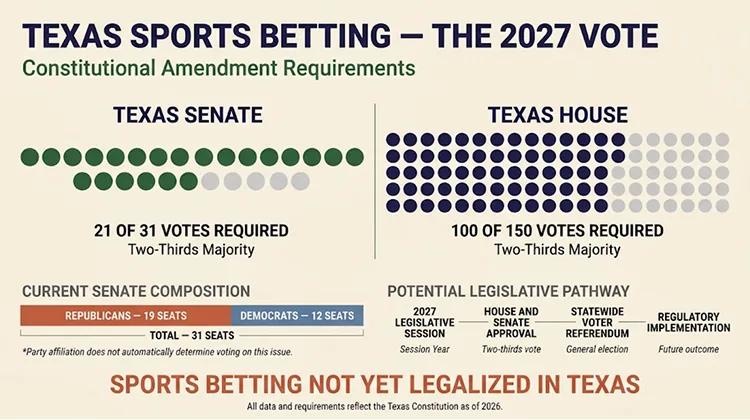
Texas still requires a constitutional amendment supported by two-thirds of both legislative chambers, followed by voter approval, to establish the proposed legal framework.
Republicans also retain a 19–12 majority in the Texas Senate, meaning any constitutional amendment would require substantial bipartisan support.
As of November 5, 2026, online sports betting and conventional real-money online casinos remain illegal in Texas. Goodwin’s election creates a new legislative opportunity, not an approved gambling market.
Texas Lieutenant Governor Election Results: Goodwin Defeats Patrick
The November 3 election produced a significant change in Texas leadership.
According to the Texas Secretary of State’s unofficial results updated November 4, Goodwin received more than 5.08 million votes, defeating Patrick by approximately 599,000 votes.
Texas lieutenant governor election — November 3, 2026
Vikki Goodwin
5,083,581
Democratic candidate
Dan Patrick
4,484,652
Republican incumbent
Vote totals by candidate
01.5M3M4.5M6MGoodwinPatrickOther candidates
Unofficial returns from the Texas Secretary of State, updated November 4, 2026. Totals may change during certification. Tuesday, November 3, 2026
| Election detail | Result |
|---|---|
| Election date | November 3, 2026 |
| Winning candidate | Vikki Goodwin (Democrat) |
| Defeated incumbent | Dan Patrick (Republican) |
| Goodwin’s votes | 5,083,581 |
| Patrick’s votes | 4,484,652 |
| Margin | 598,929 votes |
| New term begins | January 2027 |
Goodwin’s victory represents a major political shift because the lieutenant governor is one of the most influential officials in Texas government.
Unlike lieutenant governors in many other states, Texas’ lieutenant governor exercises extensive authority over the state Senate, including legislative referrals, committee leadership, and the chamber’s agenda.
That institutional power is particularly relevant to gambling legislation, which has repeatedly struggled to advance through the Senate.
Why Dan Patrick Was Texas Sports Betting’s Biggest Political Obstacle
Dan Patrick’s departure is significant because he did more than publicly oppose gambling expansion.
As lieutenant governor, Patrick held considerable influence over which bills reached the Senate floor.
Throughout his tenure, he expressed skepticism about legalizing sports betting and commercial casinos, arguing that there was insufficient support among Senate Republicans.
That position made the Senate a difficult environment for gambling legislation, even when proposals attracted support from major professional sports organizations and business interests.
Texas House approved sports betting in 2023, but the Senate did not
The clearest example came during the 2023 legislative session.
On May 11, 2023, the Texas House approved House Joint Resolution 102 (HJR 102), a proposed constitutional amendment authorizing the Legislature to legalize wagering on certain sporting events.
The final verified vote was:
Votes in favor
101
Votes against
42
Present, not voting
1
Official Texas House Journal, May 11, 2023. Texas Legislature Online
The resolution secured the House supermajority necessary to propose a constitutional amendment.
However, it did not receive the required approval in the Senate.
Consequently, Texans never voted on that proposed amendment.
The experience demonstrated that House support alone could not overcome opposition within Senate leadership.
The 2025 legislative session produced another setback
Sports betting advocates returned to Austin during the 2025 regular session, but legalization proposals again failed to advance.
Patrick’s continued opposition contributed to an unfavorable political environment for the measures.
With Goodwin preparing to assume office, supporters now see an opportunity for more substantive Senate hearings and negotiations in 2027.
The important distinction is that a more receptive Senate president can improve a bill’s prospects without guaranteeing the votes necessary for passage.
Who Is Vikki Goodwin, and What Is Her Position on Gambling?
Vikki Goodwin is a Democratic state representative from the Austin area who defeated Patrick in the November 2026 election.
Her campaign emphasized public education, healthcare, housing affordability, and other state policy priorities.
On gambling, Goodwin has expressed support for allowing Texas voters to decide whether sports betting and casino gambling should be legalized.
That position differs substantially from Patrick’s approach.
Goodwin’s support for a public vote does not necessarily mean she endorses every proposed casino development, sports betting tax structure, or operator licensing arrangement.
It means she is more willing to consider putting the question before Texans.
Goodwin previously supported the 2023 sports betting amendment
Goodwin’s record provides evidence of that position.
She voted in favor of HJR 102 during the Texas House’s consideration of the sports betting constitutional amendment in May 2023.
That vote supports the industry’s expectation that she could be more receptive to legalization proposals as lieutenant governor. 60th Day+1
Could Goodwin allow a gambling bill to reach the Senate floor?
Potentially.
The lieutenant governor influences committee assignments, legislative referrals, and Senate proceedings.
A lieutenant governor willing to consider sports betting legislation could provide opportunities for hearings and negotiations that were difficult under Patrick.
However, Goodwin cannot unilaterally approve a constitutional amendment.
She would still need a sufficient number of senators to support the proposal.
Texas Needs 21 Senate Votes to Advance a Sports Betting Amendment
The largest remaining obstacle is mathematical.
Article XVII, Section 1 of the Texas Constitution requires constitutional amendments to receive approval from two-thirds of all elected members of each legislative chamber before being submitted to voters.

That means a sports betting constitutional amendment would need:
Votes required to propose a Texas constitutional amendment
Texas Senate
21 of 31
Two-thirds threshold
Texas House
100 of 150
Two-thirds threshold
Required legislative supermajorities under Article XVII of the Texas Constitution. Texas Legislature Online+1
Following the 2026 election, Republicans retain 19 Senate seats while Democrats hold 12.
That composition makes bipartisan cooperation essential.
Even if all 12 Democratic senators supported a constitutional amendment, at least nine Republican senators would also need to vote for it.
If some Democrats opposed the proposal, additional Republican votes would be required.
Texas Senate composition after the 2026 election
| Party | Senate seats |
|---|---|
| Republicans | 19 |
| Democrats | 12 |
| Total | 31 |
| Votes needed for amendment | 21 |
This is why Goodwin’s victory should be described as a political opening rather than a guarantee of legalization.
She may change which bills receive consideration, but she cannot change the constitutional voting threshold.
Texas’ 2026 Election Also Changed the Governor’s Office
Goodwin’s victory was not the only major statewide development.
Democrat Gina Hinojosa defeated Republican Governor Greg Abbott in the November 3 election, according to reported election results.
Hinojosa’s victory adds another dimension to the gambling debate.
Although a change in governor could alter the broader political environment, Hinojosa previously voted against the 2023 sports betting constitutional amendment while serving in the Texas House.
That record complicates any assumption that the incoming administration will uniformly support gambling expansion.
The new political landscape is therefore more nuanced than a simple shift from anti-gambling to pro-gambling leadership. Tuesday, November 3, 2026+2
Could the Democratic-controlled House help legalization?
Democrats also gained control of the Texas House in the November 2026 election, winning at least 76 of its 150 seats, according to November 5 reporting.
That change could affect committee leadership and legislative priorities.
Nevertheless, a House majority is not sufficient to propose a constitutional amendment.
Supporters would still need 100 House votes, requiring cooperation across party lines. Axios
What the 2027 Texas Legislative Session Could Look Like
Texas lawmakers are scheduled to return to Austin for their next regular legislative session on January 12, 2027.
That session could become the first meaningful opportunity in years for sports betting supporters to pursue legislation under a lieutenant governor more receptive to the issue.
However, several steps must occur before legalization becomes possible.
- Step 1 — Introduce a new proposalLegislators must file a constitutional amendment addressing sports betting authorization and determine which forms of gambling would be covered.
- Step 2 — Secure committee considerationThe proposal must move through the relevant legislative committees. Goodwin’s leadership could influence whether it receives meaningful consideration.
- Step 3 — Obtain legislative supermajoritiesSupporters must secure at least 100 votes in the House and 21 in the Senate.
- Step 4 — Submit the amendment to votersIf approved by the Legislature, the amendment must be presented at an election on a date specified by lawmakers.
- Step 5 — Establish regulations and licensingIf voters approve the amendment, Texas would need to implement the applicable licensing, taxation, consumer protection, and regulatory framework before operators could launch.
The Texas Constitution allows the Legislature to specify the date of a constitutional amendment election.
Therefore, a November 2027 referendum is possible but has not been scheduled.
No confirmed statewide sports betting launch date exists. Texas Legislature Online+1
DraftKings, FanDuel, and Texas Sports Teams Have Major Interests in Legalization
Texas represents one of the largest remaining untapped markets for regulated U.S. sports betting.
With a population exceeding 31 million, the state offers a potentially substantial customer base for operators such as DraftKings, FanDuel, BetMGM, and Fanatics Sportsbook.
Major Texas professional sports organizations have also supported efforts to establish a regulated sports betting market.
Supporters have included organizations associated with the Dallas Cowboys, Houston Texans, Dallas Mavericks, Houston Astros, Texas Rangers, and other professional franchises.
During the 2023 legislative debate, representatives of several Texas sports teams and industry organizations registered support for the proposed constitutional amendment. House Research Organization
Why is Texas so attractive to sportsbook operators?
The state’s appeal extends beyond population size.
Texas has major professional sports franchises, large metropolitan areas, extensive college sports followings, and a strong sports culture.
Houston, Dallas–Fort Worth, San Antonio, and Austin could provide significant potential customer bases.
However, estimates of future Texas sportsbook revenue remain projections until a regulated market exists.
The number of residents who follow sports cannot be treated as the number who would become paying sportsbook customers.
Could legalization generate substantial tax revenue?
A regulated sports betting market could generate state tax revenue from licensed operators.
The actual amount would depend on the tax rate, operator participation, customer activity, promotional deductions, and the final regulatory framework.
Tax revenue would generally be calculated from a defined gaming revenue measure rather than the total amount wagered.
For example, a sportsbook accepting $100 million in bets does not earn $100 million in revenue because most wagers are returned to winning customers.
Texas lawmakers would need to decide whether new gambling tax revenue should support education, property tax relief, general government services, or other priorities.
No tax rate or revenue allocation for a 2027 Texas sports betting market has been enacted.
Could Texas Legalize Online Casinos Alongside Sports Betting?
The November election has also renewed discussion of commercial casinos and online casino gaming.
However, these are separate policy questions.
Sports betting generally involves wagering on sporting events, while online casino gaming includes digital slots, blackjack, roulette, and other casino-style games.
Texas could consider one category without authorizing the others.
| Gambling category | Current Texas status | Potential future pathway |
|---|---|---|
| Statewide online sports betting | Not legal | Constitutional amendment and implementing legislation |
| Retail commercial sportsbooks | Not legal | New authorization and regulatory framework |
| Commercial casino resorts | Not generally authorized | Separate legislative and constitutional changes |
| Real-money online casino gaming | Not legal | Specific authorization and regulatory framework |
| State lottery | Legal | Existing state-regulated system |
| Certain tribal gaming activities | Permitted under applicable legal frameworks | Governed by separate federal and tribal gaming rules |
Texas has existing legal exceptions for the state lottery, qualifying charitable gambling, certain racing activities, and tribal gaming conducted under applicable law.
Those exceptions do not authorize conventional statewide online sports betting or commercial online casinos.
Would casino legalization face greater opposition?
Potentially.
Commercial casino expansion has historically generated strong debate in Texas.
Supporters argue that destination casino resorts could create jobs, attract tourism, and generate tax revenue.
Opponents raise concerns about gambling addiction, community impacts, financial losses, and the expansion of commercial gambling.
A sports betting amendment could therefore follow a different political path from a broader casino proposal.
Goodwin’s victory creates an opportunity for both discussions, but the two industries should not be treated as a single legalization package unless lawmakers introduce legislation linking them.
Why Gambling Opponents Could Still Block Texas Sports Betting
Despite the change in leadership, Texas has a substantial political constituency opposed to gambling expansion.
Religious organizations, social conservatives, and consumer protection advocates have previously challenged proposals to authorize sports betting and commercial casinos.
During the 2023 House debate, organizations opposing HJR 102 included representatives associated with Texas Baptist groups, Texas Values, and other conservative advocacy organizations. House Research Organization
Their concerns have included gambling-related financial harm, increased accessibility through smartphones, and the potential social costs of expanding wagering.
Sports betting supporters counter that a regulated market could offer clearer consumer protections and oversight than unauthorized gambling activity.
Neither position automatically resolves the underlying policy debate.
For a constitutional amendment to advance, lawmakers would need to evaluate issues such as:
- Minimum betting age, identity verification, and geolocation.
- Responsible gambling programs and self-exclusion.
- Restrictions on advertising and promotions.
- Licensing standards and regulatory enforcement.
- Taxation, revenue allocation, and consumer data protection.
The debate is likely to involve both economic arguments and questions about the social consequences of gambling expansion.
Texas vs. Nebraska: Two Different Election Outcomes for Sports Betting
The November 2026 elections produced contrasting developments in two states.
In Nebraska, voters directly rejected proposals to authorize statewide mobile sports betting.
In Texas, voters elected a lieutenant governor who may be more receptive to allowing a future referendum.
| Issue | Texas | Nebraska |
|---|---|---|
| November 2026 development | Dan Patrick defeated by Vikki Goodwin | Mobile sports betting ballot measures rejected |
| Direct public vote on sports betting? | No | Yes |
| Statewide mobile sports betting legal? | No | No |
| Immediate effect | Changes future legislative leadership | Blocks the proposed legalization framework |
| Next opportunity | Potential 2027 legislation | Future legislative or ballot effort |
The distinction matters.
Texas voters did not approve sports betting in the November 3 election.
They elected new political leaders who may approach the issue differently.
The state still faces a legislative and constitutional approval process.
Nebraska, meanwhile, demonstrated that even a well-funded gambling expansion campaign can fail when voters directly decide the issue.
When Could Texas Sports Betting Become Legal?
There are several possible scenarios following Goodwin’s election.
| Scenario | What it would mean |
|---|---|
| Amendment advances in 2027 | Lawmakers could schedule a statewide referendum. |
| Amendment passes both chambers but voters reject it | Sports betting would remain unauthorized under the proposed framework. |
| Senate fails to reach 21 votes | The amendment would not advance to voters. |
| Voters approve an amendment | Texas could begin establishing the authorized regulatory and licensing system. |
| No agreement emerges | Legalization could be delayed to a later legislative session. |
Even if Texas voters approve a future constitutional amendment, sportsbooks would not necessarily launch immediately.
Regulators would need to establish rules, process licenses, and oversee operational preparations.
The length of that process would depend on the legislation.
There is currently no confirmed date for legal Texas sports betting apps to launch.
Frequently Asked Questions About Texas Sports Betting Legalization
Is sports betting legal in Texas in November 2026?
No. Texas has not authorized conventional statewide online or retail sports betting. The November 3 election changed political leadership but did not change the underlying gambling laws.
Did Vikki Goodwin defeat Dan Patrick?
Yes. Goodwin defeated Patrick in the November 3, 2026, lieutenant governor election. Unofficial Texas Secretary of State results updated November 4 show Goodwin receiving 5,083,581 votes compared with Patrick’s 4,484,652.
Does Vikki Goodwin support legal sports betting?
Goodwin has supported allowing Texans to vote on gambling expansion. She also voted for the 2023 Texas House sports betting constitutional amendment.
Could Texas legalize sports betting in 2027?
A legalization proposal could advance during the 2027 legislative session. However, it would require approval from two-thirds of both chambers and subsequent voter approval. No referendum or launch date is confirmed.
How many votes are needed to legalize Texas sports betting?
A proposed constitutional amendment requires at least 100 votes in the 150-member Texas House and 21 votes in the 31-member Texas Senate before it can be submitted to voters.
Will DraftKings and FanDuel launch in Texas in 2027?
Neither company has authorization to operate a conventional real-money sportsbook in Texas. A 2027 launch cannot be assumed because the state has not legalized sports betting.
Are online casinos legal in Texas?
No. Texas has not authorized conventional real-money online casino games such as slots, blackjack, or roulette.
Final Thoughts: Texas Sports Betting Has a New Opportunity, Not a Guaranteed Victory
Vikki Goodwin’s November 3 victory over Dan Patrick marks a significant political development for the Texas gambling industry.
Patrick’s opposition to sports betting and commercial casino expansion had made the Senate a major obstacle to legalization.
Goodwin’s election creates the possibility of a different legislative approach when lawmakers return to Austin in January 2027.
But important barriers remain.
Republicans retain a 19–12 majority in the Senate, constitutional amendments require 21 Senate votes and 100 House votes, and Texans would still need to approve any proposed constitutional change.
The election of Gina Hinojosa as governor also introduces uncertainty because she opposed the 2023 House sports betting amendment.
The central takeaway is that Texas sports betting legalization has become more politically plausible after Dan Patrick’s defeat, but it remains far from certain.
For DraftKings, FanDuel, casino developers, professional sports organizations, and Texas residents, the next meaningful developments will be the introduction of new legislation, committee hearings, and evidence of bipartisan support.
Until those steps occur, Texas remains one of the largest U.S. states without a regulated statewide sports betting market.
Leave a Reply