

DraftKings has sharply reduced its 2026 profit forecast as the Boston-based gambling company commits up to $700 million to expanding its prediction markets business, raising questions about whether its next major growth opportunity is worth the near-term financial cost.
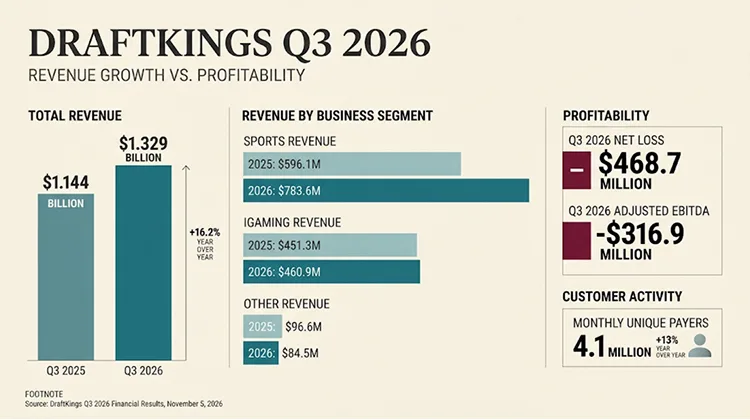
The company announced its third-quarter financial results on November 5, 2026, reporting $1.329 billion in revenue, a 16.2% increase from the same period in 2025.
Despite that growth, DraftKings lowered its full-year adjusted EBITDA guidance from $700 million–$900 million to just $175 million–$275 million.
The reduction reflects an aggressive investment strategy centered on DraftKings Predictions, a product that allows customers to trade event contracts in markets that differ from traditional state-regulated sports betting.
DraftKings expects its prediction markets business to reduce 2026 adjusted EBITDA by $650 million–$700 million, while generating little net revenue this year after promotional incentives.
The company is betting that those upfront costs will help it establish a meaningful position in a market attracting competition from Kalshi and Polymarket.
CEO Jason Robins says more than 1.6 million customers have already engaged with DraftKings Predictions during 2026.
However, the company’s larger quarterly losses and reduced profitability outlook have prompted renewed investor scrutiny.
The central question is whether DraftKings can turn early prediction market adoption into sustainable revenue without weakening the profitability of its established sportsbook and online casino operations.
DraftKings Q3 2026 Earnings: Revenue Climbs 16% to $1.33 Billion
DraftKings’ third-quarter results reveal a business experiencing substantial revenue growth alongside mounting investment costs.
For the three months ended September 30, 2026, the company generated $1.329 billion in total revenue, compared with $1.144 billion during the third quarter of 2025.
The increase was driven primarily by stronger sports wagering activity, improved sportsbook net revenue margins, and continued customer engagement.
However, profitability moved in the opposite direction.
DraftKings Q3 2026 financial highlights
Quarterly revenue
$1.33B
+16.2% year over year
Net loss
$468.7M
Versus $256.8M in Q3 2025
Adjusted EBITDA
−$316.9M
Quarterly adjusted EBITDA loss
Monthly unique payers
4.1M
+13% year over year
DraftKings revenue growth by business segment
| Business segment | Q3 2025 | Q3 2026 | Change |
|---|---|---|---|
| Sports revenue | $596.1M | $783.6M | +31.5% |
| iGaming revenue | $451.3M | $460.9M | +2.1% |
| Other revenue | $96.6M | $84.5M | −12.5% |
| Total revenue | $1.144B | $1.329B | +16.2% |
Q3 2025
Q3 2026
$0$250M$500M$750M$1BSportsiGamingOtherAmounts rounded to the nearest $0.1 million. DraftKings’ reported sports revenue includes sportsbook and prediction markets activity; it is not a pure sportsbook-only figure. MarketScreener
Sports revenue was the strongest-performing category, increasing by approximately $187.5 million.
Online casino revenue also grew, although at a slower rate, as the company continued investing in customer acquisition and promotions.
The contrast between rising revenue and widening losses illustrates the challenge facing DraftKings: its established gambling businesses are expanding, but the company is simultaneously financing an expensive new growth strategy.
Why DraftKings Slashed Its 2026 Adjusted EBITDA Forecast
The most significant development in the earnings announcement was the company’s reduction in full-year financial guidance.
DraftKings previously expected adjusted EBITDA of $700 million–$900 million for 2026.
It now anticipates $175 million–$275 million.
At the midpoint, that represents a reduction from $800 million to $225 million, or approximately 71.9%.
DraftKings’ revised 2026 financial guidance
| Metric | Previous forecast | New forecast |
|---|---|---|
| Revenue | $6.50B–$6.90B | $6.35B–$6.55B |
| Adjusted EBITDA | $700M–$900M | $175M–$275M |
| Revenue midpoint | $6.70B | $6.45B |
| Adjusted EBITDA midpoint | $800M | $225M |
DraftKings’ prior and revised guidance, published November 5, 2026. DraftKings
A $575 million reduction in expected adjusted EBITDA
The midpoint reduction is particularly important because it is not simply the result of weaker consumer demand.
DraftKings attributed much of the revision to increased investment in its Predictions business.
Management expects the new division to account for $650 million–$700 million in adjusted EBITDA investment during 2026.
That figure is an expected impact on adjusted EBITDA, not necessarily an equivalent amount of cash spent exclusively on advertising.
It reflects the broader cost of building, promoting, and expanding the business.
Core sportsbook and online casino operations remain profitable on an adjusted basis
Excluding the Predictions investment, DraftKings expects its core operations to generate $875 million–$925 million in adjusted EBITDA during 2026.
The company said that outlook also reflects additional investment in iGaming growth and somewhat customer-friendly sports results.
This distinction is essential.
DraftKings is not forecasting an adjusted EBITDA loss for the full company in 2026. It is forecasting a much smaller positive adjusted EBITDA result after substantial investment in Predictions.
Adjusted EBITDA is a non-GAAP measure and should not be confused with net income, operating profit, or free cash flow.
The company’s third-quarter GAAP net loss of $468.7 million demonstrates why investors must evaluate more than one profitability metric.
DraftKings Predictions Investment Reaches $650 Million–$700 Million in 2026
DraftKings’ prediction markets expansion is now one of the company’s largest strategic investments.
The company expects its Predictions business to reduce adjusted EBITDA by $650 million–$700 million in 2026, including $175 million–$225 million during the fourth quarter alone.
Management believes the investment is justified by early customer adoption and the potential to expand beyond conventional sportsbook markets.
More than 1.6 million customers have used DraftKings Predictions
According to the company’s November 5 earnings announcement, more than 1.6 million customers engaged with DraftKings Predictions during the first nine months of 2026.
That figure measures customer participation, not the number of customers generating recurring profits.
DraftKings is using promotions to attract customers and encourage activity, which helps explain why management expects prediction markets revenue to remain immaterial in 2026.
The company expects promotional incentives to offset most of the gross revenue generated by the business.
Why is DraftKings spending so aggressively?
DraftKings is attempting to establish a position in an emerging market before competitors capture a dominant share.
Prediction markets allow participants to trade contracts tied to future events. Depending on the platform and available markets, these can include economic indicators, political developments, entertainment outcomes, and sports-related events.
The company sees opportunities to reach customers beyond its traditional sportsbook footprint, including people in states where conventional mobile sports betting remains unauthorized.
However, the legal treatment of sports event contracts is contested.
State regulators have challenged whether certain contracts constitute gambling products subject to state licensing requirements, while prediction market operators have argued that federally regulated derivatives markets fall under the Commodity Futures Trading Commission’s authority.
The existence of a federally regulated prediction market does not mean that every sports-related contract is free from legal challenges or state enforcement.
That regulatory uncertainty is a significant consideration when evaluating DraftKings’ investment strategy.
Jason Robins and Alan Ellingson Defend the Long-Term Strategy
DraftKings CEO and co-founder Jason Robins described the third quarter as an important stage in the company’s prediction markets expansion.
Management’s central argument is that the established sportsbook and online casino businesses can help finance customer acquisition in Predictions.
Chief Financial Officer Alan Ellingson emphasized that the company is using cash flow generated by its core operations to support the new business.
During the November 6 earnings call, management also discussed customer acquisition economics and the potential for future returns.
DraftKings reported that its 2026 Predictions customer cohort was tracking toward an estimated payback period of approximately 20 months.
That estimate is a management projection based on early performance. It is not a guarantee that customers will remain active, that regulatory conditions will remain unchanged, or that the company will achieve its expected return on investment.
Prediction market trading volume is accelerating
During the earnings call, management reported that October’s annualized Predictions trading volume reached approximately $56.8 billion, more than five times the July level.
This is an annualized measure based on activity during October, not $56.8 billion of actual trading volume completed during the month.
The distinction is important because annualized trading volume describes the pace of activity rather than recognized revenue.
A high trading volume does not automatically translate into high profits, especially when customer promotions and acquisition expenses remain substantial. Quartr
DraftKings Online Casino Revenue Reaches $460.9 Million
While prediction markets dominated the earnings discussion, DraftKings’ established iGaming business remained a major revenue contributor.
The company reported $460.9 million in third-quarter iGaming revenue, compared with $451.3 million a year earlier.
That represents approximately 2.1% year-over-year growth.

DraftKings online casino revenue — Q3 comparison
$0$150M$300M$450M$600MQ3 2025Q3 2026
Source: DraftKings third-quarter financial results, November 5, 2026. DraftKings
Why did online casino revenue grow more slowly than sportsbook revenue?
DraftKings said it was investing more heavily in iGaming customer acquisition and promotional activity.
During the November 6 earnings call, management reported that iGaming customer acquisition increased 76% year over year.
That expansion helped bring more customers into the business, but promotions also limited reported net revenue growth.
Management indicated that underlying iGaming engagement was improving, including a 24% year-over-year increase in paid active days during October.
These indicators suggest the company is prioritizing future customer value over maximizing immediate reported revenue.
However, the effectiveness of that strategy will depend on whether newly acquired customers remain active after promotional incentives decline. StockAnalysis.com
DraftKings operates iGaming in five U.S. states
As of its November earnings announcement, DraftKings reported that its iGaming products were live in five U.S. states, representing approximately 11% of the country’s population.
Its mobile sports betting business had a substantially larger footprint, operating in 27 states, Washington, D.C., and Puerto Rico.
That difference illustrates why online casino legalization remains important to DraftKings’ long-term growth.
Online casino products are generally available in fewer U.S. jurisdictions than mobile sports betting.
Additional state legalization could expand the addressable market for regulated iGaming operators, although no future approvals are guaranteed. DraftKings
DraftKings Stock Falls as Investors Question Prediction Markets Spending
Wall Street reacted negatively to DraftKings’ revised guidance.
Following the November 5 earnings announcement, the company’s shares fell sharply during the November 6 trading session.
Market reporting indicated a decline exceeding 20%, reflecting concerns about the scale of the investment and the time required to generate returns.
Analysts at major financial institutions, including JPMorgan, UBS, and Stifel, subsequently reassessed their outlooks for the company.
The concerns centered on several issues: reduced near-term profitability, intense competition, customer acquisition costs, and uncertainty surrounding the regulation of sports-related prediction contracts.
Why are investors concerned if revenue is increasing?
Revenue growth alone does not establish that a company is becoming more profitable.
DraftKings must balance the costs of acquiring customers, developing products, operating its platforms, complying with regulations, and financing expansion.
Its third-quarter sales and marketing expenses rose to approximately $605.7 million, compared with $360.4 million a year earlier.
That is an increase of approximately $245.3 million, or 68%.
The $605.7 million figure represents company-wide quarterly sales and marketing expenses. It should not be confused with the $650 million–$700 million full-year adjusted EBITDA investment expected for Predictions.
Both figures demonstrate the financial scale of the company’s growth strategy, but they measure different things. DraftKings
DraftKings Forecasts Up to $7.75 Billion in Revenue for 2027
Despite lowering its 2026 outlook, DraftKings introduced ambitious financial guidance for 2027.
The company expects revenue of $7.35 billion–$7.75 billion, with adjusted EBITDA of $800 million–$1.0 billion.
Its forecast assumes that the Predictions business will begin contributing more meaningful revenue while requiring less investment than in 2026.
DraftKings’ 2027 financial outlook
Total revenue forecast
$7.35B–$7.75B
Adjusted EBITDA forecast
$800M–$1.0B
Predictions revenue forecast
$650M–$750M
Predictions EBITDA investment
$250M–$350M
Company-issued forecasts announced November 5, 2026. These are forward-looking estimates, not realized results. DraftKings
Predictions revenue could reach $750 million in 2027
DraftKings expects Predictions revenue of $650 million–$750 million next year.
That would represent a substantial increase from the immaterial net revenue contribution expected in 2026.
The company also anticipates reducing its Predictions adjusted EBITDA investment to $250 million–$350 million in 2027.
At the midpoint, that would represent a decrease from approximately $675 million in 2026 to $300 million in 2027.
Management expects its core sportsbook and iGaming operations to generate adjusted EBITDA of $1.15 billion–$1.25 billion in 2027.
The projected improvement depends on customer retention, revenue conversion, operating efficiency, and the regulatory environment.
Could Predictions become profitable in 2028?
Management has discussed the potential for Predictions to become an adjusted EBITDA tailwind in 2028.
That would require the business to move beyond its current acquisition-heavy phase and generate sufficient revenue to cover ongoing expenses.
Whether that happens will depend on factors including competition, market access, customer economics, and regulatory outcomes.
The 2028 outlook should therefore be treated as a strategic expectation rather than an established financial result. Quartr
How DraftKings Compares With Kalshi and Polymarket
DraftKings’ prediction markets strategy places it in a competitive environment that differs from conventional U.S. sportsbook operations.
Kalshi and Polymarket have helped expand public interest in event-contract trading, while established gambling companies are exploring ways to participate.
| Company | Primary business relevance | Competitive consideration |
|---|---|---|
| DraftKings | Sports betting, iGaming, and Predictions | Uses an established customer base to support expansion |
| Kalshi | Event-contract exchange | Established presence in prediction markets |
| Polymarket | Prediction market platform | Competes for event-trading customers and liquidity |
Prediction markets and sportsbooks can offer products with similar economic exposure, particularly when contracts relate to sporting events.
However, their regulatory structures, customer protections, and legal obligations may differ.
Those distinctions are central to the ongoing disputes between prediction market operators and state gambling regulators.
Why regulatory uncertainty matters
A company may invest heavily in customer acquisition only to encounter restrictions affecting which contracts it can offer or where customers can access them.
Regulatory developments could also influence advertising costs, compliance spending, and the pace of expansion.
For DraftKings, those risks matter because the company is committing hundreds of millions of dollars before the Predictions business has demonstrated sustained annual profitability.
The opportunity may be substantial, but its eventual size and profitability remain uncertain.
What DraftKings’ Strategy Means for the U.S. Online Gambling Industry
DraftKings’ revised outlook illustrates a broader strategic challenge facing the American gambling industry.
Established operators must continue investing in regulated sportsbooks and online casinos while responding to the emergence of prediction markets.
These businesses may compete for customer attention, marketing budgets, and product development resources.
At the same time, they may offer different opportunities for expansion.
For consumers, increased competition could produce new products and promotions, but it also raises questions about financial risk, advertising practices, and responsible gambling safeguards.
For regulators, the growth of sports-related event contracts creates pressure to clarify the relationship between federal derivatives oversight and state gambling law.
For investors, the central question is whether early customer acquisition spending can produce sustainable returns.
DraftKings’ financial results suggest that management is prepared to accept lower near-term profitability to pursue that opportunity.
The company’s 2027 performance will provide a more meaningful test of whether that decision was justified.
Frequently Asked Questions About DraftKings’ 2026 Earnings
Why did DraftKings lower its 2026 profit forecast?
DraftKings reduced its adjusted EBITDA forecast primarily because it increased investment in its Predictions business. Additional iGaming investment and customer-friendly sports results also affected the outlook.
How much is DraftKings investing in prediction markets?
The company expects its Predictions business to account for $650 million–$700 million in adjusted EBITDA investment during 2026, including $175 million–$225 million in the fourth quarter.
How much revenue did DraftKings report in Q3 2026?
DraftKings reported $1.329 billion in third-quarter revenue, an increase of approximately 16.2% from the $1.144 billion recorded in Q3 2025.
Did DraftKings lose money in the third quarter?
Yes. DraftKings reported a GAAP net loss of approximately $468.7 million and an adjusted EBITDA loss of approximately $316.9 million for Q3 2026.
How many customers use DraftKings Predictions?
The company reported that more than 1.6 million customers had engaged with Predictions during the first nine months of 2026.
How much did DraftKings earn from online casinos?
DraftKings reported approximately $460.9 million in iGaming revenue during the third quarter of 2026, up 2.1% year over year.
What is DraftKings’ 2027 revenue forecast?
The company expects total revenue between $7.35 billion and $7.75 billion in 2027, including $650 million–$750 million from Predictions.
Are prediction markets the same as sports betting?
Not necessarily. Prediction markets involve trading event contracts, while traditional sports betting operates under state gambling frameworks. Some sports-related event contracts are the subject of ongoing legal and regulatory disputes.
Final Thoughts: DraftKings Is Trading Near-Term Profitability for Future Growth
DraftKings’ November 2026 earnings announcement highlights a major shift in the company’s growth strategy.
Its established sportsbook and online casino businesses continue to generate substantial revenue, with total third-quarter sales rising 16.2% to $1.329 billion.
However, management’s decision to invest up to $700 million in Predictions has sharply reduced its expected 2026 adjusted EBITDA.
The company now forecasts $175 million–$275 million in adjusted EBITDA for the year, compared with its previous expectation of $700 million–$900 million.
DraftKings believes the investment will help it capture a meaningful share of the expanding prediction markets industry.
Its 2027 forecasts suggest management expects customer acquisition costs to decline relative to revenue as the business matures.
But competition, regulation, promotional spending, and uncertain customer economics remain significant risks.
The key takeaway is that DraftKings is growing its revenue while deliberately sacrificing much of its near-term adjusted profitability to build a prediction markets business.
Whether that strategy succeeds will depend less on early trading volume and more on the company’s ability to retain customers, generate sustainable revenue, and deliver the financial improvements projected for 2027 and beyond.
Leave a Reply