
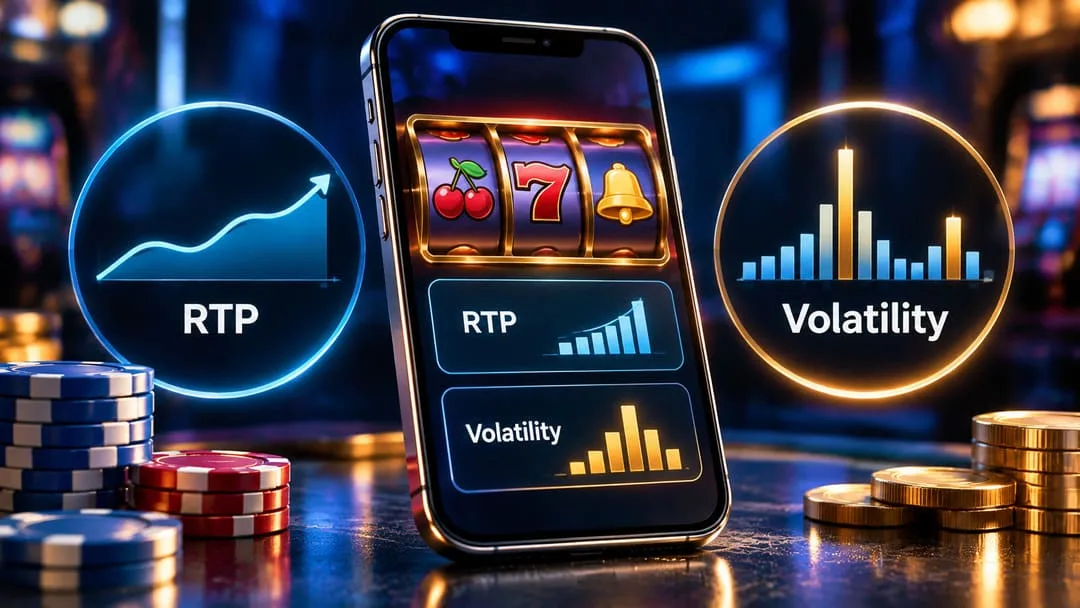
When an iPhone slot lists a 96% return to player (RTP) and a high-volatility label, those figures are not competing ratings. They describe different parts of the game’s mathematics: RTP estimates the share of total wagers returned as prizes over the long term, while volatility describes how unevenly those prizes are distributed. Neither number predicts what will happen on the next spin.
Operator rankings answer a different question. Resources listing top-rated online casinos on The RX provide an additional perspective on offshore casino operators, but an overall casino ranking does not establish the RTP setting, independent testing status, or local licensing of an individual slot. Players need to evaluate the operator and the actual game separately.
That distinction matters on an iPhone, where the main casino lobby can emphasize artwork, jackpots, and promotional features while the paytable sits behind a small information button. Our earlier coverage of mobile slot design and game-information disclosures examines why these details should remain accessible. Understanding the numbers is the next step.
What Slot RTP Actually Measures
RTP stands for return to player. It represents the theoretical percentage of all money wagered on a game that is returned to players as prizes over a sufficiently large number of rounds.
The UK Gambling Commission’s technical definitions of RTP and volatility distinguish theoretical RTP, which is built into the game’s mathematical design, from actual RTP, which measures the results recorded over a particular period. Its regulatory framework applies to Great Britain, but the definitions help explain the underlying concepts.
Consider a hypothetical slot with a theoretical RTP of 96%. Across $100,000 in total wagers over a sufficiently large sample, its mathematical model would indicate approximately $96,000 in prize returns. The remaining 4% represents the theoretical house edge.
That does not mean someone depositing $100 should expect to withdraw $96. Individual results can be considerably higher or lower, and the total amount wagered can include money that has already been won and played again.
RTP is therefore a long-term mathematical measurement, not a personal payout guarantee or a forecast for a particular playing session.
How Volatility Changes the Slot Experience
Volatility, sometimes called variance, describes how a game’s prizes are distributed. Two slots can have identical RTP figures but produce very different patterns of wins and losses.
A lower-volatility game generally distributes smaller prizes more frequently. A higher-volatility game tends to produce less frequent wins, with the possibility of larger individual payouts.
Neither category guarantees a particular result. A high-volatility game is not guaranteed to deliver a jackpot after a long losing streak, while a low-volatility game does not promise a steady return.
The following comparison separates the three measurements that iPhone players may encounter.
| Measurement | What it tells you | What it does not guarantee |
|---|---|---|
| RTP | The theoretical long-term share of wagers returned as prizes | Your individual return or session profit |
| Volatility | How widely prizes are distributed, from smaller frequent wins to larger, less frequent ones | When a substantial win will occur |
| Hit frequency | How often a game produces a winning result, if disclosed | Whether those wins exceed the amount wagered |
Hit frequency deserves particular attention. A game can register a winning combination without producing a net profit on that spin. For example, a $0.50 prize on a $1 wager is technically a win, but the player has still lost $0.50.
Looking at all three measurements provides more useful information than comparing RTP percentages alone.
Random Number Generators and Slot Fairness
RTP and volatility describe the mathematical design of a game. A random number generator (RNG) is the technology used to determine outcomes in standard RNG-based slots.
For players, the important principle is that previous results should not make the next outcome predictable. A losing streak does not automatically increase the probability of a winning combination on the following spin.
Regulatory requirements provide another way to evaluate game integrity. For example, Pennsylvania’s interactive gaming technical standards require game rules and paytables to be accessible through the player interface without requiring a deposit or wager. The state’s RNG requirements also address statistical independence, fair distribution, and recognized testing procedures.
Testing is equally important. The UK’s Gambling Commission explains its online gambling game fairness requirements, which include approved testing before games are released and ongoing operator checks after launch.
These are jurisdiction-specific examples, not a single nationwide U.S. standard. Players should verify that the casino and its games are authorized under the rules applicable to their actual location.
How to Check Slot RTP and Volatility on an iPhone
Finding game information on an iPhone can require a little navigation, particularly when the casino uses a browser-based platform.
Before playing, open the individual slot and look for its information, help, or paytable button. Depending on the developer, this may appear as an information symbol, question mark, or menu icon.
Check the following details:
- Theoretical RTP: Look for the percentage stated in the game’s information or rules.
- Volatility: Check whether the developer identifies the game as low, medium, or high volatility.
- Hit frequency: Look for this measurement if the provider publishes it.
- Maximum payout: Understand the maximum advertised prize and any conditions attached to it.
- Bonus features: Review the rules governing free spins, multipliers, special symbols, and progressive jackpots.
- Bet requirements: Confirm the minimum and maximum available stakes before starting.
Do not assume that a casino’s promotional page contains the same information as the individual game’s rules. The game-specific information should take priority over generic descriptions or third-party summaries.
If the operator does not provide understandable game rules or you cannot locate the relevant disclosures, contact its official support team before committing money.

Why Neither Number Predicts Your Next Spin
One of the most persistent slot misconceptions is that a game becomes more likely to pay after several unsuccessful rounds.
That assumption confuses long-term mathematical expectations with individual random outcomes.
A slot with a 96% theoretical RTP does not need to compensate a particular player for previous losses. Likewise, a high-volatility game does not owe anyone a large payout after a certain number of spins.
The same principle applies to claims about hot machines, cold machines, favorable playing times, or special button-tapping techniques. These ideas do not provide a reliable way to predict outcomes in properly functioning RNG-based games.
Understanding RTP and volatility is valuable because it helps players recognize the financial characteristics of a game before playing. It does not turn a game of chance into a predictable source of income.
For iPhone casino users, the sensible approach is to read the rules, verify the operator’s authorization, establish a fixed entertainment budget, and avoid chasing losses. Gambling should remain entertainment for adults who are legally permitted to participate, never a way to cover essential expenses.
The Bottom Line on Slot RTP and Volatility
RTP and volatility answer two different questions. RTP describes the theoretical long-term return, while volatility explains how that return is distributed across game outcomes.
For iPhone players, both measurements are useful when examining a slot’s information screen, but neither guarantees a payout or identifies a winning strategy.
The better standard is transparency: understandable game rules, accessible paytables, credible testing, and an appropriately licensed operator. Knowing what the numbers mean allows players to make more informed decisions without confusing mathematical expectations with promises of winning.
Leave a Reply